department,” she began. “I did not. I came here to lead it. But
leadership does not mean protecting every decision made by someone
wearing this uniform.”
An officer near the back raised his hand. “What if we get a call that
someone might be armed? We can’t wait until we’re sure.”
“You can respond to credible information,” Maya said. “You can use
appropriate caution. But you must still observe, communicate, and verify
when verification is possible. A report is a reason to investigate. It
is not permission to stop thinking.”
Another officer asked whether a person who claimed to be a chief should
receive special treatment.
“No,” Maya said. “A person’s rights do not depend on their title. If I
had been a delivery driver, a teacher, or someone without a job at all,
the same standards should have applied.”
The room grew quieter. She saw some officers nod. Others folded their
arms.
Vance’s supporters were not hard to identify. They described him as
decisive, experienced, and willing to take risks. Some said he had
helped them through difficult calls. Maya did not dismiss those
experiences. She also refused to let good work erase misconduct.
After the meeting, Miller asked to speak with her. He looked exhausted.
His leave had been extended while the review continued, and he had spent
two nights replaying the encounter.
“I want to correct my statement,” he said.
Maya gestured toward a chair. “Tell the investigators. I won’t take an
informal statement.”
“I already told them I heard you identify yourself. But there is
something else. Before we approached you, Marcus said the caller had
used the phrase ‘woman with a package.’ He said we needed to get ahead
of it because the mayor’s office was expecting you.”
Maya’s eyes narrowed. “He knew I was expected?”
“He knew a new chief was coming. I don’t know if he knew it was you.”
“Did he say he knew the caller?”
“No. But he said the call came from a trusted source.”
“Did he identify that source?”
Miller shook his head. “No.”
“Why didn’t you mention this before?”
“Because I didn’t want to make it worse for myself.”
Maya held his gaze. “You already made it worse by withholding
information.”
“I know.”
Miller said that Vance had received a message on his phone shortly
before they approached her. He could not see the screen, but he
remembered Vance reading it and saying, “Let’s get this handled before
the boss arrives.” Miller had assumed he meant the shift supervisor.
“Did you see who sent it?” Maya asked.
“No.”
“Did you preserve your own messages?”
“Yes.”
“Give that information to Dana. Include the time and the exact words you
remember. Do not fill in what you don’t know.”
Miller nodded. “I will.”
The investigators later confirmed that Vance had received a message from
a number assigned to the command office. The message contained no
explicit instruction to detain Maya. It read: “Make sure the side
entrance is clear before eight. We don’t need surprises.”
That message could have been ordinary operational housekeeping. But
paired with the internal call and the missing camera segment, it raised
new questions.
Maya asked the evidence team to examine whether the message had been
sent by Harlan, his assistant, or someone using the office phone. The
result would take time.
That afternoon, Vance’s attorney issued a statement accusing the city of
conducting a politically motivated investigation. He described Vance as
a veteran officer who had responded to a credible report and been
punished for following procedure. The statement did not address the
recording, the slap, or the refusal to check Maya’s credentials.
Maya read it once, then set it aside.
“Do you want to respond?” Brooks asked.
“Not to every sentence. We will respond to evidence.”
Brooks nodded. “The department is starting to split.”
“It was already split. We are finally seeing where.”
Near the end of the day, Dana called with the first result from the
command-office computer. The camera interruption had been initiated
using a shared account, but the login session was associated with a
device assigned to Vance for a temporary training project. The device
had been connected to the command-office network the previous evening.
Maya stared at the report.
“Was Vance authorized to use the command-office network?”
“Not for camera administration,” Dana said. “His training access should
not have included that permission.”
“Who approved it?”
Dana looked down at her notes. “The access request was approved by
Deputy Chief Harlan.”
The evidence did not yet prove that Vance had deleted the footage. But
it showed that he had access he should not have had, and that Harlan had
authorized it.
Maya asked Dana to preserve the request, the approval, and the device
history. Then she looked at the growing wall of complaint summaries.
For the first time, she could see the shape of the problem. Vance’s
actions had been protected by a system that allowed informal power to
outrun written procedure. Harlan’s office had been the place where
records converged, where complaints were closed, and where access
permissions were granted.
The question was no longer whether the morning incident had been
mishandled. The question was how much of the department had been trained
to accept it.
Before leaving, Maya received a message from an unknown number. It
contained a photograph of the precinct’s front entrance and a single
sentence:
“Ask who told Vance you were coming.”
7 | The Message Behind the Badge
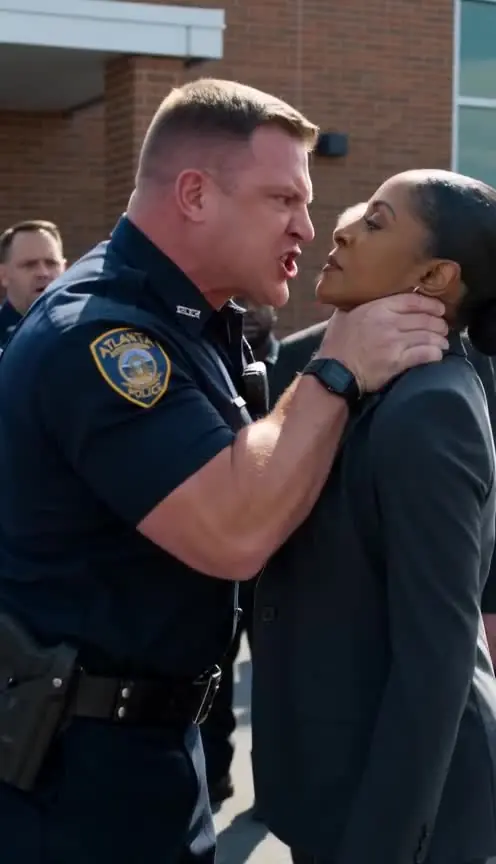
Maya did not answer the unknown number. She saved the message, forwarded
it to Dana through the approved evidence channel, and asked the city’s
security office to preserve the sender information. She also requested
that no one attempt to identify the sender through unofficial means. An
anonymous warning could be useful, misleading, or deliberately designed
to turn the investigation into a personal feud.
The photograph showed the front entrance of Precinct 12, taken from
across the street. There was no visible person in the frame. The image
could have been captured by a passerby, a reporter, or someone who had
been watching the building. The sentence beneath it was more troubling