“Dr. Carter,” he said. “I was told there was a misunderstanding.”
Maya stood straight. “Then you have been given an incomplete
description.”
Harlan’s eyes flicked toward the recorder. “Perhaps we should discuss
this privately.”
“No,” Maya said. “The first discussion happened in public. The
correction can happen with witnesses.”
A security officer appeared behind Harlan. Beyond him, Mayor Higgins
waited in the corridor, his expression unreadable. The mayor stepped
into the room and looked at Maya’s face.
“Dr. Carter,” he said, “I heard the entire exchange. Before we go
anywhere, I want to know why my new chief was placed in handcuffs.”
Vance opened his mouth. Harlan moved as if to answer first.
Maya raised one hand. “Let Officer Vance explain it in his own words.”
The mayor turned toward the officer. “I’m listening.”
Vance looked at the recorder, then at Harlan. For the first time, he
seemed unable to decide which man he feared more.
4 | The First Version of the Story
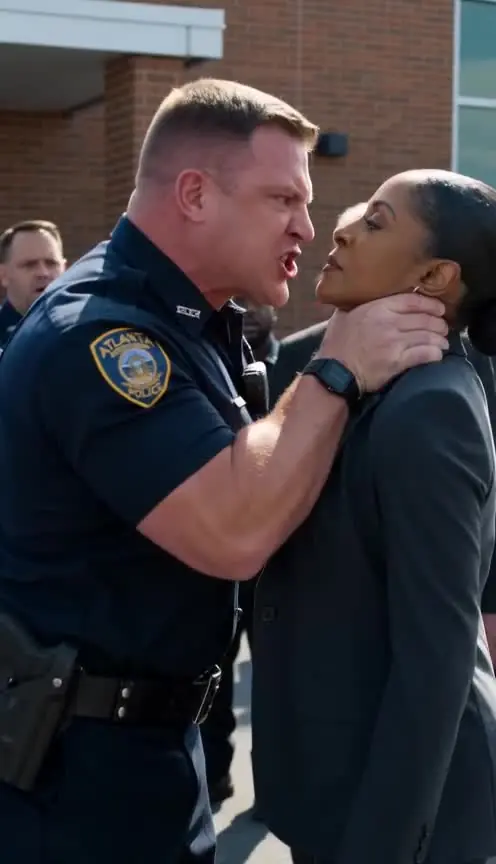
Mayor Higgins did not sit down. He remained near the door, where he
could see the table, the recorder, and every person in the room. Captain
Brooks stood beside Maya. Deputy Chief Harlan held his tablet against
his chest, his expression carefully arranged into concern. Marcus Vance
stood with his shoulders squared, while Jake Miller kept his eyes on the
floor.
“Officer Vance,” the mayor said, “you have the floor.”
Vance cleared his throat. “At approximately seven forty-five, Officer
Miller and I received information about a suspicious individual near
secured department vehicles. The individual was carrying an unidentified
package and appeared to be monitoring the lot. We approached, gave
lawful commands, and she became uncooperative.”
Maya’s expression did not change. “That is not what happened.”
Higgins lifted one hand. “Let him finish.”
Vance continued. “She refused to comply, made claims about being a
senior official, and resisted being detained. We brought her inside to
verify her identity.”
“Did you ask for her identification?” the mayor asked.
“She told us it was in her jacket.”
“Did you retrieve it?”
“No, sir. The situation was not secure.”
“Was she holding a weapon?”
“No.”
“Did you see a weapon?”
“No.”
“Did she threaten you?”
Vance hesitated. “She said I was making a catastrophic mistake.”
Higgins looked at him for a moment. “That is not a threat. That is a
prediction.”
Miller’s shoulders shifted. He looked as though he wanted to say
something, but Vance’s glance stopped him.
The mayor turned to Brooks. “Captain, secure the scene and preserve
every available record. Dispatch audio, exterior cameras, holding-area
cameras, access logs, and the officers’ body-camera files. Nothing gets
deleted, overwritten, or edited.”
“Yes, sir.”
“Dr. Carter, do you need medical attention?”
“My cheek and shoulder should be examined and documented,” Maya said. “I
also want photographs taken before anyone touches the evidence or
changes the room.”
“Agreed.”
Harlan stepped forward. “Mayor, I recommend we move this discussion to
my office. We can handle the personnel issue through the usual chain of
command. There’s no need to turn an operational misunderstanding into a
public spectacle.”
Maya looked at him. “The operational misunderstanding became public when
two officers detained the person appointed to lead them. The recorder
made sure the public record began at the same moment the incident did.”
Harlan’s mouth tightened. “We should be careful about assuming intent.”
“I have not accused anyone of intent,” Maya replied. “I have described
actions. We can determine intent after we establish the facts.”
The distinction was deliberate. Maya had spent years studying the
difference between what a person believed had happened and what the
evidence could prove. She knew that an angry chief who announced
conclusions before an investigation would give every defender of the
status quo a reason to dismiss her. She would not make that mistake for
Vance’s benefit.
Higgins nodded toward the recorder. “Can we hear the beginning?”
Brooks placed the device on the table and confirmed that the live
transmission had been received by the mayor’s office. The recording
began with the sound of Maya’s car door closing, then her footsteps on
the pavement. A moment later came Vance’s command.
“Get your hands where I can see them, lady! Don’t move!”
The recording captured the scrape of a shoe, the impact of the slap, and
the crash of the ceramic cup. Then Maya’s voice, calm and unmistakable:
“Officer Vance, lower your weapon immediately.”
No one in the room spoke as the recording continued. Vance’s shove was
audible. Miller’s handcuffs rattled. Maya identified herself. Vance
laughed.
When the playback reached the moment she asked them to check her pocket,
Higgins stopped it.
“Was that your first opportunity to verify her identity?” he asked
Vance.
Vance looked down. “Yes, sir.”
“And you declined.”
“I believed she was impersonating an official.”
“Based on what?”
“She was standing near the vehicles.”
“Is that prohibited?”
“She was close to a secured area.”
“Was she inside it?”
Vance did not answer.
Higgins turned to Miller. “Officer Miller, I want your account without
your partner’s help.”
Miller drew a slow breath. “We received a call about a suspicious woman
with a concealed package. When we arrived, Dr. Carter was outside the
side entrance. She had a briefcase. Officer Vance drew his weapon. I
followed his lead.”
“Did you see her reach for anything?”
“No, sir.”
“Did you see a weapon?”
“No.”
“Did you hear her identify herself?”
“Yes.”
“Why didn’t you check?”
Miller’s face reddened. “I thought Officer Vance had already made the
decision.”
“That is not an answer.”
“No, sir. It isn’t.”
Harlan moved closer. “Jake is a junior officer. He was operating under
the direction of a senior partner. We should distinguish between the
officer who initiated the contact and the officer who assisted.”
Maya turned to him. “Responsibility can be distinguished without being
erased.”
Higgins looked at Harlan. “No one is erasing anything. But I will not
have a chain of command used as a curtain.”
The mayor asked Brooks to retrieve the dispatch recording. She returned
several minutes later with a transcript and a digital audio file. The
call had come in at 7:39 a.m., six minutes before the confrontation. The