Maya’s expression remained steady, but the meaning was unmistakable. The
department’s leaders had not merely been preparing for a new chief. They
had been discussing how to control what she would see.
Miller gave the statement to Dana that night. The investigator asked for
the date, time, and exact wording. Miller admitted he could not remember
every sentence. He did remember one phrase clearly because Vance had
repeated it.
“Make sure she understands whose house this is.”
The statement was not proof that Harlan ordered the detention. It was
evidence of an attitude that had shaped the response.
Maya left the precinct after midnight. As she reached her car, her phone
buzzed again. This time the message came from a number she recognized:
Captain Brooks.
The message contained a photograph of an old complaint form. The
signature at the bottom belonged to Harlan.
Beside it, someone had written in pen:
“He closed this before the witness was interviewed.”
8 | The Hearing in the Open Room
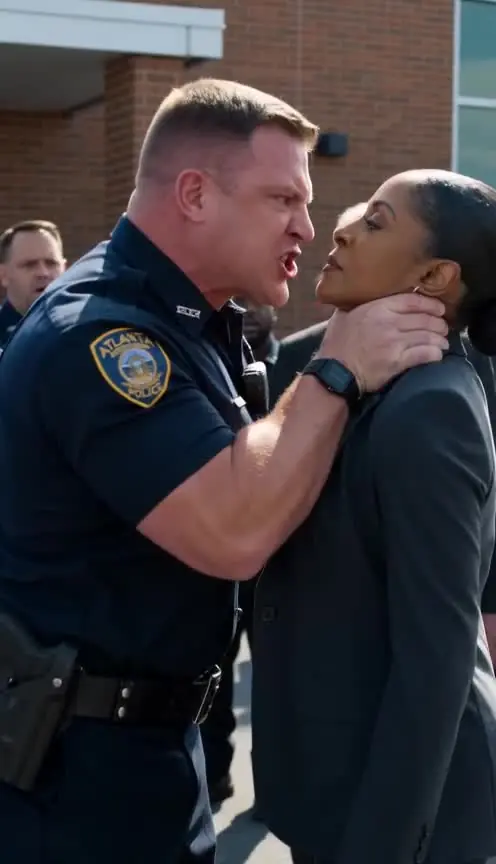
The city council hearing was scheduled for Thursday evening in the
municipal building. By late afternoon, the hallway outside the chamber
was crowded with reporters, community members, police officers, and
people who had filed complaints against Precinct 12. Some held folders.
Others held signs asking for transparency. A few wore department
uniforms and stood together near the back wall.
Maya arrived without a security escort. She wore a dark navy suit and
carried a thin folder. The mark on her cheek had faded, but the memory
of the hand that caused it had not. She had decided not to conceal what
happened. She would not make the injury the center of the hearing, but
she would not pretend it had never existed.
Mayor Higgins met her near the entrance. “The room is full.”
“I expected it.”
“Some of the council members want a quick resolution.”
“Then they should not have scheduled a public hearing before the
evidence was complete.”
Higgins gave a tired smile. “You are going to make this difficult.”
“I am going to make it accurate.”
The hearing opened with a statement from the mayor. He confirmed Maya’s
appointment, described the incident at Precinct 12, and explained that
an independent review was underway. He emphasized that no final findings
had been issued against any employee. He also confirmed that the city
had preserved the recorder transmission, the dispatch log, the available
camera footage, and the relevant network records.
Then Maya was invited to speak.
She did not begin with the slap or the handcuffs. She began with the
standard she believed should have governed the encounter.
“A police officer may receive information that justifies caution,” she
said. “An officer may approach a person, ask questions, and take
reasonable steps to protect the public. But a report is not a verdict. A
suspicion is not proof. And a uniform does not make an assumption
correct.”
She described her arrival at the precinct, the briefcase, the command to
stop, and her request that Vance lower his weapon. She explained that
she identified herself and told the officers where her credentials were.
She described the decision to ignore that information and place her in
handcuffs.
“I was not treated according to what I had done,” she said. “I was
treated according to what the officers assumed when they looked at me.
The same standards should apply to every person who stands on that
walkway.”
A council member asked whether she believed the officers had acted out
of racial bias.
Maya paused. “I can describe what happened. I can describe the language
used, the failure to verify, and the difference between the facts and
the assumptions. The independent review will examine intent, including
whether bias played a role. I will not claim to know what was in another
person’s mind when the evidence has not established it.”
Another council member asked whether she would fire Vance.
“I will not announce a disciplinary outcome before the review is
complete. He has been placed on administrative leave. The city will
follow its procedures, and the findings will determine what action is
appropriate.”
The room reacted with a mixture of approval and frustration. Some wanted
a stronger statement. Others seemed relieved that the chief was refusing
to turn the hearing into a spectacle.
The review team’s lead investigator, Dana Whitaker, then presented the
preliminary findings. She described the internal call, the missing
eleven seconds of video, the shared command-office account, and the
unauthorized access to complaint records. She made clear that the
evidence did not yet establish who placed the call or who interrupted
the camera recording.
She also presented the confirmed sequence of the encounter. The recorder
captured Maya identifying herself before the officers placed the second
cuff. The body-camera file from Vance began after the initial contact,
which meant it did not capture the first command or the slap. Miller’s
body camera had recorded the later exchange, including Maya’s request to
check her pocket.
A council member leaned forward. “Why did the officers’ cameras not
capture the entire incident?”
“The devices were not activated at the start of the encounter,” Dana
said. “We are examining why.”
“Is that a violation?”
“That depends on the applicable activation policy and the circumstances.
The review will address it.”
Denise Walker was called next. She stood at the microphone with her
folder in both hands. Her voice shook at first, but it steadied as she
described the vehicle search and the complaint she had filed. She showed
the council the video recorded by her neighbor.
“I didn’t want anybody fired,” she said. “I wanted somebody to look at
what happened and tell me whether it was right. They told me they had
reviewed it. But nobody had watched my video. Nobody had even asked me
what happened.”
The room was silent.
A delivery driver described being treated as suspicious because he asked
why an officer wanted to look inside his van. A young father described
waiting months for a response to a complaint. Their stories were
different, but the frustration was familiar. Each had tried to use the