had been closed without a complete review. The city had not yet reached
a settlement or decided whether additional action was warranted, but the
department had reopened the complaint and assigned an investigator who
had not worked at Precinct 12.
Denise read the letter quietly.
“I didn’t think anybody would ever admit that,” she said.
“It’s a beginning,” Maya replied.
“Does that mean the officer will be punished?”
“That decision will follow the investigation. I won’t promise you an
outcome before the facts are complete.”
Denise folded the letter. “I appreciate that you came yourself.”
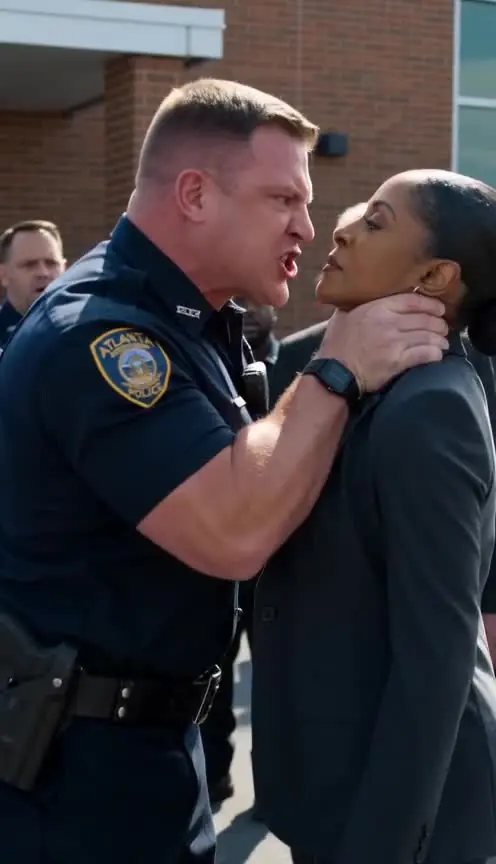
Maya thought of the morning outside the precinct. She had been carrying
a transition plan, not a weapon. She had asked for a simple
verification, and two officers had treated the request as defiance.
Denise had asked for an explanation and been treated the same way.
“I should have been listening sooner,” Maya said.
“You just got here.”
“I know. But the department has been here a long time.”
Denise nodded. “Then don’t let them make you forget why you came.”
The final report was delivered to the mayor on Friday morning. Before
the council session, Dana called Maya with one last update. The digital
specialist had recovered a short audio clip from a training folder. It
was not part of the original call. It was a recording of Vance speaking
with Harlan in the command office two days before the incident.
The clip began with Vance asking, “What if she starts asking about the
old complaints?”
Harlan answered, “Then we show her what we want her to see.”
Vance asked, “And if she doesn’t accept it?”
There was a pause.
Harlan said, “Make sure she understands this department has its own way
of doing things.”
The clip ended there.
Maya listened once. Then she asked Dana to include it in the final
evidence package, with its limitations clearly described.
The most revealing part was not what the men had said. It was what they
had assumed: that the new chief could be managed, that the complaints
could remain buried, and that the department’s habits mattered more than
the standards written in its own policies.
Maya closed the file.
10 | A Department That Had to Earn Its Name
The final review session took place in the same municipal chamber where
Denise Walker and the other complainants had testified. This time, the
room was less crowded, but the atmosphere was more serious. The
independent report had been distributed to the council, the mayor, the
department, and the officers’ representatives. The city had given
everyone time to review the findings and submit responses.
Maya sat at the witness table beside Captain Brooks. She had not been
asked to present the report’s conclusions as her own. Dana Whitaker
would do that. Maya would explain the operational changes and answer
questions about how the department would move forward.
Dana began by summarizing the evidence. The recorder transmission
established the sequence of the encounter. The dispatch audio contained
unsupported claims about a woman checking vehicle doors and carrying a
concealed weapon. The call originated from an internal terminal. The
voice comparison strongly matched Vance. Recovered messages showed that
Harlan had told Vance the chief was early, instructed him to keep the
entrance clear, and directed him to use a safety report. The camera
interruption came through the command-office network, and the shared
account prevented investigators from identifying the person who
initiated it with absolute certainty.
The report found that Vance had used unjustified force, failed to verify
Maya’s identity, and made statements that were inconsistent with the
available evidence. It found that Harlan had misused his supervisory
authority, failed to preserve a transparent complaint process, and
contributed to the circumstances that led to the detention. It found
that Miller had participated in the detention without independently
verifying the information, though his later cooperation had helped
establish the timeline.
The report did not claim that every question had been answered. It did
not identify a person who had physically interrupted the camera
recording. It did not establish that Harlan explicitly ordered Vance to
strike Maya or place her in handcuffs. It did not find that every prior
complaint had been mishandled. Those limitations were stated clearly.
A council member asked Dana whether the city could discipline an officer
based on a voice comparison that was not absolutely conclusive.
Dana explained that the voice comparison was one part of a larger body
of evidence. The dispatch record, the internal call source, the
recovered messages, the training file, the camera timeline, and the
officers’ statements supported the findings together. The city would
rely on the total record, not on one technical result.
Another council member asked whether Vance had a chance to respond.
“Yes,” Dana said. “He was represented by counsel, received the relevant
evidence under the applicable process, and provided a response. His
denial was considered.”
Harlan’s attorney argued that the report overstated the meaning of
administrative messages. He said “keep the entrance clear” was a normal
instruction and “use the safety report” was a reference to standard
documentation. He argued that shared accounts were common in older
systems and that the city was blaming one administrator for years of
technological neglect.
The city auditor agreed that the shared-account problem predated Harlan.
But the auditor noted that Harlan had approved the decision to postpone
the upgrade and had authorized Vance’s access to systems beyond his
training role. The auditor also confirmed that the complaint summaries
had been selectively omitted from the transition folder.
Harlan spoke after his attorney. He said he had spent twenty-seven years
serving the department. He had supervised officers through difficult
incidents, helped families after tragedies, and worked long hours to
keep the precinct functioning. He said the morning of Maya’s arrival had
been mishandled, but he had never intended for anyone to be harmed.
Maya listened without interrupting.
Harlan continued. “I thought I was protecting the department from
disruption. I believed the new chief would come in, look at a stack of
complaints, and assume the worst about people who had spent their
careers doing this job.”