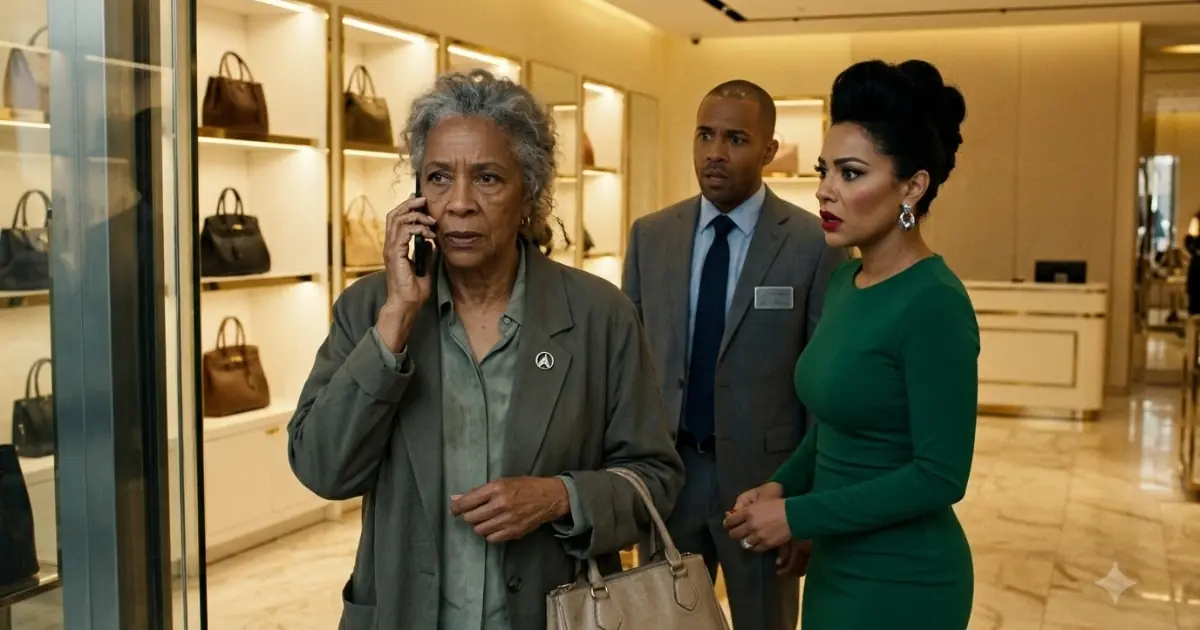
The woman in the emerald-green dress grabbed the elderly customer's shoulder and shoved her toward the entrance.
"Get this filthy woman out of my store!"
Her voice rang across the marble floor of Bellamy & Rose, one of the most expensive handbag boutiques in Manhattan. Several customers turned to stare. A sales associate froze beside a glass display case, while a security guard near the entrance looked uncertainly at the woman issuing the order.
The elderly customer stumbled, catching herself against the brass frame of a display cabinet. Her beige handbag slipped down her arm, but she managed to keep hold of it.
She was seventy-eight years old, with silver-gray hair loosely gathered at the back of her head. Her charcoal jacket was faded at the elbows, her blouse had been repaired by hand, and her black shoes had clearly seen better days.
She looked ordinary. That was what everyone noticed.
What none of them noticed was the small silver brooch pinned near her collar. It was shaped like a rose, with one imperfect petal.
The woman in green stepped closer.
"Did you hear me? You don't belong here. This is a luxury establishment, not a shelter."
A tall man in an expensive gray suit hurried over from the rear office. His name was Marcus Bennett, the boutique's regional operations manager. The embroidered badge on his lapel identified him as senior management.
He took one look at the elderly woman, then at the furious store manager, Vanessa Cole.
"What's going on?"
Vanessa pointed at the customer.
"This woman has been wandering around touching our merchandise. I asked her to leave, and she refuses to cooperate."
The elderly woman straightened herself.
"I haven't touched anything without permission."
Marcus barely looked at her.
"You heard the manager," he said sharply. "Get out. Right now."
The elderly woman studied his face.
"Are you certain that's how you wish to handle this?"
Marcus gave a short, contemptuous laugh.
"Ma'am, I don't have time for games. We have important investors visiting this afternoon. People like you cannot just walk in here and disrupt our business."
For a moment, the woman seemed almost disappointed rather than angry.
Then she reached into her handbag and removed a black smartphone.
Vanessa rolled her eyes.
"Oh, wonderful. She's going to call somebody."
The elderly woman selected a contact and raised the phone to her ear.
When someone answered, her voice was calm.
"Daniel, cancel the acquisition."
There was a pause.
"The entire acquisition," she continued. "Effective immediately."
Marcus's expression changed.
Vanessa stopped smiling.
The elderly woman looked directly at both of them.
"And prepare termination proceedings for the management team responsible for this location."
Marcus took an involuntary step forward.
"Excuse me? Who exactly are you?"
The woman lowered her phone.
"My name is Eleanor Hayes."
For several seconds, nobody moved.
Then Marcus whispered something that sounded almost like a prayer.
"Eleanor Hayes?"
His eyes widened.
Vanessa looked between them.
"Who is Eleanor Hayes?"
Marcus turned toward her, his face drained of color.
"She's the woman whose company is buying our entire retail group."
The silence that followed was so complete that everyone heard the soft click of the automatic entrance doors.
But what happened next would reveal that the humiliation Eleanor had just endured was only the beginning of a much larger story—one involving a dying promise, a hidden financial scheme, a dishonest corporate empire, and a woman who had spent fifty years learning that true power meant very little unless it was used to protect people who had none.
Three hours before Eleanor Hayes entered Bellamy & Rose, she had been standing in the kitchen of her modest house in Connecticut, studying an old photograph.
In it, two young women stood beside a narrow storefront decorated with paper flowers. One was Eleanor, barely twenty-five, wearing a simple blue dress. The other was her younger sister, Margaret, smiling beneath a white hat.
They had taken the photograph in 1973, on the afternoon they opened a tiny shop selling handmade handbags and repaired leather goods.
Back then, they owned almost nothing.
Their father had worked at a furniture factory until an accident destroyed his ability to continue. Their mother took in laundry, stitched torn coats, and mended wedding dresses for families who could not afford new clothing. Eleanor and Margaret learned early that a household survived through patience, work, and the willingness to help one another.
The first handbag they ever sold had been made from leather recovered from an abandoned suitcase.
Margaret had stitched a crooked rose into the lining.
When Eleanor complained that the flower looked uneven, Margaret laughed and told her that beautiful things did not have to be perfect.
That sentence became the foundation of everything Eleanor built afterward.
Their small business grew slowly. They repaired purses for factory workers, made durable school satchels for children, and offered installment payments to women who could not afford expensive accessories.
When other retailers refused customers who appeared poor, the sisters welcomed them.
They treated every visitor with the same attention, whether that person came to purchase a handbag or simply asked how to repair one.