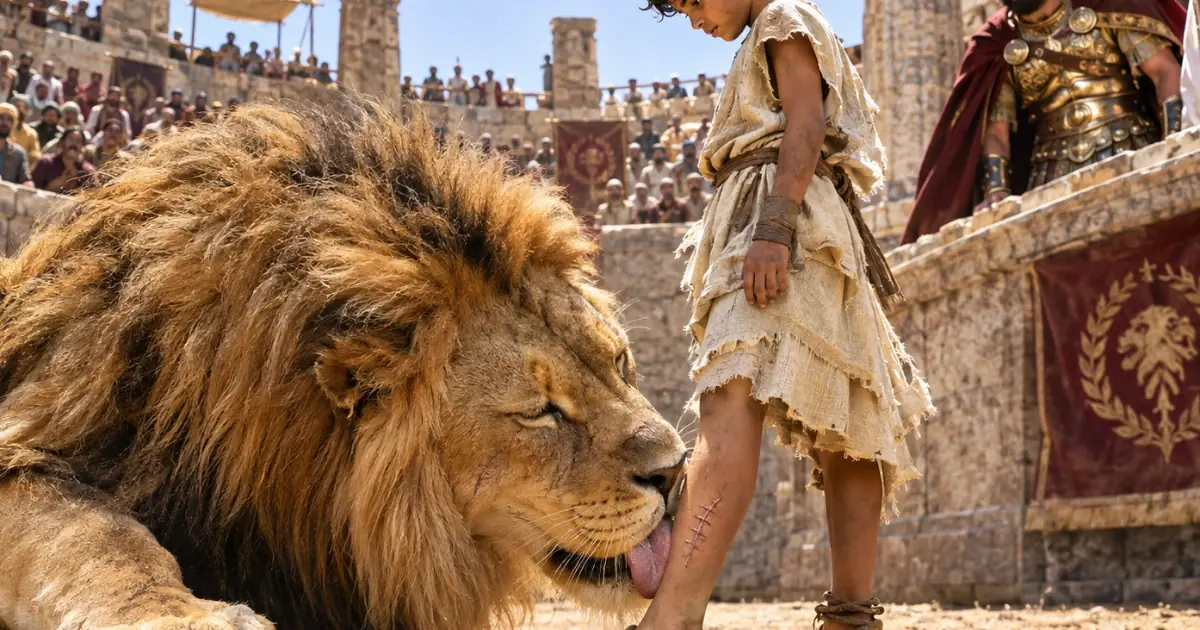
 The morning came bright and clear over the arena, and the light fell in pale gold bars across the sand. The great stone ring stood open to the sky, and its tiers rose in wide steps around the floor, row upon row of pale stone worn smooth by the feet of many crowds. The air smelled of hot dust and dry grass, and the heat of the day was already rising from the stones. People came in through the high arches in a steady stream, farmers and traders and mothers with children on their hips, and they found their places on the tiers and settled down to watch. They spoke in low voices, and the low voices joined together into a single deep murmur that filled the arena like the sound of the sea heard from far away. Every face was turned toward the sand below, and every eye was waiting for the same thing.
Corin stood alone in the middle of the sand. He was nine years old, small for his age, with dark hair that fell across his forehead and bare feet that sank a little into the warm sand with each step he took. He wore a rough tunic of undyed wool that hung to his knees, and the sleeves were too short for his arms, so that the long stitched scar on his forearm showed plainly in the light. The scar ran from his wrist almost to his elbow, a pale line with small dark marks where the thread had once held the skin together. He had carried that scar for two years, and he had almost forgotten it was there, but now, standing alone in the sand with a thousand eyes upon him, he felt it as if it had been cut that very morning. His hands hung at his sides, and his fingers were curled tight, and his heart beat so hard in his chest that he could feel it in his throat. He was afraid, and he did not try to hide it from himself, but he held his head up, and he did not run, and he did not cry out.
At the far end of the arena, above the sand, stood the raised platform where the great ones sat. King Aldous sat in the middle, in a robe of deep purple that fell in heavy folds around his chair, and a gold crown sat upon his head, catching the light each time he turned. He was fifty two years old, broad shouldered and broad faced, with a short dark beard touched with gray, and his eyes were small and bright, and his smile came easily to his face. He leaned back in his chair as if the morning belonged to him, and he looked down at the boy in the sand with the mild interest of a man watching a game whose ending he already knew. To his right sat Bram, the priest, seventy one years old, in a robe of plain white, with a white beard that fell to his chest and a gold staff resting against his shoulder. Bram sat very still, his old hands folded in his lap, and his eyes were fixed upon Corin with a grave and steady gaze, as if he were weighing something that no one else in the arena could see. To the king's left sat Osric, forty eight years old, in robes of dark brown, with a smooth face and smooth hands and a smooth voice that had talked many men into many troubles. Osric did not smile. He watched Corin with the cold patience of a man who had waited for this morning and meant to enjoy it.
Three days had passed since the guards had come to the village for Corin, and in those three days he had learned what it was to be alone in the world. The guards had come at dawn, with spears in their hands and dust on their boots, and they had taken him from his mother's door while the goats bleated in the pen behind the house. They had said that the king's gold cup was missing from the king's hall, and that Corin had been seen in the hall that same day, carrying a young goat for the king's table, and that no one else had entered the hall after him. Osric had stood in the hall and pointed his finger, and the king had listened, and the king had given the order. A boy who stole from the king would face the lion in the arena, and the lion would judge him. Corin had told them he had not taken the cup, and he had told them again and again, in a voice that grew smaller each time, until at last he had stopped telling them, because no one was listening. He had not taken the cup. He had never even seen the cup. He had carried the goat into the hall, and set it down, and left by the same door he had entered, and that was all he had done. But Osric had smiled his smooth smile, and the king had nodded, and the guards had taken him away.
High in the stone seats, among the crowd, sat Tam, ten years old, Corin's friend from the village, who had walked the long road to the arena at dawn with his father and had taken a place where he could see the sand. Tam sat with his hands gripping the edge of the stone before him, and his face was pale, and his eyes never left Corin. He had known Corin since they were small, and they had herded the goats together in the hills, and they had fished in the stream, and they had raced each other along the long road, and Tam knew, as surely as he knew his own name, that Corin had not stolen anything. Tam had wanted to shout, to stand up and tell the whole arena that his friend was innocent, but his father had held his shoulder and told him to be still, and so he sat still, and he watched, and his heart beat hard against his ribs.
Corin thought of his mother as he stood in the sand. Isolde was thirty four years old, a weaver, steady and plain spoken, with hands that were never idle and a voice that was never raised without cause. When the guards had taken him, she had run after them along the long road, begging them to let him go, and when they would not listen, she had walked to the king's hall herself and asked to speak with the king, and Osric had met her at the door and told her that the king would not see her. She had come to him the night before, in the small dark room where they had kept him, and she had held his face in her hands, and she had told him to be brave, and to stand tall, and to tell the truth, and to remember that she loved him, and that the truth would find its own way even when men would not listen. He held her words in his mind now, the way a man holds a rope in a storm, and he stood a little straighter, and he lifted his chin, and he looked up at the platform where the king sat smiling.
A herald stepped forward to the edge of the platform, a tall man in a blue tunic, and he raised his hand, and the murmur of the crowd died away into silence. The herald's voice rang out across the sand, loud and clear, and every word fell upon the crowd like a stone dropped into still water. He said that Corin, son of Isolde the weaver, stood accused of stealing the king's gold cup from the king's hall, and that the king, in his mercy, had ordered a trial by lion, so that the gods might judge the boy where men could not. If the lion spared him, he was innocent. If the lion did not spare him, he was guilty. The crowd heard the words, and a great roar went up from the tiers, some cheering, some shouting, some only watching with wide eyes, and the sound rolled around the stone ring and came back upon itself, louder than before. Corin stood in the middle of it, small and alone, and the roar washed over him like a wave, and he felt the sand shift under his bare feet, and he set his feet a little wider, and he waited.
King Aldous raised one hand, and the roar faded, and the arena fell silent again. The king looked down at Corin, and his smile widened a little, and he spoke in a voice that carried easily across the sand. He said that the boy should count himself fortunate, for few boys were ever given so grand a stage, and that the gods would now decide his fate, and that the crowd would see justice done before the sun stood at its height. He laughed then, a short easy laugh, and the people nearest the platform laughed with him, and the sound of their laughter was thin and eager, like the sound of men who laugh because a king has laughed and not because they find anything funny. Corin heard the laughter, and he felt it settle upon him like a weight, and he thought of the goats in the hills, and of the stream where he and Tam had fished, and of his mother's hands holding his face, and he held himself still, and he did not look away from the king.
Bram the priest did not laugh. He sat in his white robe, his gold staff resting against his shoulder, and his old eyes were fixed upon Corin, and his face was grave. He had served the gods for fifty years, and he had seen many trials in the arena, and he had seen many men and boys walk into the sand and never walk out again. He had seen the lion tear its prey, and he had seen the crowd cheer, and he had seen the king smile, and he had grown old watching it all. But now, as he looked at the small boy standing alone in the sand, with the scar showing plainly on his forearm, Bram felt a strange unease settle in his chest, as if something in the morning did not sit right, as if the gods were holding their breath. He said nothing. He only watched, and he waited, and his hands folded a little tighter in his lap.
At the far end of the arena, beyond the sand, stood the dark gate. It was a low opening in the stone wall, barred with thick iron, and behind the bars lay a darkness so deep that no eye could see into it. Beside the gate stood Gareth, forty five years old, the keeper of the arena, a broad man with scarred hands and a quiet face, who fed the black lion and cleaned its den and knew it better than any man alive. Gareth stood with one hand resting on the great lever that held the bars, and his eyes were upon the king, waiting for the signal. From behind the bars came a low sound, deep and slow, a rumble that seemed to rise from the stone itself, and the crowd heard it, and the murmur died, and every face turned toward the gate. Corin turned too, and he looked at the darkness behind the bars, and his heart beat faster, and his hands curled tighter at his sides. King Aldous raised his hand once more, and nodded, and Gareth took hold of the lever, and the iron bars began to rise, slow and heavy, out of the dark gate.
The iron bars rose slowly out of the dark gate, and the sound of them was a low grinding that seemed to come from deep inside the stone. The crowd fell silent, and the silence was so complete that Corin could hear his own breathing, quick and shallow, and the faint rustle of the sand under his bare feet as he shifted his weight. The darkness behind the gate was thick and still, and for a long moment nothing moved within it, and Corin thought that perhaps the lion would not come, that perhaps the darkness was empty, and that the morning would end without blood. Then a low sound rose from the dark, deep and slow, a rumble that seemed to come from the belly of the earth itself, and the sound grew louder, and the sand under Corin's feet seemed to tremble with it, and every face in the arena turned toward the gate.
Out of the darkness came the black lion. It moved with a slow and terrible grace, its great paws silent upon the stone at first, and then it stepped into the light, and the whole arena seemed to draw in its breath at once. It was giant, larger than any lion any man in the crowd had ever seen, with a coat black as night and a mane like a dark cloud around its great head, and its eyes glowed in the sunlight, pale and bright, fixed upon the boy in the sand. Its shoulders rose and fell with each breath, and its tail moved slowly behind it, and its mouth was closed, and its teeth did not show, and yet the sight of it filled the arena with a fear so sharp that men in the high tiers leaned back from the edge, and mothers pulled their children close. Gareth stood beside the gate, his hand still resting on the lever, and his face was calm, and his eyes never left the lion, for he knew it better than any man alive, and he knew what it could do.
The crowd knew this lion. For two years it had lived in the dark den behind the gate, and in that time it had faced strong men in the sand, men with spears and swords, and none of them had walked out of the arena again. The lion had never been beaten, and it had never been tamed, and it had never shown mercy to any living thing that stood before it in the sand. That was why the king had chosen it for this morning, and why the crowd had come in such numbers, for they knew that what they were about to see would be swift, and terrible, and final.
The lion stopped at the mouth of the gate, and it lifted its great head, and it looked across the sand at Corin, and its glowing eyes held him still, as if they had pinned him to the ground. Corin looked back at it, and his mouth was dry, and his hands hung at his sides, and he could not move, and he could not speak, and the whole world seemed to narrow to the space between himself and the lion, to the sand and the sunlight and the great black shape at the far end of the arena. He thought of the hills, and of the goats, and of his mother, and he thought of the long road home, and he thought that he would never walk it again, and the thought was clear and cold in his mind, like water from a deep well. Then the lion roared, and the roar filled the arena, and it shook the stone tiers, and it shook the sand, and it shook the very air, and the crowd cried out, some in fear, some in delight, and the sound of their cries joined the roar and rose together toward the open sky.
High in the stone seats, Tam gripped the edge of the stone before him so hard that his knuckles turned white, and his father put a hand upon his shoulder, and Tam did not feel it, for his eyes were fixed upon Corin, and his whole body leaned forward, as if by leaning he could lend his friend his own strength. Tam had seen lions before, in the stories the old men told in the village, and in the carved figures on the stones of the king's hall, but he had never seen a living lion, and he had never dreamed that a lion could be so large, or so black, or so terrible.
Corin heard the roar, and he felt it in his chest, and for a moment his mind went back to the hills, to the mornings when he had led the goats along the high paths, and the sun had been warm on his back, and the world had been simple and kind. He thought of his mother's hands, and of the bread she baked in the morning, and of the way she sang softly while she worked at her loom, and he wished, with all his heart, that he could be back in that small house, safe and warm, instead of standing alone in the sand with a lion before him. But the thought passed, and his mother's words came back to him, the words she had spoken to him in the dark room the night before, that he should be brave, and stand tall, and tell the truth, and he held those words close, and he lifted his chin, and he did not run.
On the platform, King Aldous leaned forward in his chair, and his smile had grown wider, and his small bright eyes gleamed, and he watched the lion with the delight of a man who had paid for a fine show and was now getting his worth. Osric sat beside him, still and smooth faced, and his hands were folded in his lap, and he did not smile, but there was a quiet satisfaction in his eyes, as if the morning were unfolding exactly as he had planned it. Bram sat in his white robe, his gold staff resting against his shoulder, and his old face was grave, and his eyes were fixed upon the boy in the sand, and his lips moved a little, as if he were speaking words that no one could hear, words that might have been a prayer, or might have been a warning.
The lion stood at the mouth of the gate, and it did not move, and the whole arena seemed to hold its breath with it. Its great chest rose and fell, and its glowing eyes were fixed upon the boy, and its tail moved slowly from side to side, and the sand beneath its paws was still. The crowd watched, and no one spoke, and the silence was so deep that Corin could hear the faint sound of the wind moving over the high stones of the arena, and the distant cry of a bird somewhere beyond the walls. Then the lion's muscles tensed, and its great head lowered a little, and its ears went back, and every man in the arena knew what was coming, and the women in the tiers put their hands over their children's eyes, and Tam gripped the stone so hard that his fingers ached.
The lion moved. It came forward out of the gate in a rush, its great paws pounding the sand, and the sand flew up behind it in pale clouds, and the ground seemed to shake with each stride. It was fast, faster than anything so large had any right to be, and it crossed the sand in great leaps, and its black mane streamed behind it, and its glowing eyes never left Corin. The crowd roared, and the roar rose higher, and men stood up in the tiers, and women covered their faces, and children cried out, and the whole arena seemed to be shouting at once. Corin saw the lion coming, and his legs would not move, and his body would not obey him, and he stood rooted in the sand, small and alone, watching death rush toward him across the bright sand.
At the last moment, as the great black shape bore down upon him, Corin stumbled. His bare foot caught in the soft sand, and his legs gave way beneath him, and he fell forward, face down in the sand, his arms thrown out before him, his cheek pressed against the warm grit. The sand filled his mouth, and his breath came in short gasps, and his heart pounded in his chest, and he squeezed his eyes shut, and he waited for the teeth, and for the claws, and for the end. He could hear the lion's paws pounding closer, and closer, and the sound filled his ears, and the sand trembled under his body, and then, all at once, the pounding stopped, and a great shadow fell over him, and the light went dark above his head, and he knew that the lion stood over him.
The crowd held its breath. The roar died away, and the arena fell silent, so silent that Corin could hear the lion breathing above him, slow and deep, and he could feel the heat of its breath upon his back, and the warmth of its great body standing over him like a black cloud. He did not move. He lay face down in the sand, his arms out before him, his cheek against the grit, and he waited, and every heartbeat seemed to last a lifetime. He could feel the lion's shadow covering him, and he could smell its breath, and he could hear the low rumble deep in its chest, and he thought of his mother, and of the hills, and of the scar on his forearm where the skin had been stitched long ago, and he did not know why he thought of the scar then, but the thought came to him clear and sudden, as if the scar itself had called out to him.
He lay still in the sand, and he did not dare to move, and he did not dare to open his eyes. The sand was warm against his cheek, and it filled his mouth, and he could taste the dust of it, and he could feel the small stones pressing into his skin. His heart beat so hard that it seemed to shake his whole body, and his breath came in short quick gasps, and he thought that each breath might be his last. He listened for the lion, and he heard its breathing above him, slow and deep, and he felt the heat of its great body, and he waited for the pain to come, and the pain did not come, and the waiting stretched out, long and terrible, until he did not know whether a moment had passed or a lifetime.
Above him, the lion lowered its great head. Corin felt the shadow shift, and he felt the hot breath move along his back, and then along his arm, and he heard the lion's breathing change, and the low rumble in its chest grew softer, and then stopped altogether. The lion's head came lower still, until its great black muzzle was close beside Corin's forearm, close beside the long stitched scar that ran from his wrist almost to his elbow. The crowd watched, and no one spoke, and no one moved, and even the king sat still in his chair, leaning forward, his smile frozen upon his face. Gareth stood by the gate, his hand still upon the lever, and his eyes were fixed upon the lion, and his face had changed, and there was wonder in it now, and something else besides, something that looked very much like hope.
Corin lay face down in the sand and did not move. The sand was warm against his cheek and fine grains of it clung to his lips, and his heart beat so hard against the ground that he could feel the sand tremble under his chest. Above him the black lion stood with its great shadow falling across his small body, and the heat of the beast came down on his back like the heat of a summer sun. Corin could hear the lion breathing, slow and deep, and each breath stirred the fine hairs on the back of his neck. He kept his eyes shut tight and he kept his hands flat against the sand, because every tale he had ever heard in the village said that a lion killed what ran, and he would not run. He would not move at all. He would lie still and let whatever came next come to him, and he thought of his mother Isolde at her loom, and he thought of the goats on the hill, and he thought that he was nine and that the world was very large and the lion was larger still.
The lion did not roar. The lion did not strike. The lion lowered its great head, and Corin felt the hot breath of the beast wash across the back of his neck, and then across his shoulder, and then down his arm. The breath moved slowly along his forearm, and where it touched him his skin prickled, and he could feel each separate hair on his arm rise. The lion sniffed. It was a long deep sniff, the kind a dog gave to a new scent, and then another, and then a third, and with each sniff the lion moved its nose a little farther along his arm, until its wet nose rested against the long pale line that ran from his wrist almost to his elbow. Corin knew that line better than he knew his own face. He had looked at it a hundred times in the two years since his mother had stitched it closed. It was the scar the cub had left on him, the scar of the snare and the hills, and now the black lion pressed its nose to it as if it were reading words written on his skin.
Then the lion licked it. The tongue was pink and rough and warm, and it moved along the scar in one long slow stroke, from his wrist to his elbow, and Corin gasped despite himself, because the touch was gentle, so gentle that it seemed impossible from a beast so huge. The tongue came again, slower still, and it followed the scar as faithfully as a finger following a line drawn in the sand. Corin opened his eyes. He did not lift his head, but he turned his face a little in the sand, and he could see the black lion beside him, its great head bent low over his arm, its glowing eyes half closed, its ears forward and soft. The lion was not hunting him. The lion was remembering him. Corin did not know how he knew it, but he knew it in the same way he knew the sun was warm, and the knowledge went through him like a shock of cold water.
The arena had gone silent. The crowd that had roared when the gate opened now sat as still as stone, and no one in all those rows of seats moved or spoke. Corin could feel their silence pressing down on him almost as heavily as the lion. Somewhere above him, on the platform, a cup clattered and fell, and the sound rang out in the stillness like a stone dropped into a deep well. A woman cried out once, a short sharp cry, and then was silent again. The lion lifted its head and looked toward the sound, and then lowered it again, and its tongue came out once more and licked the scar, tenderly, almost lovingly, as if the scar were something precious that the lion had lost and found again.
Corin slowly lifted his head from the sand. His cheek was caked with it, and his hair was full of it, and his eyes stung, but he lifted his head and he looked at the black lion, and the lion looked back at him. Its eyes glowed in the sunlight, deep and amber and strange, and in those eyes Corin saw no hunger and no hate. He saw only a question, and the question was one he almost understood. The lion nudged his arm with its nose, very gently, and then it licked the scar a third time, and Corin felt tears rise in his eyes, because he had come into this arena to die, and the beast that was meant to kill him was treating him as tenderly as his mother had treated him when she stitched his arm two years ago.
Above them on the platform, King Aldous leaned forward in his chair. His purple robe had slipped from one shoulder, and his gold crown sat crooked on his head, and his mouth hung open, and no sound came from it. The king who had laughed when the gate opened, the king who had smiled at the crowd and raised his hand to them, now sat frozen, and his hands gripped the arms of his chair so hard that his knuckles showed white. Beside him Osric sat with his face gone pale beneath his smooth smile, and his brown robe was twisted in his lap where his hands clutched it, and his eyes were fixed on the lion and the boy as if he could not look away and could not bear to look. On the other side Bram rose slowly to his feet, his white robe falling in folds around him, his gold staff trembling in his old hand, and his white beard shook as his lips moved in words that no one could hear.
In the crowd, Tam stood on his seat and pointed, his arm stretched out straight toward the sand, and his mouth was open in a shout that had no sound in it, because the silence of the arena had swallowed every voice. The boy beside Tam clutched at his sleeve, and an old woman behind them pressed her hands to her face, and a soldier in the front row had risen halfway from his seat and stood bent over, caught between sitting and standing, his hand still on his sword. No one moved. No one breathed aloud. Every eye in the arena was on the boy and the lion in the sand, and on the scar that the lion was licking as gently as a mother cat licking her kitten.
The black lion raised its head at last and turned away from Corin's arm, and for a moment Corin feared that the spell was broken and that the beast would remember its hunger. But the lion did not turn toward the gate, and it did not crouch to spring. It circled him slowly, its great paws sinking a little into the sand with each step, and it sniffed at his shoulder, and at his hair, and at the rough cloth of his tunic, and with each sniff its body seemed to loosen, as if some tight knot inside it were coming undone. Then it came back to his arm and pressed its broad forehead against his hand, and Corin, without thinking, without deciding, lifted his hand from the sand and laid it on the lion's head, between its ears, where the black fur was thick and warm and softer than he would ever have believed.
The lion closed its eyes. It closed them slowly, the way a cat closed its eyes in the sun, and it leaned its great weight into the boy's small hand, and a sound came from deep in its chest, low and rolling, not a roar but a rumble, the sound a great beast made when it was content. Corin felt the rumble travel up through his arm and into his own chest, and his own heart, which had been beating so hard, began to slow. He sat up then, slowly, carefully, and the lion did not move away. He sat in the sand with his legs folded under him, and the lion lay down beside him, its great body curving around him like a wall, and its head rested near his knee, and its eyes stayed half closed, and its tongue came out one last time and touched the scar on his arm, lightly, as if to make sure it was still there.
Corin looked at the scar. He looked at it in the bright sunlight, the long pale line with its row of small stitch marks running from his wrist to his elbow, and he remembered the hills, and the snare, and the small black cub with its leg caught and its eyes wide with terror. He remembered it all at once, as if a door in his mind had opened, and he knew, with a certainty that made his breath catch, that this great black lion was that cub, grown huge and strong and wild, and that it knew him, and that it had known him from the moment it smelled his arm. The lion had not come to kill him. The lion had come to find him.