A Story of Pride, Betrayal, Mercy, and the Truth Waiting at Thirty Thousand Feet
The first thing Eleanor Hayes noticed about the old man was that he did not look at the airplane.
Most passengers who stepped aboard the silver-and-white Gulfstream G650 paused for a moment. They admired the polished wood, the cream leather seats, the soft amber lighting, and the panoramic windows that made the clouds seem close enough to touch. Some tried not to stare, which only made their fascination more obvious. Others asked questions about the aircraft as though it were a museum exhibit. Even executives who traveled privately every week sometimes allowed themselves a small smile when they entered a cabin this immaculate.
The old man did none of those things.
He walked in slowly, holding a dark brown leather case in one hand and a folded newspaper in the other. His suit was charcoal gray, carefully pressed but old-fashioned. The cuffs were slightly worn. His shoes had been polished so often that the leather had developed fine creases. A silver watch rested on his left wrist. It was not the sort of watch that announced a fortune. It was the sort of watch a person kept because someone important had given it to him.
He chose the broad cream-colored seat in the forward cabin, near the window, and sat down with a quiet sigh. Then he placed the leather case beside his feet and unfolded his newspaper.
Eleanor glanced at the passenger manifest on her tablet. She was twenty-six, three years into her career as a private flight attendant, and proud of the fact that she had never made a serious mistake. She had learned to anticipate wealthy clients' needs before they voiced them, to remember their preferred tea, to keep conversations light, and to remain invisible whenever invisibility was what they wanted.
But the old man had appeared in the wrong place.
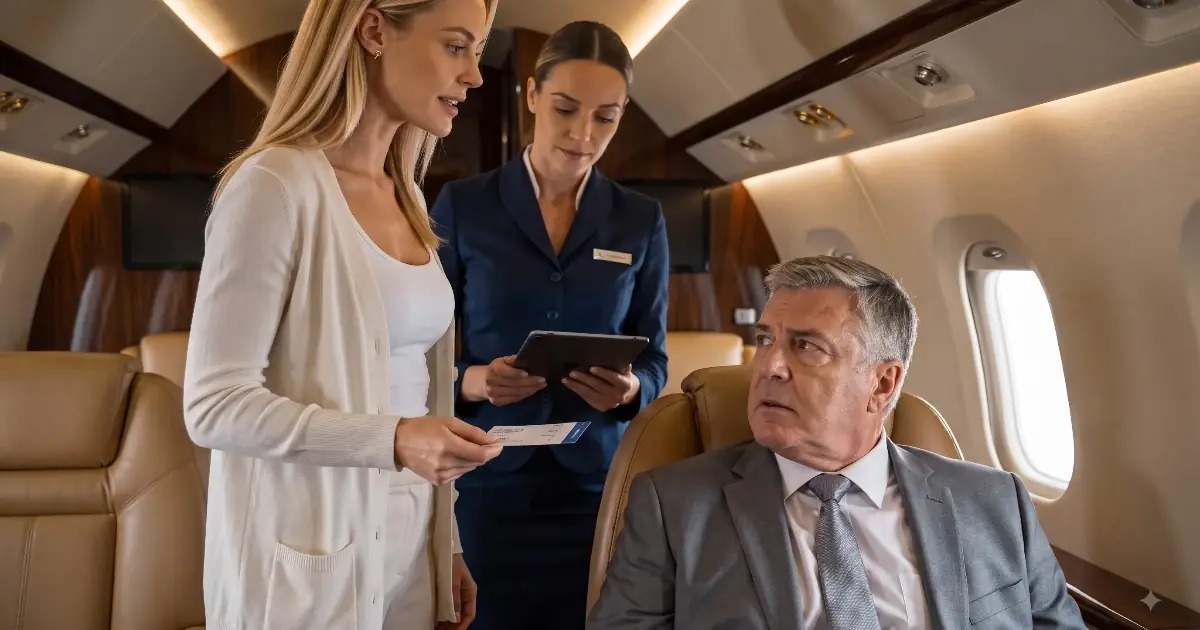
The seat he had chosen, 1A, was reserved for a passenger whose name had been added to the flight manifest only twenty minutes earlier. Eleanor checked the screen again. The system showed a new booking authorization, a seat reassignment, and a note marked CONFIDENTIAL. She had received instructions from the ground coordinator: the passenger in 1A must be moved before departure. No exceptions.
She approached with her professional smile.
“Good morning, sir. May I see your boarding pass, please?”
The old man lowered the newspaper. His eyes were pale blue, almost colorless, and far more alert than his age suggested. He handed her a small cream-colored ticket.
Eleanor compared it with her tablet. “Thank you. I’m afraid there’s been a seating adjustment. This seat has been reserved for another guest, so I’ll need to ask you to move to seat 4C.”
He looked at the ticket, then at her. “I was told I would be sitting here.”
“I understand, sir. But the manifest has changed.”
“Has it?”
“Yes, sir.”
“Who changed it?”
Eleanor hesitated. “The ground operations team, I believe.”
The old man studied her face, not with anger but with an unsettling patience. “And did they explain why?”
“They only gave us the updated seating plan.”
He glanced toward the empty seat opposite him. “Is the person who reserved this seat already aboard?”
“Not yet.”
“Then perhaps we should wait until he arrives.”
Eleanor felt the first small spark of irritation. She had been told to move him, not negotiate. “I’m sorry, sir, but we have a schedule to keep.”
“I have spent much of my life being told that schedules matter more than people,” he said. “It is a poor way to run an organization.”
She did not know what to make of that. His voice was gentle, but it carried an authority she could not place. Still, she had a job to do.
“Sir, I really do need you to take your assigned seat.”
He looked again at the ticket. “Are you absolutely certain this is not a mistake?”
“I’m certain, sir.”
The old man folded the ticket carefully and stood. He did not argue, raise his voice, or make a scene. He lifted his leather case and moved toward the rear cabin. As he passed Eleanor, he said, almost conversationally, “I hope the person who needs this seat deserves the trouble.”
Eleanor watched him settle into 4C. She entered a confirmation on her tablet and sent a short message to the ground coordinator: SEAT CHANGE COMPLETED.
Then she noticed something she had not seen before. The old man's ticket was not a standard passenger boarding card. It had been printed on heavy cream paper, embossed with a small silver wing. At the bottom, beneath his name, was a code she recognized from the aircraft's ownership documents.
C-001.
It was the owner's personal passenger designation.
Eleanor blinked and looked back at the old man. He had already opened his newspaper again.
She told herself there must be an explanation. Perhaps the code was outdated. Perhaps a guest had been issued an old card. Perhaps she had misunderstood the symbols. She had no reason to believe that the quiet gentleman in the worn suit was anything other than an elderly passenger whose seat had been changed.
She returned to the galley and called the ground coordinator.
“Daniel, I moved the gentleman in 1A. Can you confirm the new passenger's name?”
There was a pause. “Why do you need it?”
“Just so I know who to expect.”
“You don't. Keep the cabin ready. The arrival is private.”
“Daniel, the old man's ticket had an owner's designation.”
Another pause. This one was longer.
“What designation?”
“C-001.”
The line went quiet. When Daniel spoke again, his voice had lost its casual confidence. “Don't mention that to anyone. Just do your job.”
“Is there a problem?”
“No.”
“Then why—”
“Eleanor, listen carefully. The person in 1A is important. The old gentleman is not to be allowed back into that seat. Do you understand?”
Eleanor looked through the open galley doorway. The old man was reading. He appeared entirely unconcerned.
“I understand,” she said, though she did not.
A few minutes later, the second flight attendant, a young woman named Sophie, joined her in the galley. Sophie had been assigned to the aircraft for only six weeks. She was quick, cheerful, and sometimes too curious for her own good.
“Who did you move?” Sophie whispered.
“An older gentleman.”
“Why?”
“Seat change.”
Sophie glanced toward the rear cabin. “He looks like someone's grandfather.”