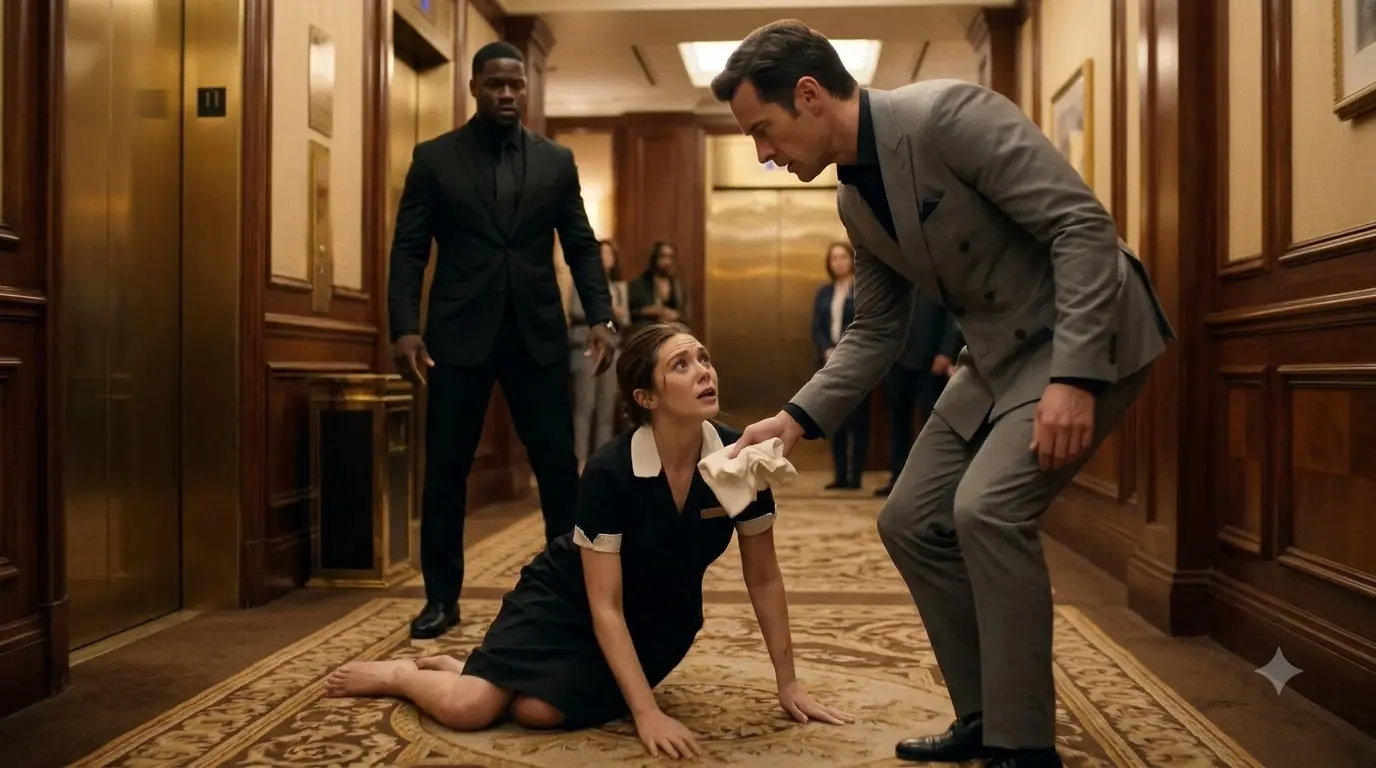
The hallway of the Aurelia Grand Hotel was built to make people feel small in a beautiful way. Chandeliers hung from the ceiling like frozen fireworks, their crystals catching the light and throwing it back in a thousand soft pieces across the polished marble floor. The walls were cream and gold, the carpet at the edges was thick and silent, and the air smelled faintly of lilies and old wood and money that had been in the same family for a very long time. Guests walked through that hallway slowly, the way people walk when they know they belong somewhere expensive, their suitcases rolling quietly behind them, their voices low and unhurried. No one ran in the Aurelia Grand. Running was for emergencies, and emergencies were not supposed to happen in a place like this.
Maya Reed was running.
She ran barefoot, one black flat shoe clutched in her right hand, the other foot slapping against the cold marble, her breath coming in short, ragged gasps that hurt her chest. Her black uniform dress, the one with the white collar and the white cuffs and the small gold name tag that read MAYA, was torn at the right sleeve where a hand had grabbed her too hard. The tear was not large, but it felt enormous to her, as if the whole world could see through it to the shame underneath. Her dark hair had come loose from its ponytail and fell around her face in damp strands. Her eyes were wide and wet, her mouth open, her face flushed with panic and exhaustion and a terror she did not have time to name. She was not running toward something. She was running away from something, and the difference mattered, because people who run toward something look determined, and people who run away look guilty, and Maya knew, even as she ran, that everyone watching her would decide she was guilty before they ever asked her what had happened.
Behind her, down the long hallway, two men in dark suits were following her, not running at first, then running, their shoes loud on the marble, their voices sharp and angry. "Stop! Stop her! She stole from the suite!" The words echoed off the walls and the chandeliers, and Maya felt them land on her back like stones. A couple near the elevators stepped aside, the woman pulling her child close, the man frowning as if Maya were a danger. A bellhop froze with a luggage cart halfway through a doorway. An older woman in a fur coat put a hand to her chest. No one stopped the men. No one asked Maya if she was all right. In a hotel built for the rich, a young maid running barefoot with a torn sleeve and a shoe in her hand could only be one thing in the eyes of strangers, and that thing was not innocent.
Maya did not stop. She could not stop. Clutched against her chest with her left arm, pressed so tightly to her body that her knuckles were white, was a small brown leather notebook. It was old and worn, its edges soft from years of being held, its cover scratched, its elastic band stretched loose. It was not hers, and that was the whole problem, and it was also the whole reason she was running. She had found it that morning, hidden where no one was supposed to find it, and she had known, the instant she opened it and saw the handwriting on the first page, that it was important, that it belonged to someone who had loved and lost and waited, that it was not a thing to be left in a drawer to gather dust. She had been trying to take it to the one person in the hotel who deserved to see it. She had been trying to do the right thing. And now the right thing looked exactly like theft, and she was running for her life through a hallway made of light.
Her bare foot slipped on the marble, and for a terrible second she thought she would fall. She caught herself against the wall, her palm smearing against the gold trim, her breath catching in a sob she swallowed before it could become a sound. The shoe in her hand had come off when she had tried to run up the service stairs, the heel catching, the strap snapping, and she had not stopped to fix it because stopping felt like surrender. She could hear the men behind her getting closer. She could hear her own heart hammering against her ribs, so loud she was certain the chandeliers could hear it. She thought of her little brother waiting at home. She thought of her mother, gone two years now, and what her mother would say if she could see her daughter running barefoot through the grandest hotel in the city, accused of stealing, clutching a dead woman's notebook like it was the only proof she had ever mattered. She thought, I am not a thief, I am not a thief, I am not a thief, repeating it in her head like a prayer, hoping that if she said it enough times, someone, anyone, would believe it.