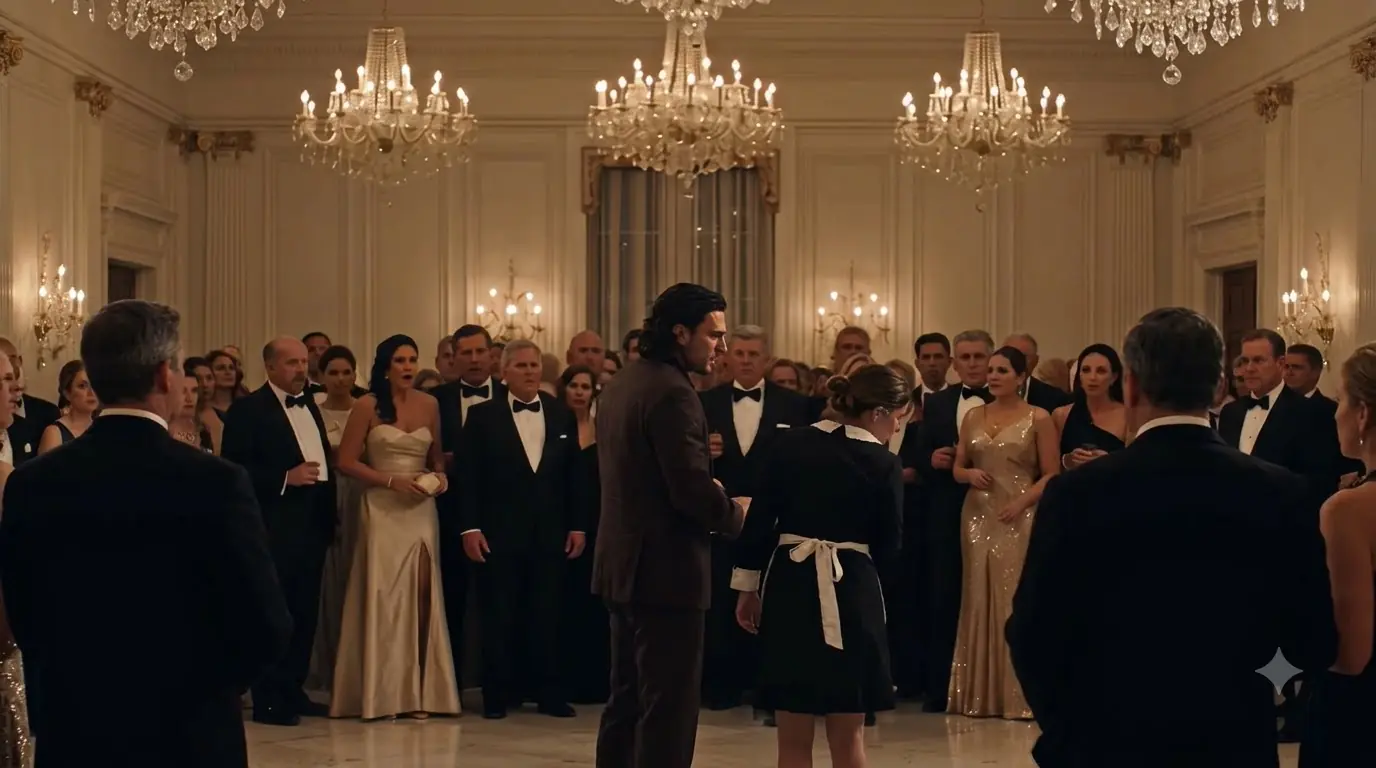
The ballroom of the Whitmore Grand was built to make ordinary people feel as if they had stepped inside a dream they did not belong to, and to make rich people feel as if the dream had been built only for them. Chandeliers hung from the ceiling in rows, crystal upon crystal, catching the warm light and throwing it back in a thousand soft pieces across the polished marble floor, so that every step a guest took seemed to walk on reflected stars. The walls were cream and gold, the curtains were heavy velvet, the tables were covered in white linen and crowned with lilies, and the air smelled of expensive perfume, champagne, and the particular kind of power that comes from knowing no one in the room will ever say no to you. Men in black tuxedos stood with their hands in their pockets or around glasses of whiskey, laughing in low voices about deals and yachts and other men's failures. Women in long gowns of gold and silver and midnight blue moved slowly, their diamonds catching the light, their smiles practiced and perfect, their eyes always watching, always measuring, always deciding who mattered and who did not. Music played from a small orchestra in the corner, soft and elegant, the kind of music that is meant to be heard without ever being listened to, and waiters moved between the tables like shadows, silent and careful, carrying trays of champagne and canapés, their faces trained to be pleasant and invisible at the same time.
Clara Bennett was one of those shadows. She was twenty-three years old, and she wore the uniform of the hotel staff, a black dress with a white Peter Pan collar, white cuffs, and a white apron tied neatly at her waist, a uniform that had been designed to make the person inside it disappear, to turn a human being into a function, a pair of hands, a tray, a smile. Her brown hair was pulled back into a low bun, a few loose strands escaping around her face because she had been working since five in the afternoon and it was now nearly midnight, and her feet ached in her black flat shoes, and her back ached from bending and lifting and smiling, and her hands were dry from washing glasses in the kitchen between services. She had not eaten since lunch, a sandwich eaten standing up in a staff room that smelled of bleach, and she had not sat down except for three minutes on a crate behind the kitchen door, and yet she moved through the ballroom with a grace that came not from training, but from a lifetime of learning how to be careful, how to be quiet, how to take up as little space as possible while still doing a job perfectly. She knew the names of the regular guests, she knew who was allergic to shellfish, she knew who liked their champagne cold and who pretended to like it but never drank it, and she knew, most of all, that in a room like this, a maid was not a person, she was a mistake waiting to happen, and one small mistake could cost her everything.
That mistake happened the way mistakes always happen, not with malice, but with a small, ordinary accident that the world decides to punish as if it were a crime. A guest near the center of the room, a man in a tuxedo who had drunk too much champagne and was laughing too loudly at his own joke, stepped backward without looking, directly into Clara's path, and his elbow caught the edge of her tray. The tray tilted, a glass of champagne slid, and a few drops, no more than a few drops, splashed onto the sleeve of the woman standing beside him. The woman was Victoria Ashford, twenty-nine years old, beautiful in the cruel, polished way of people who have never been told no, her blonde hair in perfect waves, her gold gown sparkling under the chandeliers, her diamond earrings catching the light every time she turned her head. She was the fiancée of the man who owned the hotel, the woman every other woman in the room envied and feared, the woman who had arrived that night as if the ballroom were a stage and she were the only performer who mattered. She looked down at the tiny wet spot on her sleeve, a spot no larger than a coin, a spot that would dry in minutes, and her face changed, not with surprise, but with a cold, delighted anger, the anger of a person who has finally found an excuse to be cruel in public and to be applauded for it.
Clara apologized instantly, her voice shaking, her hands already reaching for a napkin, her whole body bending slightly forward in the posture of someone who has learned that apology is the only shield a poor person is allowed to carry. "I am so sorry, miss, I am so sorry, it was an accident, please, let me clean it, I will get a towel, I am so sorry." She did not see the slap coming, because people who are truly kind do not expect cruelty to arrive without warning, because they still believe, despite everything life has taught them, that an apology should be enough. Victoria's hand moved fast, open-palmed, across Clara's cheek, the sound sharp and shocking in the ballroom, louder than the music, louder than the laughter, louder than the clinking of glasses, a sound that seemed to stop time itself. The force of it turned Clara's head to the side, sent her hair loose from its bun, and left a red mark blooming across her cheek, a mark that would darken into a bruise within the hour. A thin line of blood appeared at the corner of Clara's mouth where her own teeth had cut her lip, a small, dark, terrible line that made the cruelty suddenly real, suddenly physical, suddenly impossible to pretend away as a misunderstanding.