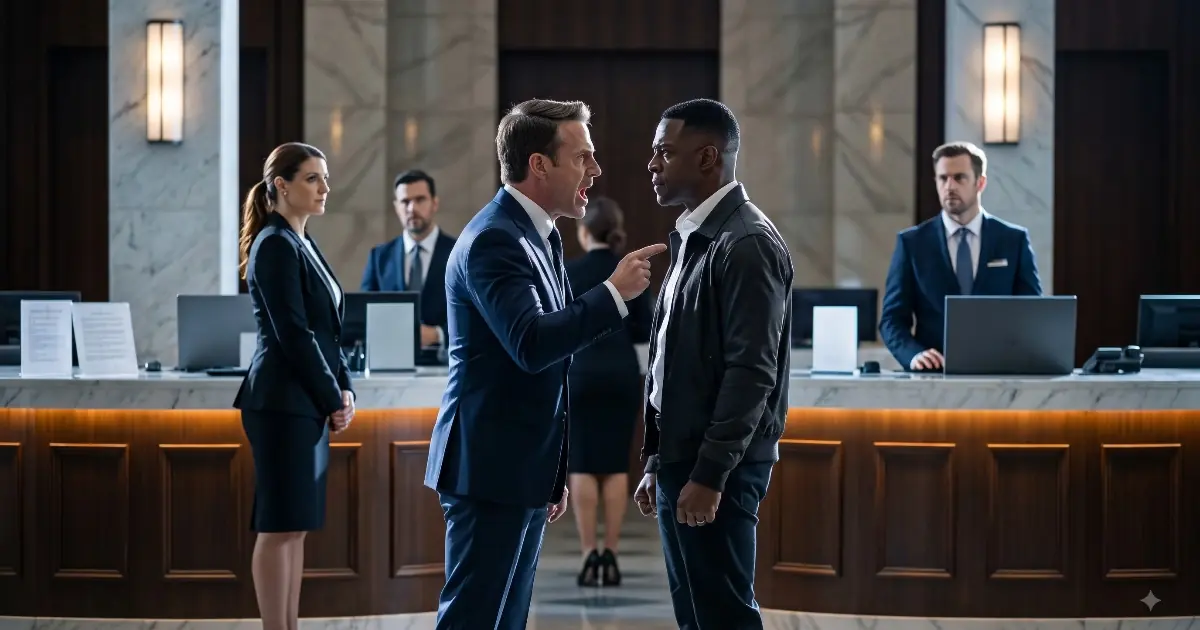
At exactly 8:15 on a Monday morning, Daniel Carter stepped through the revolving doors of Sterling Tower, carrying a black leather briefcase in one hand and a paper cup of coffee in the other.
The building stood at the heart of the city's financial district, its glass exterior reflecting the morning sunlight. Inside, everything looked expensive. The marble floors were polished until they shone, the elevators moved silently, and the reception desk was decorated with fresh flowers that were replaced every morning.
To visitors, Sterling Tower represented success, influence, and financial power.
To Daniel, it was simply the place where he had worked for nearly seven years.
He adjusted his tie, greeted the security guard, and walked toward the elevators.
"Morning, Mr. Carter."
The receptionist offered him a polite smile.
"Good morning, Susan."
Daniel had always remembered people's names. He greeted the cleaners, security guards, assistants, and senior executives with the same courtesy. He believed that a person's position should never determine how much respect they deserved.
Unfortunately, not everyone in the building shared that belief.
When Daniel entered the thirty-second-floor office, several employees were already gathered around the coffee machine.
Robert Ellis, one of the senior analysts, noticed him.
"Look who's here. The man who never takes a day off."
A few people laughed.
Daniel smiled slightly.
"Someone has to make sure the reports are ready."
Robert shook his head.
"You really need to relax. Nobody gets promoted by spending all night checking spreadsheets."
"Maybe," Daniel replied, placing his briefcase beside his desk. "But somebody has to make sure the numbers are correct."
The laughter grew louder.
At the far end of the room, Richard Morgan emerged from his private office.
Richard was the company's senior executive responsible for financial operations. He was in his early fifties, always dressed in expensive suits, and carried himself with the confidence of a man who believed the entire building belonged to him.
He rarely walked past an employee without making a comment about their work, their appearance, or their position.
When he noticed Daniel, he stopped.
"Carter."
Daniel turned.
"Good morning, Mr. Morgan."
Richard glanced at the paper cup in Daniel's hand.
"Coffee again? I hope you're spending as much time on your actual responsibilities as you are on your morning routine."
"Of course, sir."
"Good. The quarterly reports need to be ready by Friday. I don't want excuses."
"They will be ready."
Richard gave a short nod and continued toward the conference room.
Robert leaned closer to Daniel.
"One day, you'll learn that being polite doesn't get you anywhere around here."
Daniel opened his computer.
"Maybe it doesn't. But it makes the day easier."
Robert laughed and walked away.
Daniel didn't take the comments personally. He had learned long ago that some people needed to make others feel small in order to feel important themselves.
He had not joined Sterling Tower to become popular.
He had joined because he believed financial institutions could make a positive difference when they were managed responsibly. He wanted to build a career based on accuracy, fairness, and professional integrity.
His father had taught him those values.
Samuel Carter had worked in financial administration for most of his life. He was not wealthy, famous, or particularly influential. He had lived modestly, repaired things instead of replacing them, and believed that a person's reputation was worth more than any amount of money.
When Daniel was a teenager, Samuel had once found a wallet containing several hundred dollars outside a grocery store.
Daniel had asked whether they should keep it until someone came looking.
His father had smiled.
"If it isn't yours, son, you don't get to decide that keeping it is harmless."
They had returned the wallet to its owner.
That simple lesson had stayed with Daniel long after his father's death.
At 9:00, the weekly financial operations meeting began.
Daniel entered the conference room carrying a folder of preliminary reports. Richard sat at the head of the table. Beside him were Charles Whitmore, the company's chief executive officer, and several department managers.
Charles was a man in his late sixties who had spent decades building his reputation in the financial industry. His name appeared regularly in business magazines, and his photograph was displayed in the lobby alongside the company's founding documents.
He rarely raised his voice.
He didn't need to.
His position gave every sentence weight.
"Let's begin," Charles said.
The meeting covered routine matters: departmental expenses, investment performance, staffing costs, and upcoming operational changes.
When the discussion reached the quarterly financial summary, Daniel noticed a discrepancy.
He checked the figure printed in his folder, then looked at the presentation on the screen.
The amount listed under operational maintenance expenses was different.
He raised his hand.
"Excuse me. There appears to be a discrepancy in the maintenance figures."
Richard didn't look at him.
"Which figures?"
Daniel pointed toward the screen.
"The amount in the summary is approximately twelve percent higher than the amount recorded in the supporting ledger."
Richard sighed.
"That's a reporting adjustment."
"I understand, sir. I just wanted to confirm that the adjustment has been documented."
Charles finally looked toward him.
"Is there a problem, Mr. Carter?"
"I don't believe so. I simply want to make sure the supporting records match the summary."
Richard leaned back.
"Daniel, not every adjustment needs to become a discussion."
Daniel remained calm.
"I agree. But this one should have an explanation."
A few people exchanged glances.
Charles studied Daniel for a moment before turning back to the screen.
"Richard, have the department review the documentation. Let's move on."
The meeting continued.
Daniel wrote down the issue and returned to his desk afterward.
He didn't realize that Richard had been watching him leave.
Nor did he notice the brief exchange between Richard and Charles near the conference-room door.
"He's becoming a problem," Richard muttered.
Charles adjusted his jacket.
"Then make sure he doesn't become a bigger one."
Later that afternoon, Daniel received an email requesting that he review several supplier invoices connected to the maintenance budget.
The request seemed ordinary.
But as he opened the attached files, he noticed something strange.
Three separate invoices listed almost identical descriptions of work.
Each had been submitted by a different supplier.
Each had been approved within a few days of the others.
And all three payments were significantly higher than the estimates in the original contracts.
Daniel leaned closer to the screen.
He opened the supplier database and searched the company names.
One supplier had a registered address that appeared to belong to a residential apartment building. Another had no clear record of employees or operating facilities.
The third had a name he had never seen before.
Northbridge Advisory.
Daniel wrote the name on a yellow note and placed it beside his monitor.
He checked the invoices again.
Something about the pattern bothered him.
The amounts were not large enough to attract immediate attention, but the frequency of the payments suggested a deliberate process.
He spent the next two hours comparing records from different departments.
By the time he finished, he had identified eleven transactions that deserved closer examination.
At 6:40, most of the office had emptied.
Emily Parker, a compliance assistant who worked on the same floor, stopped beside his desk.
"You're still here?"
Daniel looked up.
"Just finishing something."
Emily glanced at the papers.
"More financial reports?"
"Something like that."
She noticed the name on the yellow note.
"Northbridge Advisory?"
Daniel looked at her.
"You know them?"
Emily hesitated.
"I've seen that name before."
"Where?"
"Some internal payment requests. I thought they were ordinary suppliers."
"Did you notice anything unusual?"
Emily looked toward Richard's office.
The door was closed, but the lights were still on.
"Not here," she whispered.
Daniel studied her expression.
"Is something wrong?"