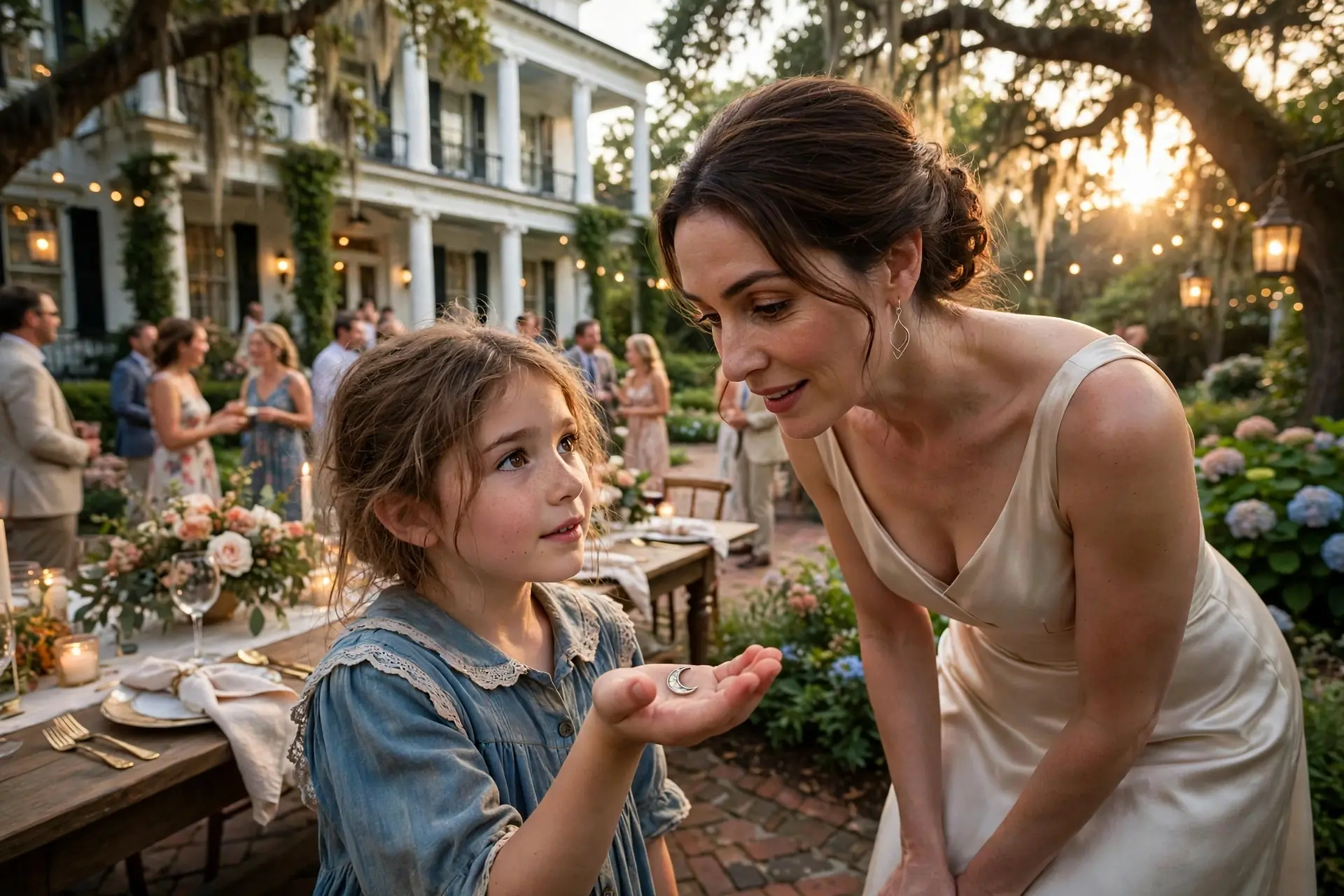
 The garden of Hale House lay open to the late light, and the whole of Charleston seemed to have come through the iron gate to stand upon the lawn. White cloths covered the long tables under the old oak trees. Lanterns hung from the lower branches, unlit as yet, waiting for dusk. A small band played near the fountain, soft enough that people could talk above it, and the air smelled of cut grass and roses and the lemon cakes cooling on the trays in the kitchen. Victoria Hale stood near the center of the lawn in a pale satin dress, a glass of iced tea in her hand, and received her guests one by one as they came to wish her well.
She had run Hale House for twenty years. She had taken the house in hand when she was only twenty one, a young woman with no husband and no living parent to guide her, and she had held it through every season since, through storms that tore tiles from the roof and summers that dried the garden to dust and winters when the pipes froze in the oldest wing. The house was large and old and full of rooms that no one used, and the garden was larger still, with hedges that needed cutting and beds that needed tending and a fountain that needed mending every spring. People in Charleston said that Hale House was Victoria Hale, and that Victoria Hale was Hale House, and she had long since stopped correcting them. She had given the house her youth, and the house had given her a place to stand, and the bargain had held for twenty years.
Now she was almost forty one, and the lines at the corners of her eyes showed when she smiled, and her dark hair, pulled back from her face, showed a few threads of gray that she did not bother to hide. She had never married. She had never wanted to marry, or so she told herself on the quiet evenings when the house was empty and the garden lay still under the moon. She had the house, and she had her work, and she had the small circle of people who had stayed near her through the years, and that had been enough. It had to be enough. She had learned long ago to want only what she could keep.
The party was her own idea, though she had resisted it at first. Margaret Graham, her housekeeper, had pressed for it all spring, saying that twenty years of keeping a great house deserved a proper celebration, and that the people of Charleston would think badly of the house if the day passed without notice. Margaret Graham was sixty seven and had worked at Hale House since Victoria Hale was a small child, and she had a way of speaking that made disagreement feel like bad manners. So Victoria Hale had agreed, and the invitations had gone out, and the gardeners had spent a week trimming the hedges and sweeping the paths, and the cook had spent three days baking, and now the garden was full of people in summer clothes, drinking iced tea and eating small sandwiches and telling Victoria Hale how fine the house looked and how fine she looked and how the twenty years had passed so quickly.
Edward Hale stood near the fountain, talking with two men from the Hale company, and Victoria Hale watched him from across the lawn with the calm, distant affection she always felt for her cousin. Edward Hale was forty seven, tall and graying, with the same dark eyes as her father, and he had been her nearest kin since her parents died. He had managed the business side of the Hale estate for years, while she managed the house and the garden and the people who worked in them, and the arrangement had suited them both. He smiled when he caught her eye, and lifted his glass a little, and she smiled back. She trusted him. She had trusted him for as long as she could remember, and trust, once given in a family, was hard to take back.
The afternoon wore on in the slow, golden way that summer afternoons wear on in Charleston. The band played a waltz, and then a slower tune that made the older guests nod and close their eyes. Children ran between the tables, chasing each other around the fountain, and their mothers called them back in low voices and then gave up and let them run. The cook sent out tray after tray from the kitchen, and Margaret Graham moved through the crowd with her usual quiet authority, seeing that no glass stayed empty and no guest stood alone for long. Victoria Hale moved with her, from one group to another, thanking people for coming, asking after their families, listening to stories she had heard a dozen times before and answering as if she heard them for the first time. She was good at this. Twenty years of receiving guests had taught her how to listen, how to smile, how to make each person feel that the house was glad to see them. An old friend of her mother caught her arm and told her that the garden had never looked finer, and Victoria Hale thanked her and asked after her grandchildren, and the old woman smiled and said that Hale House was the pride of Charleston, and that Victoria Hale herself was its finest ornament, and Victoria Hale laughed and shook her head and moved on.
Once, as she crossed the lawn toward the rose beds, she stopped and looked back at the house itself, at the tall windows and the white columns and the wide porch where her father had once stood to greet his own guests. The house had been in her family for generations. Her grandfather had kept his papers in a room in the oldest wing, and her father had kept the house after him, and now she kept it, and the thought came to her, as it often did on quiet days, that the house was larger than any one life and would outlast her as it had outlasted them all. She pushed the thought away. It was a day for celebration, not for old sorrows. She turned back to her guests and smiled.
She did not see the girl at first. No one did. The garden was full of people, and the girl was small, and she moved the way small frightened creatures move, slipping between the guests and keeping close to the hedges, where the shadows lay thick. She had come through the side gate, the one the gardeners used, and her shoes were caked with mud from the lane outside, and her faded blue dress was damp at the hem and streaked with dirt. Her soft brown hair had come loose from its ribbon and hung about her face, and her cheeks were flushed from walking in the heat. She carried nothing in her hands. She had no invitation, and no one had seen her arrive, and no one had asked her name. She simply came, one small figure among so many, and made her way across the lawn toward the woman in the pale satin dress.
Victoria Hale was talking with an elderly neighbor about the roses when she felt it, a light tug at her skirt, so gentle that at first she thought it was the wind. She looked down, expecting a child of one of her guests, expecting a small hand and a shy smile and a mother hurrying over to apologize. What she saw stopped her in the middle of her sentence.
The girl stood close beside her, so close that the mud on her shoes had touched the hem of Victoria Hale's dress. She was nine years old, small for her age, with soft brown hair and wide dark eyes that looked up at Victoria Hale without fear, though her hands trembled at her sides. Her faded blue dress was torn at one shoulder, and there was a smudge of dirt on her cheek, and her breath came fast, as if she had been running. She did not speak. She only stood there, looking up, and tugged once more at Victoria Hale's dress, lightly, insistently, as if she had walked a very long way to do exactly that and would not be turned aside.
Victoria Hale stared down at her. For a moment the whole garden seemed to go quiet around them, though the band still played and the guests still talked and the fountain still ran. She had seen many children in this garden over twenty years, the children of her friends and her neighbors, running and laughing among the roses, but she had never seen this child before, and she knew at once, with the cold certainty that comes before understanding, that this child had not come to the party. She had come to her.
"Who are you, child?" Victoria Hale asked, and her voice sounded strange in her own ears, low and careful, as if she were speaking to something wild that might bolt if she moved too fast. "Where is your mother?"
The girl did not answer at once. She looked up at Victoria Hale, and then she looked around at the garden, at the white cloths and the lanterns and the crowd of well dressed strangers, and then she looked back at Victoria Hale, and her small face set itself with a resolve that seemed far too old for nine years. She lifted one hand and pressed it flat against her own chest, over her heart, as if to hold something in place there, and she drew a deep breath.
"Please," the girl said, and her voice was small and hoarse, as if she had not spoken in hours. "Please, I need to talk to you. My mother told me to come here. She told me to find you."
Victoria Hale felt the ground shift under her feet. She did not know why. She did not know this child. She had never seen her before in her life. And yet something in the girl's face, something in the way she stood, in the set of her mouth and the shape of her eyes, woke a memory so old and so deep that Victoria Hale could not name it, only feel it, like a hand closing around her heart. She bent down slowly, until her eyes were level with the girl's, and the satin of her dress brushed the grass, and she did not care.
"Tell me your name," Victoria Hale said softly. "Tell me who your mother is."
The girl hesitated. Around them, the guests had begun to notice. A woman near the fountain turned and stared. A man lowered his glass. Margaret Graham, seeing Victoria Hale bent down in the grass in her party dress, began to move across the lawn toward them, her face full of concern. Edward Hale, from his place by the fountain, watched with a frown, and set down his glass, and started forward. But the girl paid no attention to any of them. Her eyes stayed on Victoria Hale, and her hand stayed pressed flat against her chest, and when she spoke again, her voice was steady, though it shook a little at the edges.
"My name is Lucy Mercer," she said. "I came here alone. I came on the bus. And my mother told me that you hold the other half."
Victoria Hale went very still. The band played on. The fountain ran. The guests murmured. And somewhere deep inside her, behind twenty years of careful silence, something that had slept for a very long time began, very slowly, to wake.
For a long moment Victoria Hale did not move. She stayed bent down in the grass in her pale satin dress, her eyes level with the eyes of the small girl, and the garden went on around them as if nothing had happened, though nothing was the same as it had been a moment before. The band played a slow tune near the fountain. The guests talked and laughed and lifted their glasses. A child ran past, chasing a ball, and a woman called after him. And in the middle of it all, on the green lawn of Hale House, a nine year old girl in a muddy blue dress stood with her hand pressed flat against her chest, and waited.
"Show me," Victoria Hale said at last, and her voice was quiet and steady, though her heart beat hard against her ribs. "Show me what you carry there, child. Show me what your mother gave you."
Lucy Mercer looked down at her own hand, and then she looked back at Victoria Hale, and slowly, carefully, as if the thing she carried were made of glass, she drew her hand away from her chest and reached inside the neck of her faded blue dress. A thin cord hung around her neck, dark with wear and frayed at the edges, and from the cord hung a small piece of silver, dull with age and handling. She lifted it out and held it in her open palm, and held her palm out toward Victoria Hale, so that the late light fell upon it.
It was a half moon, cut from silver, no bigger than the top joint of Victoria Hale's thumb. The curve of it was smooth and worn, and the edge where it had been cut was rubbed thin by years of touch, as if many fingers had held it and turned it over and over in the dark. The silver had gone dull in some places and bright in others, where it had been rubbed clean by skin. It was old. It was very old. And Victoria Hale knew it at once, knew it the way she knew her own face in a mirror, the way she knew the sound of her own name.
She did not speak. She could not speak. Her breath caught in her throat, and her hand rose to her own neck before she knew what she was doing, to the thin gold chain that lay hidden beneath the satin of her dress, against her skin, where it had lain for twenty eight years. No one at the party knew of that chain. No one had ever seen it. She had worn it every day since she was twelve years old, through every season and every sorrow, and she had never once taken it off, not to bathe and not to sleep, and she had never spoken of it to a living soul. It was hers. It had always been hers. And now a strange child stood before her in the garden and held out its twin in a small muddy palm.
"Where did you get that?" Victoria Hale whispered, and the words came out rough, as if they had been dragged up from deep inside her. "Child, where did you get that silver moon?"
"My mother gave it to me," Lucy Mercer said, and her voice was clear now, and certain, though her small hand shook a little as she held the silver out. "She told me to keep it safe, and she told me that the other half is here, with you. She said you would know it when you saw it. She said you would know me by it."
Victoria Hale stared at the half moon in the girl's palm, and then, with fingers that trembled so much she could scarcely manage the clasp, she reached beneath the neck of her satin dress and drew out her own chain. The thin gold links caught the light as they came free, and at the end of them hung a piece of silver, a half moon, the same size as the one in the girl's hand, the same dull brightness, the same worn curve. And near the top of the curve, small and neat, was a notch, a tiny mark cut into the silver, the mark she herself had made with a sewing needle when she was twelve years old, sitting in her bedroom on a summer afternoon, while her sister watched and laughed and told her she would spoil it.
Her sister. The thought came to her unbidden, and with it a rush of memory so sharp that it hurt: a summer afternoon, a small room in the oldest wing of the house, two girls with their heads bent close over a piece of silver, and a needle, and laughter, and a promise made in the thoughtless way children make promises, as if the world would hold still and let them keep it forever. Victoria Hale had not thought of that afternoon in years. She had buried it, as she had buried so much else, under twenty years of work and duty and silence. And now it rose up before her, bright and whole, called back by a child she had never seen and a piece of silver she had worn against her skin for twenty eight years. She remembered the day the silver had been cut, a hot summer afternoon when the two of them had sat on the floor of the small bedroom under the eaves, with a jeweler's saw borrowed from the drawer of their grandfather's desk, and they had cut the little moon in two with trembling hands, laughing when the blade slipped, and promising each other that each would keep her half close, so that no distance and no time could ever lose them from each other. She remembered how her sister had taken the needle and made the small notch near the top of Victoria Hale's half, so that they would always know which half belonged to whom, and how Victoria Hale had scratched a faint mark near the bottom of her sister's half with the same needle, and how they had hung the halves on cords and worn them to supper, and how their father had frowned and told them to take off such foolish trinkets, and how they had hidden them under their dresses instead. She remembered the years after, the long empty years when she had worn her half alone, touching it when the house was quiet and the grief came back, holding it in the dark on nights when she could not sleep, keeping it close because it was all she had left of the sister she had lost.
"Look," Lucy Mercer said softly, and she leaned forward and laid her half moon beside Victoria Hale's, in the palm of Victoria Hale's own hand, so that the two pieces of silver lay side by side in the light. "Look, they fit. My mother said they would fit."
And they did. Victoria Hale watched, hardly breathing, as the girl turned the two halves toward each other with a small careful finger, and the worn edge of one met the worn edge of the other, and the curve of one completed the curve of the other, and where there had been two broken pieces there was now a single moon, whole and round, with the small notch near the top and a faint scratch near the bottom, as if the silver had only ever been one piece and had waited all these years to be joined again. The fit was perfect. There was no gap, no roughness, no doubt. The two halves had been cut from the same silver, by the same hand, on the same day, and they had lain separated for twenty eight years, and now they were together again in the palm of Victoria Hale's hand, in the garden of Hale House, in the middle of her anniversary party.
A sound came from Victoria Hale then, a small sound, half a gasp and half a sob, and she pressed her free hand to her mouth to hold it back. She had not cried in years. She had taught herself not to cry, on the long nights after her parents died, on the mornings when the house was cold and the garden was empty and the silence pressed in on her from every side. She had taught herself to be still, and to be strong, and to keep her grief locked away where no one could see it. But now the grief rose up in her like a tide, and the two halves of silver lay warm in her palm, and the child watched her with wide dark eyes, and Victoria Hale knew, with a certainty that shook her to her bones, that everything she had believed for twenty eight years was wrong.
Around them, the garden had gone quiet at last. The guests nearest the fountain had stopped talking and turned to look. Margaret Graham had crossed the lawn and stood a few yards away, her face pale, her hands clasped tight before her, waiting to be called. Edward Hale had left the fountain and stood near the rose beds, his face dark with something that Victoria Hale could not read, watching the woman in the satin dress and the small muddy girl with an attention so fixed that it looked like fear. No one spoke. No one came closer. The band had fallen silent, one instrument at a time, until only the fountain could be heard, and the bees in the roses, and the breathing of the woman and the child in the middle of the lawn.
Victoria Hale closed her fingers slowly around the two halves of silver, holding them together, holding them safe, and she looked down into the face of Lucy Mercer, into the wide dark eyes and the smudged cheek and the soft brown hair coming loose from its ribbon, and she saw there, plain as daylight, the shape of a face she had loved and lost when she was little more than a child herself, and the knowledge of it went through her like a blade. Margaret Graham took a step forward, as if to come to her mistress, and then stopped, uncertain, her old hands twisting in her apron. Edward Hale moved nearer too, his face white beneath his graying hair, and his mouth opened as if to speak, and then closed again. Victoria Hale saw them both from the corner of her eye, and she lifted one hand, just a little, in a gesture that asked them to wait, to give her a moment more, and they obeyed, as they had always obeyed her in this house, and stood where they were, watching. The guests held their breath. Even the children by the fountain had gone still. No one in the garden understood what was happening on the lawn, but every person there understood that something solemn was passing before them, something that belonged to the house and to the woman who kept it, and that it was not a thing to be broken into with questions.
"Tell me," she said, and her voice shook now, though she fought to hold it steady. "Tell me truly, child. Who is your mother? What is her name?"
Lucy Mercer drew a deep breath, and her small shoulders rose and fell, and she looked up at Victoria Hale without flinching, the way a child looks when she has carried a heavy truth for a long time and is glad, at last, to set it down. She opened her mouth to speak. And in that moment, before a single word had left her lips, Victoria Hale knew that whatever the girl said next would change everything, and that Hale House would never be the same again.
Lucy said the name as if it were the easiest thing in the world to say. Her mother was Anna Mercer.
She said her mother had died in February of this year, aged thirty nine, and that she would have turned forty before the summer ended. The words dropped into the garden and the garden went quiet all at once. Victoria stood very still with the two halves of the locket in her hand, the small notch catching the light, and felt the ground tilt under her feet.
Anna Mercer. The name belonged to a girl of twelve who had vanished in the summer of nineteen ninety eight and never come home. The name belonged to a sister who had been mourned and missed and spoken of in lowered voices for twenty eight years. It did not belong to the mother of a living child standing muddy in the garden in a faded blue dress.
Victoria looked at the child and then at the locket and then at the child again, and her thoughts would not hold still long enough for her to catch one. She had worn her half of the locket against her skin for twenty eight years, and she had never once imagined that the other half still existed in the world, let alone that it would arrive in the hand of a nine year old girl at her own anniversary party. She opened her mouth to speak and found that she had no voice ready. The garden seemed very far away, and the only things near to her were the child and the silver moon in her palm.
Edward Hale was the first to find his voice. He stepped forward from the edge of the little crowd that had gathered, and his face was pale and set, and his hands were clenched at his sides. He said that the child was mistaken. He said that Anna Mercer had died at twelve, in the summer of nineteen ninety eight, and that everyone in Charleston had known it for twenty eight years. He said it firmly, as if firmness could make it true.
Victoria turned toward him slowly. She had known Edward all her life. He was her cousin, forty seven years old, a man who had always been careful with his words and careful with his loyalties. She had never seen him look frightened before, and she saw it now, under the firmness, in the tightness around his eyes and the way his jaw worked when he stopped speaking. She did not answer him yet. She looked back down at Lucy.
Lucy did not flinch under the eyes of the grown people around her. She stood with her hands clasped in front of her faded blue dress, and her chin lifted a little, and her gaze steady. She said again that her mother was Anna Mercer. She said that her mother had told her about Victoria Hale, and about Hale House, and about the locket, and that her mother had told her to come here if anything happened to her. She said it the way a child says something she has repeated to herself many times, carefully, so as not to forget any of it.
A murmur went through the guests. Victoria heard her own name spoken in low voices, and she heard the name Anna spoken in low voices, and she heard someone near the rose beds whisper that it could not be true, and someone else whisper that the child had the look of the family about her. She did not know whether the second whisper was true or only a kindness, but it settled in her chest all the same. She looked at the soft brown hair and the shape of the child's face, and thought of her sister at nine, and of her sister at twelve.
Edward spoke again, louder now. He told the family story as if telling it would end the matter. In the summer of nineteen ninety eight, Anna had gone down toward the river, and she had not come back. Their father had said there was an accident near the river. A search party had gone out, and the searchers had found her jacket caught on a branch downstream, and blood on the rocks, and they had never found her body. That was the story, Edward said, and it had been the story for twenty eight years, and no child with a trinket could change it.
Victoria listened to the story as if she were hearing it for the first time, though she had heard it a hundred times and had lived inside it for twenty eight years. She remembered the summer of nineteen ninety eight as a season of heat and shouting and slamming doors, and then of silence. She remembered the searchers coming back with mud on their boots and nothing in their hands. She remembered her father's face, grey and closed, and the way he would not speak of it, and the way her mother had wept in her room with the door shut. She remembered the jacket, blue like the dress Lucy wore now, and the rocks by the river, and the way the whole house had held its breath for weeks, waiting for news that never came.
She looked at Edward. She said, very quietly, that there had never been a body. She said that the jacket and the blood had been all they found, and that the river had kept the rest, and that a family could believe a thing for twenty eight years and still be wrong about it. She did not raise her voice, though her hands were shaking so much that the two halves of the locket trembled in her palm.
Edward shook his head. He said that Anna had been twelve years old, a child, and that children did not vanish and grow up and have children of their own in secret. He said that the girl had been sent by someone, or coached by someone, and that someone had given her the locket and taught her the story, and that Victoria must not let a stranger's trick undo twenty eight years of truth. He said that the locket proved nothing, that any silversmith could make such a thing, and that anyone could cut a notch with a needle.
Victoria looked down at the notch. She had made it herself with a sewing needle when she was twelve, a small secret mark, because the two halves had looked so alike that she had feared mixing them up. She had never told anyone about the notch, not her mother, not her father, not Margaret Graham, not Edward. And now a child she had never seen before had told her that her mother had said Victoria held the other half, and the notch was exactly where her memory said it would be.
She asked Lucy how her mother had known about the notch. Lucy said her mother had told her about it, on a night when the two of them sat together and her mother held the locket in her hand and turned it over and over. She said her mother had told her that Victoria had made the mark herself, with a needle, when they were girls, and that the mark meant the half was Victoria's and no one else's. She said her mother had told her many things about Victoria, about the garden and the house, and that she had remembered all of it because her mother had asked her to remember.
Victoria felt tears come into her eyes, and she did not wipe them away, because the guests were watching and because she did not care. She thought of her sister at twelve, sitting beside her with a needle and a silver moon, laughing at the smallness of the mark and saying it would be their secret. She thought of February of this year, and of a woman of thirty nine dying of cancer in North Carolina while she, Victoria, stood in her garden in Charleston knowing nothing of it. The thought was like a weight pressing on her chest, and she had to breathe slowly to bear it.
She asked Lucy, gently, what her mother had died of. Lucy said it was a sickness in her body, a cancer, and that the doctors had done what they could, and that her mother had grown thin and tired, and that in the end she had slept more and more, until one morning she did not wake. Lucy said it plainly, without tears, in the flat voice of a child who has said the words many times and has learned to say them without breaking. Victoria saw then how thin the child's wrists were, and how old her eyes looked, and she understood that Lucy had lived with dying for a long time before she had come here.
Edward said that cancer proved nothing either, that many women died of cancer, and that a child could learn such details from anyone. But his voice had lost its firmness, and he did not look at Victoria when he spoke. Victoria watched him, and a slow suspicion began to form in her mind, that Edward knew more than he was saying, and that his fear was not the fear of a man watching a stranger lie, but the fear of a man watching a truth come home.