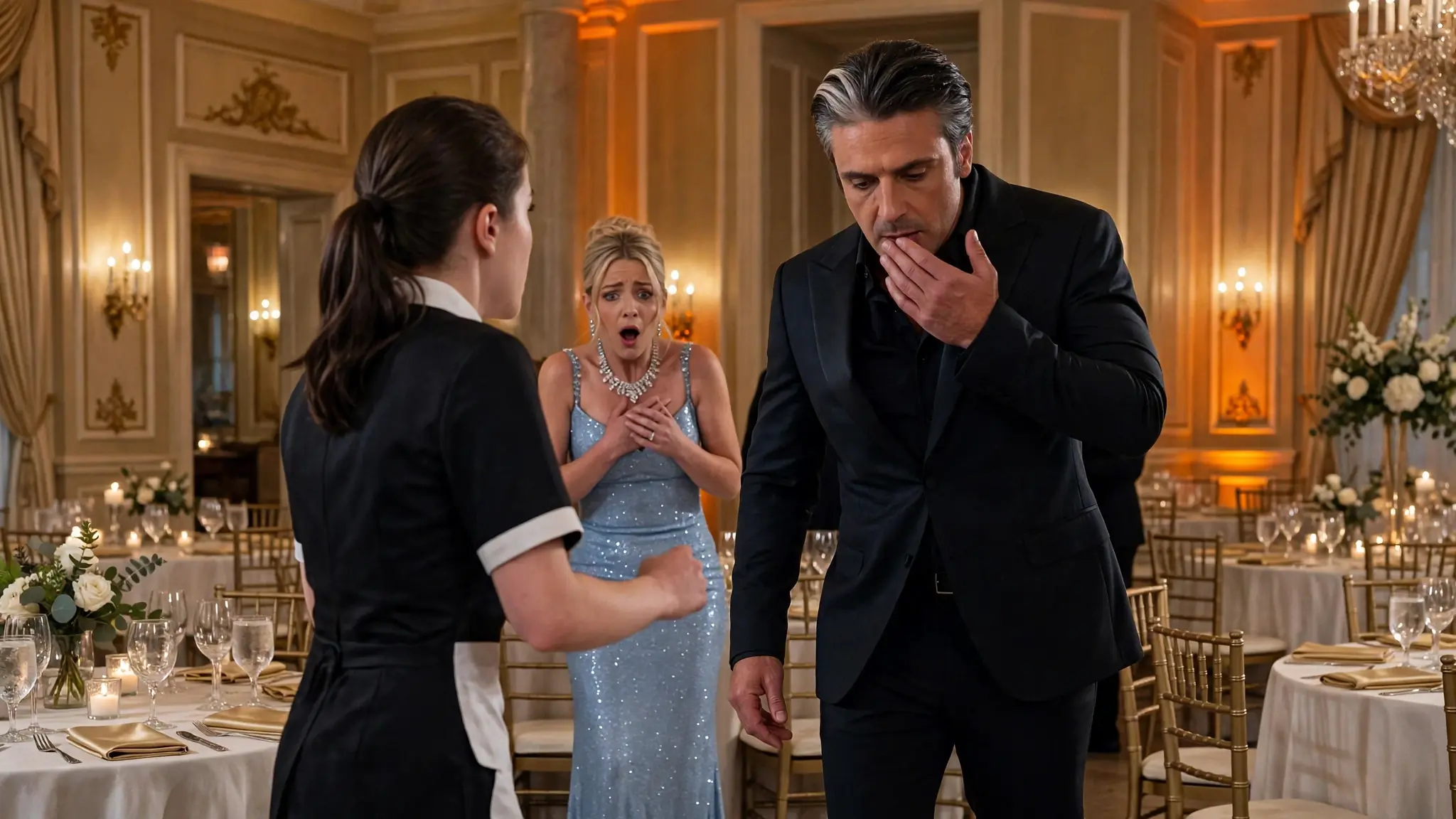
The ballroom glowed gold that night, the kind of warm, expensive gold that made the chandeliers look like they were holding their breath and made the marble floor shine like still water. The air smelled of lilies and champagne and roasted food and perfume, and the low hum of a hundred conversations rose and fell like music that no one was really listening to. Men in black tuxedos stood in small groups with glasses in their hands, talking about money in the bored, confident voices of people who had never worried about it. Women in long dresses of pale blue and black and silver moved slowly between the tables, their jewellery catching the light every time they turned, their smiles bright and practised, their eyes always watching. Waiters moved between them like shadows, silent and careful, carrying trays, clearing glasses, trying to be useful without ever being noticed, because in a room like this, being noticed was the most dangerous thing a person in uniform could do.
Lily Moreno was trying very hard not to be noticed. She was twenty-three years old, and she wore the uniform of the house staff, a black dress with a white Peter Pan collar, white cuffs, and a white apron tied neatly at her waist, a uniform that had been designed to make the person inside it disappear. Her brown hair was pulled back into a bun, a few loose strands escaping around her face because she had been working since four in the afternoon and it was now nearly nine, and her feet ached in her flat black shoes, and her hands were dry from washing glasses, and yet she moved through the ballroom with a care that came from a lifetime of learning how to be quiet in rooms where other people were loud. She carried a small silver tray with two glasses of champagne, held steady at shoulder height, her eyes fixed on the table ahead of her, her steps measured, her breathing slow. She had done this a hundred times before. She knew to watch for chairs pushed back without warning, for guests who stepped sideways without looking, for elbows that swung out in the middle of a story. She knew that one small mistake, one spilled glass, one broken piece of crystal, could cost her a job she could not afford to lose, and she carried that knowledge with her the way other people carry a wallet, close to her body, always aware of its weight.
She did not see Alexander Kane until it was too late, because he had turned at exactly the wrong moment, because the room was crowded, because fate, when it wants to change a life, does not always announce itself with thunder, sometimes it announces itself with a single, ordinary step. Alexander Kane was forty-eight years old, tall and broad, his hair black with a thick streak of silver at the front, swept back from his forehead, his face lined and handsome in the way of men who have survived things that should have broken them, his black suit perfectly tailored, his black shirt open at the collar, a glass of champagne in his right hand. He had been standing near the centre of the room, talking to a woman in a pale blue sequinned dress, listening with only half his attention, his eyes already tired from an evening of small talk, when he turned, sharply, to answer a question from someone behind him, and his shoulder met Lily's tray with a force that neither of them expected. The tray tilted. The glasses slid. Time did not slow down the way it does in films. It sped up, cruelly fast. One glass fell, struck the marble floor, and shattered, the sound sharp and bright and final, like a small explosion, and champagne spread across the pale stone in a thin, golden pool, catching the chandelier light, glittering with broken crystal. The second glass wobbled, then steadied in Lily's hand, and for one frozen second, the whole ballroom seemed to hold its breath, waiting to see what would happen next, waiting to see who would be blamed, waiting to see who would speak first.
Lily froze. Her mouth opened, but no sound came out. Her hands were shaking so hard she had to set the tray down on a nearby table before she dropped the other glass as well. She looked at the broken glass on the floor, at the champagne pooling around the shards, at the guests who had turned to stare, and then she looked at Alexander Kane, and her heart stopped, because he was not looking at the floor, he was looking at his own hand, at his own mouth, with an expression of pure shock, an expression she had never seen on a powerful man's face before. He raised his left hand slowly to his lips, touched them with his fingertips, and when he pulled his hand away, there was blood on his fingers, a thin, dark line of blood, bright against his pale skin. A shard of crystal, small and sharp as a needle, had caught him as the glass broke, cutting the corner of his mouth, and the blood was already beginning to trickle, slow and steady, down toward his chin. He stared at the blood as if he could not believe it, as if blood were something that happened to other people, to weaker people, to people who could be hurt, and for a moment, the most powerful man in the room looked completely, utterly human, completely, utterly vulnerable, completely, utterly alone.
The woman in the pale blue dress gasped, her hands flying to her chest, her mouth open in shock, her eyes wide. Guests nearby whispered, then fell silent. A waiter froze with a tray in his hands. The orchestra, somewhere in the corner, faltered, then stopped, the music dying away into an awkward, echoing quiet that made the ballroom feel suddenly too large, too bright, too exposed. Lily felt her face burn with shame and terror, felt tears fill her eyes, felt her whole body tremble with the knowledge that she had just, accidentally, hurt a man who could destroy her life with a single phone call, a man whose name was spoken in the staff room in whispers, a man who owned this hotel, this ballroom, this city, or so the other maids said when they thought no one was listening. She began to apologise, her voice shaking, her words tumbling over each other, her hands pressed together in front of her chest as if in prayer. "I am so sorry, sir, I am so sorry, I did not see you, please, I am so sorry, I will clean it, I will pay for the glass, please, do not fire me, please."