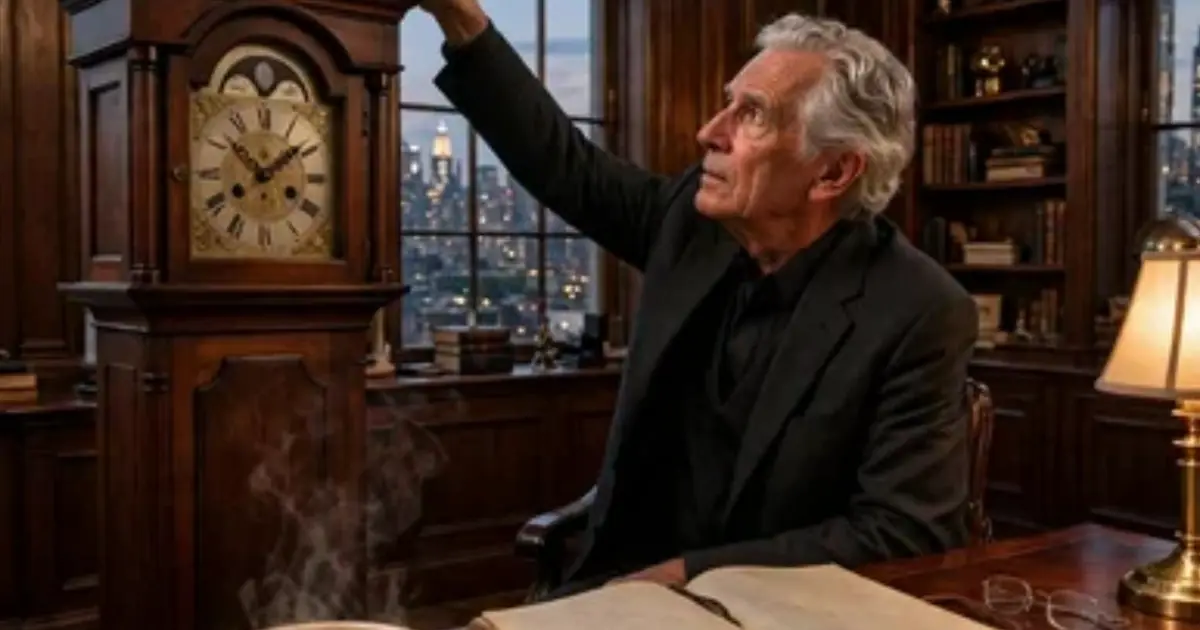
Charles Sterling stood at the tall window of the west wing study and watched the last light leave the garden below. He was seventy two years old, chairman of a company he had built from a single desk and a borrowed telephone, and he had learned long ago to trust the quiet unease that came to him in the evening when the house grew still. The unease had been with him for three weeks, ever since the London books had arrived on his desk in a thick leather binder and he had opened them after dinner and read them line by line until the lamps burned low. Something in the figures did not sit right. Something in the neat columns and the careful totals told him that a hand he knew well had been moving money through places where it did not belong, and that the hand belonged to his own daughter.
He turned from the window and looked around the study, a room he loved for its dark wood and its shelves of old volumes and its smell of cedar and paper and time. The grandfather clock stood against the far wall, tall and solemn, its brass face catching the lamplight, its pendulum swinging with a steady rhythm that had measured the hours of his marriage and his children and his long working life. Eleanor had loved that clock. She had wound it every Sunday morning with a small brass key, and she had told Charles that a house needed one sound it could always rely on, one steady tick. She had been gone for two years now, and Charles still wound the clock himself on Sunday mornings, and he still listened for its tick when he woke in the night and could not sleep.
On the desk behind him lay the London books, closed now, their binder fastened, their pages marked with small slips of pale paper where he had found the entries that troubled him. He had not spoken of them to anyone. He had not called his son Marcus, who was thirty four and loyal and quick to anger, and he had not called his daughter Victoria, who was thirty seven and clever and hungry for power in a way that frightened him more with each passing year. He had not called Dr. Evans, his old friend and physician, and he had not called any member of the board. He had sat alone with the figures and he had thought, and the thinking had led him to a single hard conclusion. He could not prove what he suspected with figures alone, and he could not accuse his own daughter on suspicion alone, and he could not wait for the next set of books to arrive and tell him the same story in a louder voice. He needed to see. He needed to watch his own house with his own eyes, even if the watching broke his heart.
The small black camera sat in the top drawer of his desk, wrapped in a soft cloth, no larger than a matchbox, its lens no wider than a coin. He had bought it himself that morning from a small shop on Madison Avenue, paying with a card and asking no questions and answering none, and the young man behind the counter had shown him how the camera streamed to a telephone and how the stream saved itself to a distant store of memory in the sky, a cloud, where it would wait even if the camera itself were found and smashed. Charles had listened carefully and he had nodded and he had carried the camera home in his coat pocket, feeling its small weight against his chest like a secret he had not yet decided to keep.
Now, in the quiet of the evening, he took the camera from the drawer and unwrapped it and held it in his palm. It was lighter than he expected, smooth and cool, and its lens glinted in the lamplight. He walked to the grandfather clock and stood before it, listening to its tick, and he looked for a place where the camera could sit and see the room without being seen. The top of the clock was broad and flat, crowned with carved wood, and behind the carved crest there was a shallow hollow where dust gathered and where no eye ever looked. He set the camera there, angling its lens toward the door and toward the desk and toward the chair where he sat each evening with his tea. He stepped back and looked. From the doorway, from the desk, from the chair, the camera was invisible, a small black shape lost against the dark wood. Only a man who knew it was there would ever find it, and Charles intended to tell no one.
He took his telephone from his pocket and opened the small program the young man in the shop had shown him, and the screen filled with the study as the camera saw it, the desk and the chair and the door and the clock face below, all in clear colour, all in steady light. He watched his own hand move across the screen as he raised it, and he felt a strange cold settle in his chest, because he was now a man who watched his own home, and a father who watched his own daughter, and he did not know which of the two hurt more. He pressed a small button and the program told him that the stream was live and that the recording was saving itself far away, where no hand in this house could reach it and erase it. He put the telephone away and stood for a long moment with his hand resting on the clock, feeling its tick travel up through the wood into his palm, steady and patient, like a heart that had never learned to lie.
Eleanor would have understood, he thought, and then he corrected himself, because Eleanor had understood long before he had. She had seen the recklessness in Victoria when Victoria was still a girl, the way she reached for what she wanted and called it her right, the way she smiled when she was caught and called the smile an apology. Eleanor had kept the voting rights with Charles in her own will, a separate will she had written in her own hand and sealed with her own seal, because she had known that Victoria was reckless with power and that power in Victoria hands would be used like a hammer, quickly and without mercy. Charles had thought at the time that Eleanor was too harsh, that a mother should trust her daughter, that time would soften the girl. Time had not softened her. Time had sharpened her, and the London books were the proof of the sharpening, written in figures that did not lie even when people did.
The house was quiet around him. Somewhere downstairs a door closed softly, and somewhere upstairs a floorboard creaked, and the clock ticked on, measuring the evening in small even beats. Charles walked back to his desk and sat down and opened the London books once more, not to read them again, but to look at the small slips of paper he had placed between the pages, each one marking a place where the figures bent in a direction they should not have bent. He touched each slip with a fingertip, as if touching the evidence could make it less true, and then he closed the binder and fastened it and set it aside.
He stood and crossed to the window again and looked out at the garden where Eleanor had once grown herbs in neat rows, and he thought about the years when his children had been small and the house had been loud with their voices, and he wondered when exactly the loudness had turned into silence, and when the silence had turned into suspicion. He could not name the day. He could only name the feeling, and the feeling was that something in his house had changed, and that the change had a name, and that the name was Victoria, and that Victoria wanted the chair he sat in, and the company he led, and the power that came with both, and that she wanted them now, not later, not after his death, not in the natural order of things, but now, while he still lived and breathed and held the voting rights Eleanor had left in his hands.
A knock sounded at the door, soft and polite, and Charles turned as Victoria herself stepped into the study, tall and elegant in a dark dress, her hair swept back, her smile bright and practised. She carried no papers and no binder, only a small cup of tea on a saucer, and she set it on the desk beside him with a care that looked like love and felt like theatre. "Father," she said, "you have been working too late again. I brought you chamomile. Drink it while it is warm." Charles thanked her and lifted the cup and smelled the steam, sweet and floral, and he smiled at her, and he said nothing about the camera on the clock, and nothing about the London books, and nothing about the slips of paper between the pages. He drank the tea slowly, and Victoria watched him drink, and the clock ticked behind them both, and the small black camera watched them both, and no one in the room knew that the watching had begun except the man who had set it in motion.
Victoria stayed a little while, talking of the office and of a meeting the next day and of a client who needed an answer by noon, and Charles listened and nodded and answered in the calm voice he had used for forty years in boardrooms, and all the while he was thinking of the camera and of the London books and of Eleanor and of the long road that had brought a father to the point of watching his own daughter in his own house. When Victoria left, closing the door softly behind her, Charles sat alone in the lamplight and finished his tea and set the cup down, and he looked up at the grandfather clock and at the dark hollow behind its carved crest, and he felt the cold settle deeper in his chest, because he knew that the tea tonight had been only tea, and that the night when it would not be only tea was coming, and that he would be ready for it, and that readiness was the only gift he had left to give himself.