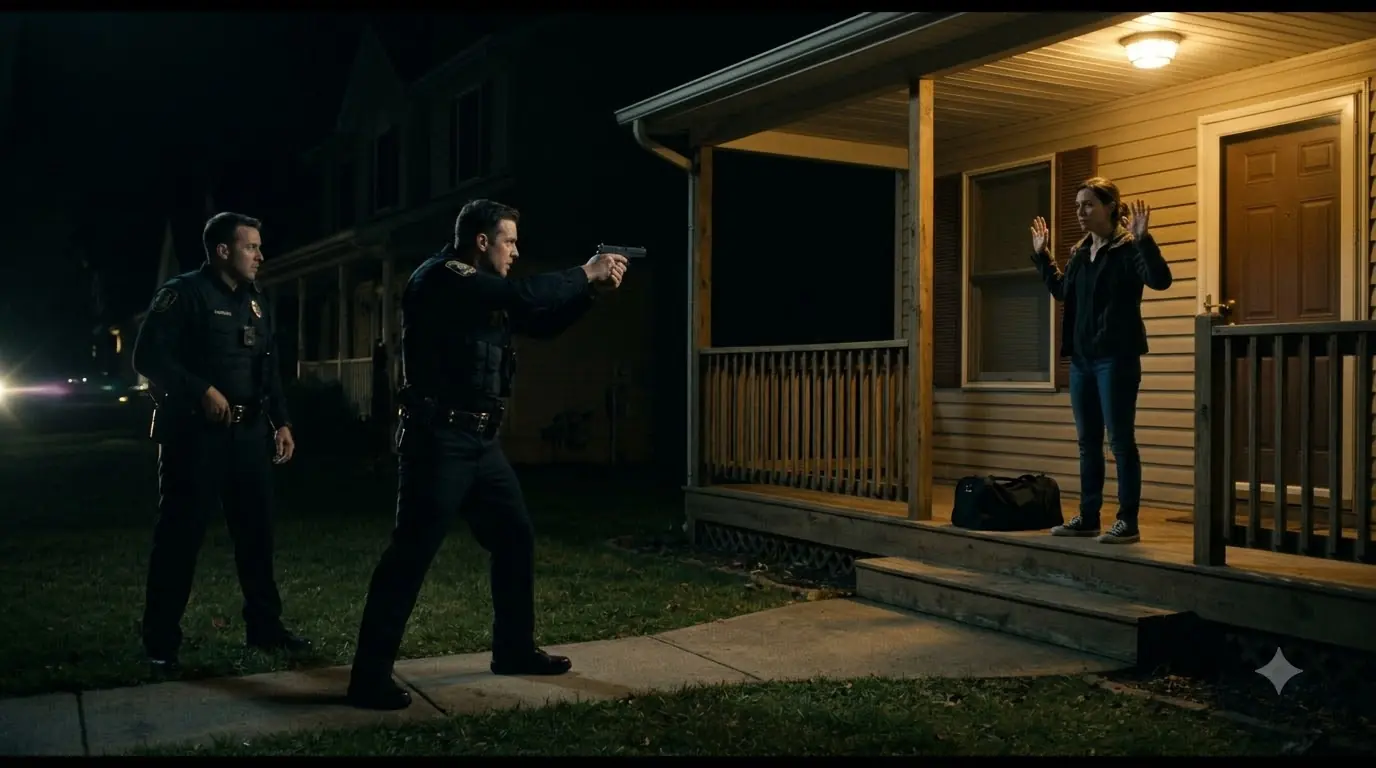
THE BADGE THEY REFUSED TO RECOGNIZE
A Story of Justice, Courage, Betrayal, and the Truth Behind a Uniform
CHAPTER 1: THE WOMAN AT THE DOOR
The night was unusually quiet when a dark vehicle pulled into the driveway of a beautiful suburban house. The streetlights flickered above the empty road, and a cold wind moved through the trees. A woman stepped out of the vehicle, carrying a black leather bag. She wore a dark jacket, her hair neatly tied behind her head, and her expression revealed nothing about the thoughts running through her mind. Before she could reach the front entrance, two police vehicles arrived. Three officers quickly surrounded her. Leading them was Sergeant Richard Hayes, a veteran officer known throughout the department for his intimidating personality and unquestioned authority. He raised his hand and ordered the woman to stop. She calmly turned around, surprised but not frightened. Hayes demanded that she identify herself and explain why she was standing outside a private residence so late at night. The woman slowly reached toward her jacket, but Hayes immediately became suspicious. He shouted at her to keep her hands visible. She stopped moving and looked directly into his eyes. “Officer, I believe there has been a serious misunderstanding,” she said quietly. Hayes ignored her explanation. He had already decided that she was a potential threat, and nothing she said seemed capable of changing his mind.
CHAPTER 2: AN ORDER WITHOUT AN EXPLANATION
Sergeant Hayes stepped closer, his hand resting firmly on his weapon. His younger partner, Officer Daniel Brooks, watched nervously from several feet away. He noticed that the woman was unusually calm for someone surrounded by armed officers. Hayes demanded that she explain her connection to the property. She replied that she had come to speak with the homeowner about an urgent matter involving an ongoing investigation. Instead of listening, Hayes accused her of making excuses. He asked whether she had permission to be there and whether she was carrying anything dangerous. The woman answered every question patiently, refusing to raise her voice. “I understand that you have responsibilities, Sergeant, but you need to verify who I am before making assumptions.” Those words irritated Hayes. He believed that criminals often used confidence and carefully chosen language to manipulate police officers. He ordered her to turn around and place her hands behind her back. Daniel hesitated, sensing that something about the situation did not feel right. Before anyone could move, the woman warned them that reaching for her identification would be easier if they allowed her to explain what she was carrying. Hayes interpreted the warning as a challenge. His frustration began turning a routine encounter into something far more dangerous.
CHAPTER 3: THE IDENTIFICATION THAT CHANGED EVERYTHING
The woman slowly reached into the inside pocket of her jacket after receiving permission to move. She removed a small leather case and carefully opened it. Inside were official identification cards bearing her photograph and the seal of a federal law enforcement agency. She held them where the officers could see them. “My name is Agent Emily Carter. I am assigned to a federal investigation, and I am here on official business.” Daniel leaned forward, trying to read the identification. Hayes, however, refused to lower his weapon. He demanded that she hand over the cards so he could examine them. Emily calmly explained that the documents were genuine and that her supervisor could verify her identity through official channels. She even offered to provide the case number. But Hayes had already made up his mind. He claimed that anyone could carry a convincing fake badge. Daniel noticed the photograph, the official markings, and the professional identification format. Something about it appeared legitimate. He quietly suggested that they verify the information before escalating the situation. Hayes turned toward him angrily and told him to follow orders. Emily watched the exchange in silence. She realized that the greatest danger that night might not come from the investigation she was conducting, but from the people who were supposed to uphold the law.
CHAPTER 4: THE SERGEANT’S PRIDE
Richard Hayes had spent more than twenty years wearing a police uniform. During that time, he had arrested hundreds of suspects, received several commendations, and developed a reputation as a man who never backed down. His colleagues respected his experience, but some privately believed that his confidence had slowly transformed into arrogance. Hayes could not tolerate being questioned, especially in front of younger officers. When Emily presented her identification, he felt that she was attempting to undermine his authority. He told her that a badge did not give anyone the right to ignore local police instructions. Emily agreed that every officer had responsibilities, but reminded him that professional cooperation was essential when federal and local investigations overlapped. Her calm response made him even angrier. He ordered Daniel to take her bag and search the vehicle. Daniel hesitated again. He asked whether they should contact their supervisor first. Hayes responded with a sharp warning about insubordination. Meanwhile, Emily recognized the name on Hayes’s uniform. She had encountered it in confidential investigative documents, although she did not yet know whether the connection was meaningful. She decided not to reveal what she knew. Instead, she asked Hayes one simple question: “Sergeant, are you absolutely certain you want to handle this situation without contacting your department commander?”