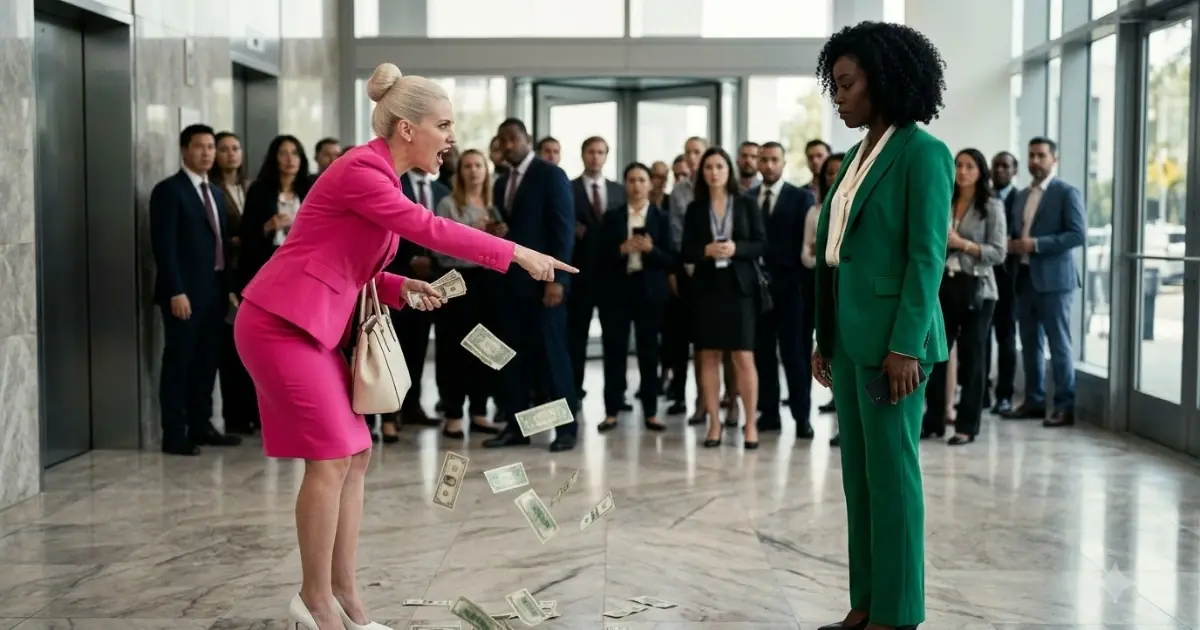
The first dollar bill landed against Angela Brooks’s shoe.
The second fluttered across the polished marble floor.
Then came a handful more, scattering beneath the crystal chandeliers of one of Manhattan’s most prestigious corporate headquarters.
“Go ahead,” the blonde woman said, smiling as though she had just told the funniest joke in the world. “Pick it up. That’s probably more money than you make in a week.”
A few people laughed nervously.
Others looked away.
Angela stood perfectly still, her emerald-green pantsuit immaculate, her black curls framing a face that betrayed almost nothing. She held a slim leather portfolio in one hand and watched the money settle around her feet.
Across from her, Vanessa Whitmore adjusted the sleeves of her hot-pink designer blazer.
Vanessa was forty-six, wealthy by marriage, and accustomed to being treated as though every room she entered belonged to her. Her platinum-blonde hair was arranged in an elaborate bun, her diamond earrings glittered beneath the lobby lights, and her expression carried the effortless cruelty of someone who had rarely been told no.
“Did you hear me?” Vanessa demanded. “Or do I need to explain it more slowly?”
Angela looked down at the scattered bills.
Then she raised her eyes.
“I heard you perfectly.”
Vanessa gave a short, contemptuous laugh.
“Well, then. What are you waiting for?”
Angela’s voice remained calm.
“I’m waiting to see how far you're willing to go.”
Vanessa threw back her head and laughed.
She had no idea that those eleven words would mark the beginning of the worst day of her professional life.
And she certainly had no idea who the woman standing in front of her really was.
Three hours earlier, Angela had been sitting at the kitchen table of her childhood home in Brooklyn, drinking coffee from a chipped blue mug that had belonged to her mother.
The house was small compared with the penthouses and luxury residences she could easily afford. Its wooden floors creaked, the kitchen cabinets were older than most of her employees, and the little garden outside still contained the rosebushes her father had planted nearly thirty years earlier.
Angela loved every inch of it.
Her mother, Evelyn Brooks, had died six years before, but the house remained full of her presence. There were recipe cards written in her careful handwriting, photographs of family birthdays, and a faded yellow curtain Evelyn had insisted made the kitchen feel cheerful even during the coldest New York winters.
On the refrigerator, held in place by a small magnetic butterfly, was a photograph of Angela at twelve years old.
She was standing beside her mother outside a downtown office building.
Evelyn wore a plain navy cleaning uniform and carried a canvas lunch bag.
Angela wore a school uniform and a smile wide enough to light up the entire picture.
Her mother had cleaned offices for nearly twenty-five years.
Every evening, while executives went home to comfortable houses and expensive dinners, Evelyn emptied their trash cans, scrubbed their conference tables, and polished the floors beneath their feet.
She had never considered the work beneath her.
But some of the people whose offices she cleaned certainly had.
Angela remembered one winter evening when she had accompanied her mother to work because the school heating system had broken and classes had been dismissed early.
She had been ten years old.
An executive carrying a leather briefcase stepped out of an elevator and nearly collided with them.
He looked at Evelyn’s uniform, then at Angela.
“Employees shouldn’t bring their children into professional spaces,” he said sharply.
Evelyn apologized, although Angela knew her mother had done nothing wrong.
The man walked away without looking back.
Later, while they were riding the subway home, Angela had asked a question she had carried inside her ever since.
“Mom, why did he talk to you like that?”
Evelyn had smiled sadly.
“Because some people mistake a job title for a measure of a person's worth.”
“But you work harder than he does.”
“Maybe I do, baby. But that's not the point.”
“Then what is?”
Her mother had taken her hand.
“The point is that every person deserves respect before anyone knows their name, their money, or what they do for a living.”
Angela had never forgotten those words.
She carried them through college, through business school, through twenty-hour workdays, and through every rejection she encountered while building a small technology consulting firm into a national corporation.