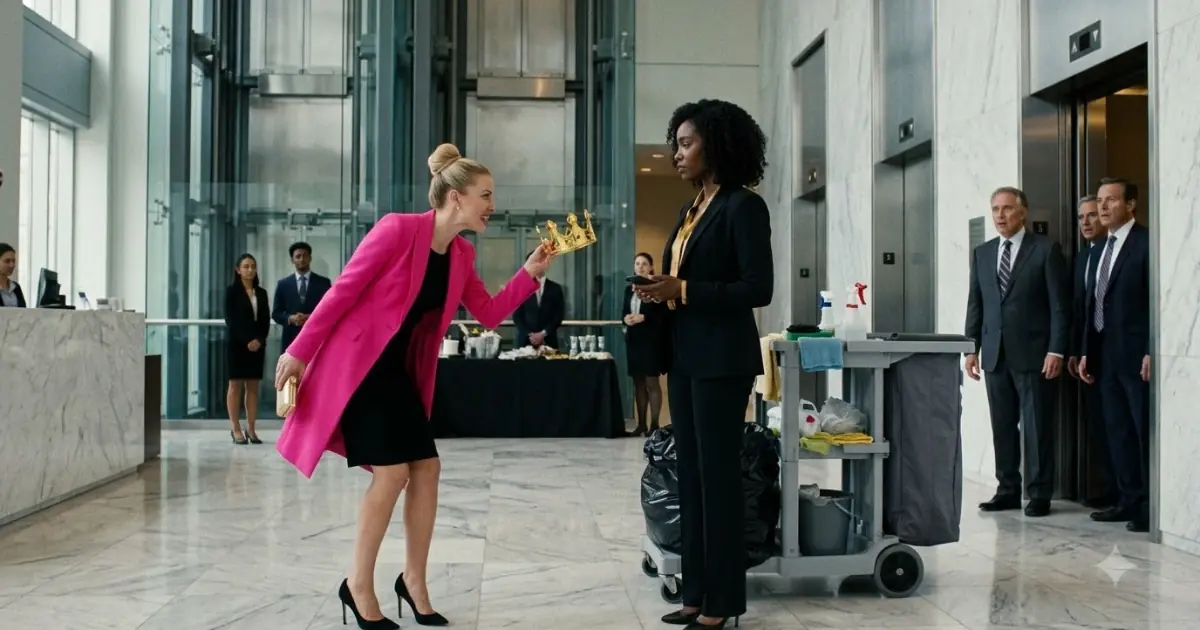
At 8:47 on a Monday morning, the lobby of Halston & Pierce looked exactly the way its architects had intended it to look: expensive, controlled, and intimidating.
Sunlight poured through two-story glass walls and spilled across polished stone floors. Employees in tailored suits crossed the lobby with coffee cups in one hand and phones in the other. Visitors paused beneath a massive silver company logo while receptionists checked names against appointment lists. Somewhere behind the security desk, a printer hummed steadily. Elevator bells chimed every few seconds as people disappeared toward offices on the upper floors.
Everything seemed perfectly ordinary.
No one in that lobby knew that within minutes, one woman's career would begin to collapse because of a single assumption.
Near the eastern elevators stood Dr. Naomi Brooks.
She was thirty-nine years old, tall, composed, and dressed in a black tailored suit over a soft beige blouse. Her dark hair framed her face neatly. She wore no flashy jewelry, only a thin gold necklace and a simple watch. In one hand she held her phone. In the other was a small leather portfolio.
Naomi had learned long ago that people often mistook calmness for weakness.
She had also learned that correcting every person who underestimated her was exhausting.
So she had developed another habit.
She watched.
She listened.
And she allowed people to reveal themselves.
That morning, Naomi had arrived earlier than almost everyone expected.
There was a reason for that.
For the previous eleven months, Halston & Pierce had been undergoing the largest internal restructuring in its forty-three-year history. The company had once been considered one of the most respected corporate consulting firms in the country, but the previous three years had been difficult. Several major clients had left. Employee turnover had increased. Two internal investigations had uncovered serious management problems.
The board wanted change.
Not cosmetic change.
Real change.
That was why, six weeks earlier, the board had unanimously selected Naomi Brooks to become the company's new chief executive officer.
The announcement had not yet been made publicly.
Only the board, the legal department, and a small group of senior executives knew.
To the rest of the company, Naomi Brooks was still just a name whispered in meetings.
Some employees had searched for her online. Others had heard rumors about her career. She had spent twelve years turning around struggling organizations. She had a reputation for being disciplined, demanding, and unusually attentive to company culture.
She believed financial problems could be repaired with strategy.
Broken cultures were harder.
A company could have beautiful offices, impressive clients, and polished mission statements while still being rotten inside.
Naomi wanted to know which kind of company she was inheriting.
So she had asked the board for something unusual.
Before her official introduction, she wanted to spend one morning walking through the building without an entourage.
No photographers.
No welcome committee.
No executive assistant announcing her arrival.
She wanted to see how people behaved when they did not know the CEO was watching.
The board chairman had laughed when she suggested it.
“You're conducting an undercover inspection?”
“Not exactly,” Naomi had replied.
“What are you looking for?”
“Character.”
That answer had ended the conversation.
Now, standing in the lobby, Naomi was beginning to understand why the board had been so eager for cultural change.
A cleaning cart stood several feet away from her.
Its owner, an older maintenance employee named Rosa Martinez, had stepped into a nearby supply room to retrieve replacement trash bags. The cart held folded cloths, spray bottles, paper towels, and a yellow caution sign.
Naomi barely noticed it.
Someone else did.
Her name was Claire Whitmore.
Claire was forty-one and served as vice president of client relations.
She entered the lobby like someone who believed the building belonged to her.
Her bright pink blazer immediately caught attention. Beneath it she wore a fitted black dress and high heels that clicked sharply against the marble floor. Her hair was twisted into a precise bun, and she carried a designer handbag tucked beneath one arm.
Claire was good at being noticed.
It was one of the reasons she had risen quickly.
She remembered important clients' birthdays. She knew which executives preferred whiskey and which preferred wine. She could transform her voice from warm to authoritative in half a second.