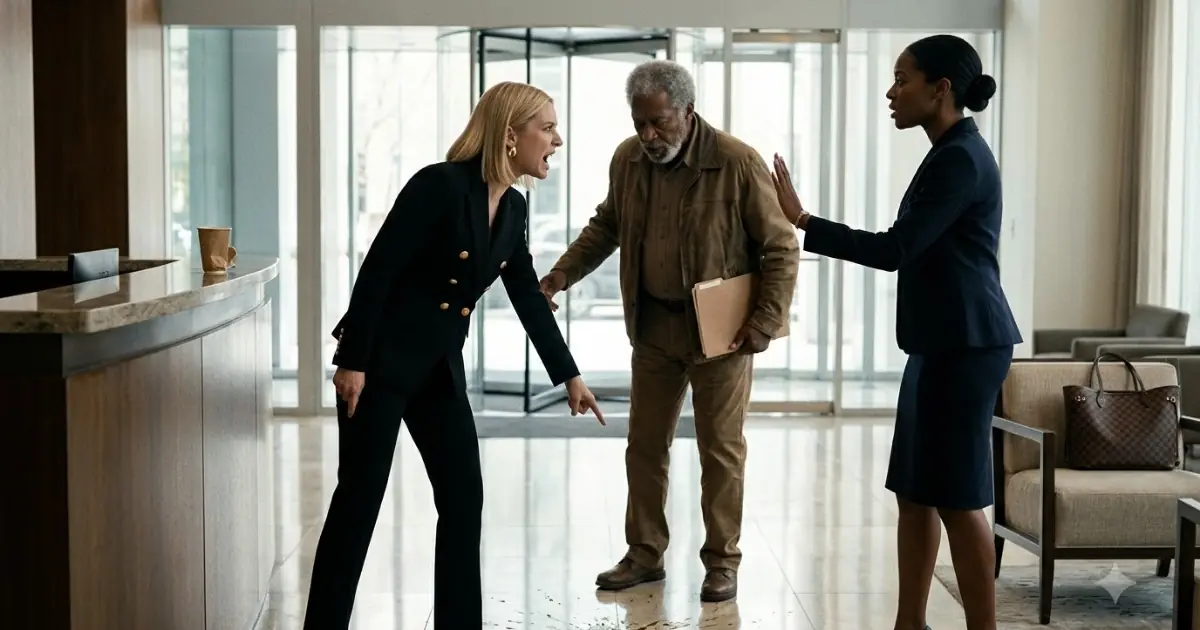
“The cleaning crew waits outside.”
The words cut through the elegant lobby of Whitmore & Hayes like a knife through silk.
Eleanor Price didn't lower her voice. She didn't glance around to see who might be listening. In fact, judging by the satisfied little smile forming on her lips, she seemed perfectly pleased that other people could hear her.
Standing before her was an older Black man wearing a faded tan jacket, a pale blue shirt, and trousers that had clearly seen better days. His thick gray beard was neatly trimmed, but his shoes were worn, and the leather briefcase beneath his arm looked as though it had survived several decades of hard use.
The man had done nothing to attract Eleanor's attention.
He had simply walked through the glass doors of the towering corporate headquarters, paused beside the reception desk, and asked a question.
That was enough.
Eleanor, thirty-two years old and wearing a sharply tailored black designer blazer with polished gold buttons, had immediately decided that he didn't belong there.
“Excuse me?” the man asked.
His voice was quiet, almost gentle.
Eleanor tilted her head with exaggerated patience.
“I said the cleaning crew waits outside. Employees use the service entrance. This is the executive lobby.”
For a moment, the man simply studied her.
He was perhaps seventy, with weathered features, thoughtful brown eyes, and the kind of upright posture that suggested a lifetime of discipline. There was no anger in his expression.
Only curiosity.
“And what makes you think I'm part of the cleaning crew?” he asked.
Eleanor's smile tightened.
“Sir, I'm trying to help you avoid an embarrassing situation.”
She gestured toward his jacket.
“This building hosts important corporate meetings. People are expected to present themselves appropriately.”
The older man looked down at his clothes.
Then he looked back at her.
“I see.”
He said nothing more.
To Eleanor, his silence was confirmation that she had been right.
She turned away, straightening the lapel of her blazer as though she had just performed a public service.
What she didn't know was that the man standing before her had personally approved the architectural plans for the building twenty-three years earlier.
He had paid for the marble beneath her expensive heels.
He had helped establish the company whose name appeared in silver letters above the reception desk.
And within the next hour, he would be deciding whether Eleanor Price deserved one of the most powerful executive positions in the organization.
But the morning had begun long before Eleanor stepped into that lobby.
At five fifteen, while most of the city remained asleep, Samuel Bennett was sitting at the small kitchen table of his modest brick house on the outskirts of Philadelphia.
A cup of black coffee rested beside his elbow.
Rain tapped lightly against the kitchen window.
On the table lay a photograph of his late wife, Margaret, standing in front of their first little business office in 1983.
She wore a yellow dress, had one hand resting on her hip, and was laughing at something outside the frame.
Samuel touched the corner of the photograph.
“Another big day, Maggie,” he murmured.
The kitchen was quiet enough that he could hear the old refrigerator humming.
Margaret had been gone for six years.
Even now, he sometimes reached for a second coffee mug before remembering there was no one to drink from it.
They had been married for forty-one years.
During that time, they had raised two children, buried their parents, survived financial disasters, celebrated unexpected victories, and built a company that neither of them could have imagined when they were young.
Samuel had started with almost nothing.
His father had worked at a steel mill until a workplace accident left him unable to continue. His mother cleaned offices at night and took in sewing during the day.
There had been winters when the family couldn't afford proper heating.
Samuel remembered watching his mother warm bricks in the oven and wrap them in towels so the children could sleep with something warm near their feet.
He remembered his father's hands, rough and scarred, teaching him to repair broken furniture rather than throw it away.
And he remembered one particular conversation when he was fourteen.
His mother had returned home after midnight, exhausted from cleaning a downtown office building.
A young executive had accused her of stealing a missing fountain pen.
The pen was later discovered inside the executive's own briefcase.
No apology followed.
Samuel had watched his mother remove her work shoes and silently massage her swollen feet.
“Why didn't you tell him he was wrong?” he asked.
His mother looked at him for a long moment.