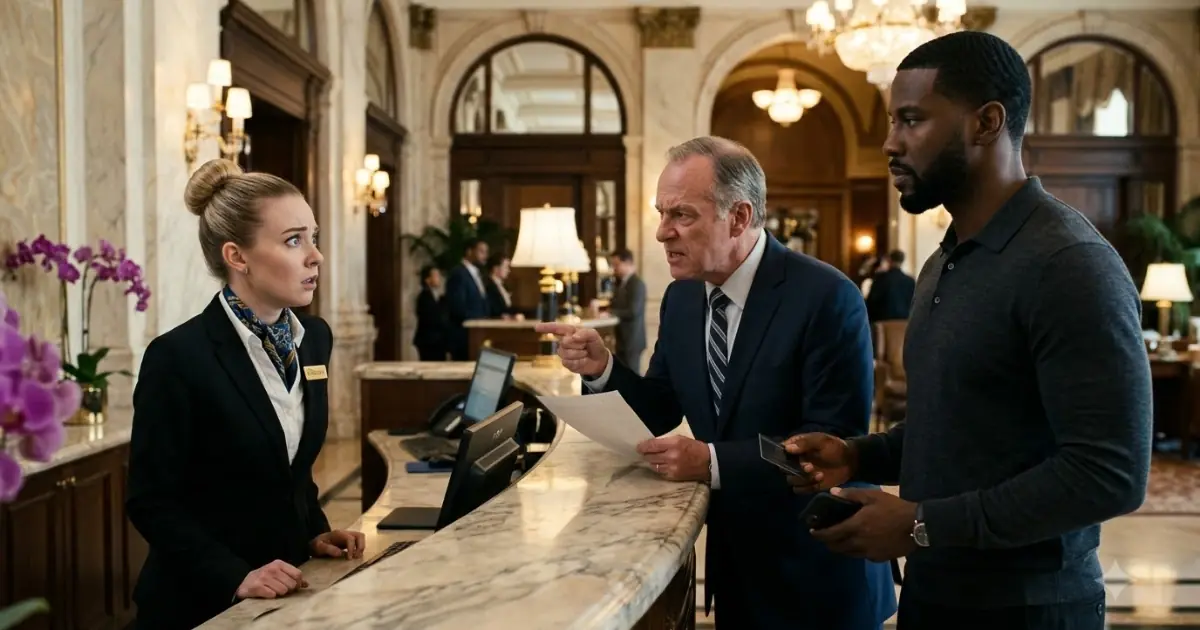
The moment Vanessa Whitmore pointed her perfectly manicured finger at the Black man standing across the marble reception desk, she had no idea that the next few minutes would destroy everything she believed about power, privilege, and the people she thought she could humiliate without consequences.
“Nice card,” she sneered, holding his identification between two fingers as though it were something dirty. “Did it come with the costume?”
Her voice carried across the magnificent lobby of the Grand Wellington Hotel, a five-star establishment where wealthy executives, celebrities, and international investors paid thousands of dollars for the privilege of being treated like royalty.
Several guests turned their heads.
A young couple stopped beside the elevators.
An elderly woman sitting near the fireplace slowly lowered her newspaper.
The man standing before Vanessa did not raise his voice.
He did not insult her.
He did not even appear surprised.
He simply looked into her eyes and asked two words.
“Your name?”
Vanessa straightened her black blazer, lifted her chin, and smiled with the confidence of someone who had never seriously considered the possibility that she might be wrong.
“Vanessa,” she replied sharply. “Now leave before I call security.”
Behind her, a distinguished silver-haired gentleman in an expensive navy suit stopped walking.
He had heard every word.
His name was Richard Bennett, and what Vanessa did not know was that he had spent the previous eighteen months negotiating a business agreement that could determine the future of the entire hotel.
He approached the reception desk slowly.
“Vanessa,” he said, his voice dangerously quiet, “what did you just say to him?”
For the first time that morning, Vanessa's confident expression faltered.
But the real shock had not yet arrived.
Richard turned toward his assistant, who had followed him into the lobby carrying a leather portfolio.
“Tell the board,” he said, “the deal is off.”
The words fell into the room like shattered glass.
Vanessa blinked.
The assistant froze.
And the Black man standing at the counter finally placed his identification card back into his wallet.
To understand why those few words carried such devastating consequences, one would have to go back several hours, to a quiet morning on the other side of the city, where a man named Daniel Carter had begun his day with a promise he had made to his mother many years earlier.
Daniel was thirty-eight years old, broad-shouldered, quietly spoken, and accustomed to being underestimated.
He lived in a modest brick house in a peaceful neighborhood outside the city, although he could easily have afforded something far grander.
His driveway contained an eight-year-old sedan.
His kitchen table had a small scratch near one corner.
And every morning, before leaving for work, he drank coffee from a chipped blue mug that his daughter had painted for him when she was six.
There were no marble statues in his entrance hall.
No expensive paintings.
No private gates.
Daniel had learned long ago that wealth could purchase comfort, but it could never purchase character.
That morning, he stood at his kitchen counter reading a message from his attorney.
The message concerned the Grand Wellington Hotel.
For nearly two years, Daniel's investment company had been considering a major partnership with the hotel group. The proposed agreement involved renovating several historic properties, expanding employment opportunities, and creating a hospitality training program for young people who had grown up without financial advantages.
The Grand Wellington was supposed to become the flagship property.
If everything went according to plan, the agreement would be announced that afternoon.
Daniel had requested one final visit before the signing.
Not a ceremonial tour.
Not a champagne reception.
Not a carefully staged meeting with executives who knew exactly who he was.
He wanted to see the hotel as an ordinary guest might see it.
He had made similar visits to dozens of businesses over the years.
He believed that an organization's true character was revealed not by its advertisements or polished mission statements, but by the way its employees treated people who appeared to have nothing to offer them.
His late mother had taught him that lesson.
Her name was Evelyn Carter.
She had worked as a hotel housekeeper for twenty-six years.
When Daniel was a boy, he sometimes waited for her after school in the employee entrance of a downtown hotel.
He remembered the smell of cleaning supplies on her uniform.
He remembered how tired her hands looked after a twelve-hour shift.
And he remembered one particular evening when a wealthy guest had accused her of stealing a gold bracelet.
The woman had shouted at Evelyn in front of other employees.