CHAPTER 1: THE WOMAN AT THE KITCHEN ISLAND
Ruth Bennett knew the sound of her own front door better than she knew the sound of her own voice. For forty-three years it had complained softly when the weather turned damp. Her husband, Samuel, had promised to repair its hinges every autumn and forgotten every winter. After he died, Ruth left them alone. Their small complaint reminded her that a house could remember people long after their photographs began to fade.
On Thursday morning, the door was silent. Someone had replaced the hinges without asking her. That was the first warning. The second was finding her blue ceramic sugar bowl in the garbage, cracked beneath a stack of expensive grocery packaging. The third was the expression on her daughter-in-law's face when Ruth walked into the kitchen.
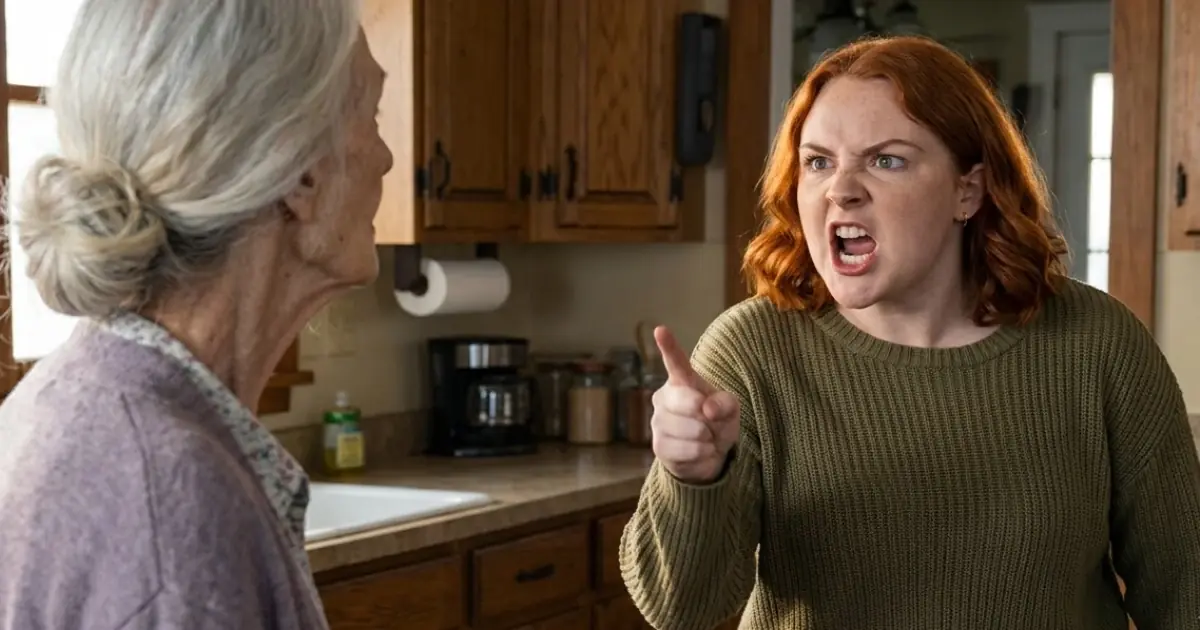
"We need to discuss your living arrangements," Vanessa Bennett announced. She stood beside the granite island in a silk blouse and gold necklace, her blonde hair arranged in a careful sweep. There were fresh flowers in a vase Ruth had bought with Samuel at a flea market thirty years earlier. Someone had removed the old family photographs from the refrigerator.
Ruth set her shopping bag on the counter. "Good morning to you too. Where's Andrew?"
Her son sat on a tall stool, his tie loosened and a folded mortgage statement beneath his hands. He looked toward his wife, then at the floor. "Morning, Mom. We're trying to make a plan."
"A plan for what?"
Vanessa held out a glossy brochure for Silverbrook Residences, an assisted-living complex forty miles away. "It's lovely. They have card games and a shuttle. You'd meet people your age."
Ruth read the brochure without touching it. "I'm seventy-four, Vanessa. I attend a book club, volunteer twice a week, and still drive myself. I already meet people my age."
"That's not the point. We need space. The children are getting older, and your things are everywhere."
Ruth looked around the kitchen she had designed before Vanessa was born. The countertops were new, but the warm maple cabinets were Samuel's handiwork. The window above the sink still framed the pear tree Andrew had planted for his eighth birthday. "Which things?"
"All the clutter. The boxes in the study. Your sewing machine. Your entire old life." Vanessa gestured toward the hall. "Honestly, Ruth, this arrangement cannot continue."
Andrew rubbed his forehead. "Vanessa, lower your voice."
"Why should I? Nobody listens unless I raise it." She pointed toward the front door. "We've been generous long enough. You're leaving this weekend."
For a moment, Ruth simply watched her finger. She had imagined many conversations in that kitchen: the news of a grandchild, a difficult diagnosis, an apology after an argument. She had never imagined being instructed to leave by a guest she had welcomed into her own home.
"Andrew," she said, "is that your decision too?"
Her son opened his mouth. Nothing came out. He had inherited Samuel's brown eyes and Ruth's habit of pressing his lips together when uncertain. At forty-one, he looked suddenly like a boy who had broken a window and hoped somebody else would confess.
Vanessa mistook his silence for permission. "We consulted someone. If you won't go voluntarily, we can make it official."
"Who did you consult?"
"Our financial adviser. This is our marital home now."
Ruth considered correcting her. She could have reached into the drawer beneath the oven and produced the deed. Instead she remembered a letter from her attorney, delivered the previous afternoon: Please do not discuss the questionable signatures until I arrive. Preserve the original documents. Ruth had spent a sleepless night weighing that instruction against the hope that her son would finally speak honestly.
"You believe this house belongs to you?" she asked.
"Of course it does," Vanessa said. "Andrew manages the mortgage and pays the bills."
"Andrew pays the utilities," Ruth answered. "That isn't the same thing."
Vanessa gave a short, dismissive laugh. "You may have lived here a long time, but you can't hold everybody hostage with nostalgia."
Ruth picked up her shopping bag. Inside were pears, bread, and a small container of medicine for the neighbor recovering from surgery. Her life outside that kitchen remained ordinary. Strangely, that knowledge steadied her.
"I won't argue with you," she said. "But nobody is packing my belongings today."
Vanessa moved closer. "We'll see about that."
The doorbell rang before Ruth could answer. Through the front window she saw a gray sedan and, behind it, a county vehicle. A silver-haired attorney stood on the porch holding a leather folder. Two uniformed public-safety officers waited respectfully beside him.
Ruth looked toward Andrew. "Now," she said softly, "we can discuss what is official."
CHAPTER 2: THE HOUSE SAMUEL BUILT
Ruth and Samuel bought it in 1981, three weeks after they married. Friends called them reckless. Their combined savings barely covered the down payment, and their first winter was so cold that Ruth wore gloves while reading in bed.
Samuel was a carpenter. He could look at a crooked doorway and see the precise angle needed to make it square. Ruth was a school librarian whose salary arrived on the same date each month. Together they made a plan that fit in an ordinary notebook: repair the roof, replace the plumbing, plant two trees, save for children. Nothing on the list suggested they would become rich. Everything suggested they intended to stay.