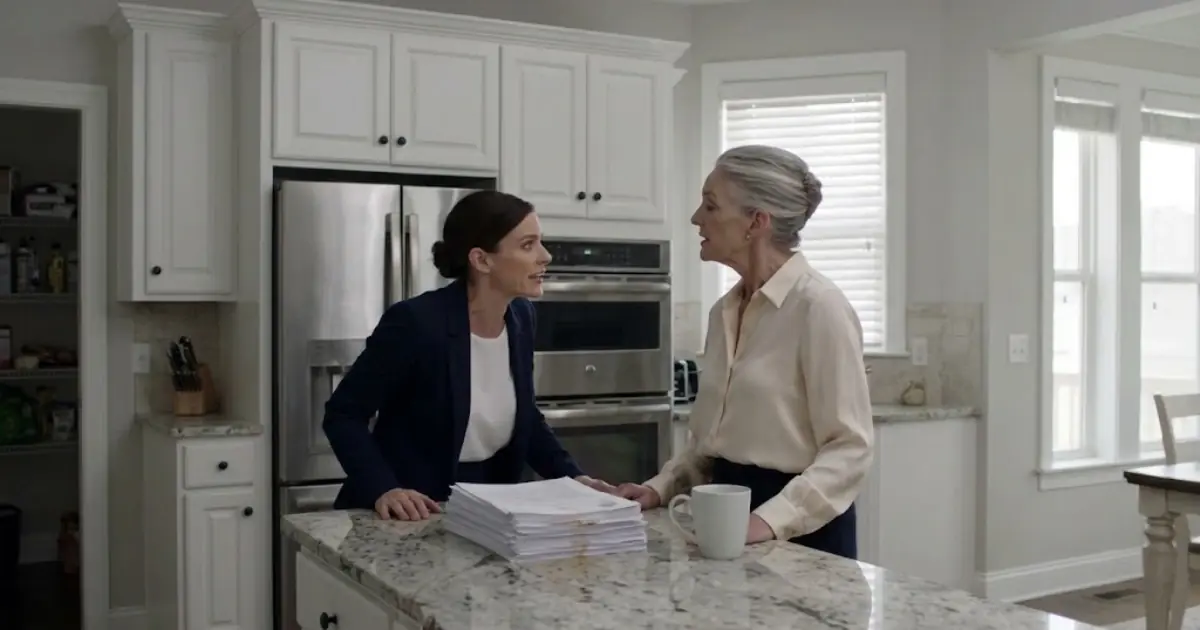
The morning my son tried to erase me from my own life, he stood less than ten feet away, looked directly into my eyes, and told me that I was no longer capable of making decisions for myself.
My daughter-in-law stood beside him, holding a thick stack of documents. She wore an expensive navy-blue suit, her hair perfectly arranged, and an expression of concern so convincing that anyone who didn't know her would have mistaken it for love.
But I knew better.
I had spent sixty-eight years learning the difference between someone who cared about me and someone who was simply waiting for me to become useful.
And that morning, I finally understood what my own family had been planning behind my back.
My name is Eleanor Whitmore. I am sixty-eight years old, a widow, a mother, and the owner of a beautiful house that my late husband and I spent thirty-seven years building together.
For most of my life, I believed that family was the one thing money could never replace. I believed that a mother's responsibility did not end when her children became adults. If they needed help, I helped. If they made mistakes, I forgave them. If they fell, I gave them a hand.
I never imagined that one day those same people would look at everything I had sacrificed and see nothing more than an opportunity.
My husband, Richard, died four years ago.
He had been the kind of man who fixed leaking faucets before anyone noticed them, who remembered birthdays without checking a calendar, and who always kissed my forehead before leaving for work.
We weren't wealthy when we married. Our first apartment had peeling wallpaper, an unreliable heating system, and a kitchen barely large enough for two people. But we had something more important than comfort. We had plans.
Richard worked as an architect, and I spent most of my career managing a small accounting office. Every dollar mattered. Every vacation was carefully planned. Every major purchase was discussed over dinner.
Eventually, we bought our first house.
Then, after years of saving, we purchased the property where we would spend the rest of our lives. It had a large garden, an old maple tree near the driveway, and white kitchen cabinets that Richard installed himself.
Our son, Daniel, grew up in that house.
He learned to ride his bicycle on the driveway. He celebrated birthdays beneath the maple tree. He brought home his first girlfriend, graduated from high school, and left for college with a suitcase that Richard had repaired twice.
I remembered all of it.
That was perhaps why it took me so long to recognize the person he had become.
Daniel was thirty-nine when his father died. He had a respectable job in commercial real estate, a comfortable house of his own, and a wife named Vanessa.
Vanessa was intelligent, ambitious, and extraordinarily good at making people feel that they owed her something.
When Daniel first introduced us, she brought flowers and addressed me as Mrs. Whitmore. She complimented my cooking, asked about Richard's work, and spent an entire afternoon looking through our family photographs.
I wanted to like her.
And for a while, I believed I did.
But after the wedding, small things began to change.
Vanessa started making comments about my house.
"Have you ever considered downsizing, Eleanor?" she asked one afternoon while drinking coffee in my kitchen. "This place must be exhausting to maintain."
I laughed.
"Your father-in-law and I built this house together. I don't think I'm ready to leave it."
She smiled.
"Of course. I just worry about you living alone."
Daniel nodded from the doorway.
"She's right, Mom. You shouldn't have to handle everything yourself."
At first, I interpreted their concern as affection.
Then the suggestions became more frequent.
They wanted me to give Daniel a spare key. They wanted access to my financial records in case of emergencies. Vanessa offered to help organize my bills. Daniel suggested that I transfer some of my savings into an account he could manage.
I refused.
Not because I didn't trust my son, I told myself, but because Richard and I had always handled our finances carefully.
Daniel didn't like my answer.
"You act as though we're strangers," he said.
I looked at him.
"Trust isn't the same thing as giving someone control over everything you own."
He walked away without answering.
Six months later, I discovered that Vanessa had been telling relatives I was becoming forgetful.
She said I had repeated conversations, misplaced important documents, and sometimes confused dates.
Some of those things were true.
I had forgotten where I put my reading glasses twice. I had once missed a lunch appointment because I wrote down the wrong time.
But I was sixty-eight, not incapable of understanding my own life.