Marcus Reed had been in his new home for nine days when a neighbor called the police on his first backyard barbecue. She told the dispatcher that four suspicious men had gathered behind the fence and that an elderly resident might be in danger. When the officers refused to remove them, she demanded an emergency HOA meeting and promised to produce the complaint that would justify everything she had done. She never expected the woman whose name appeared on that complaint to walk through the meeting-room door.
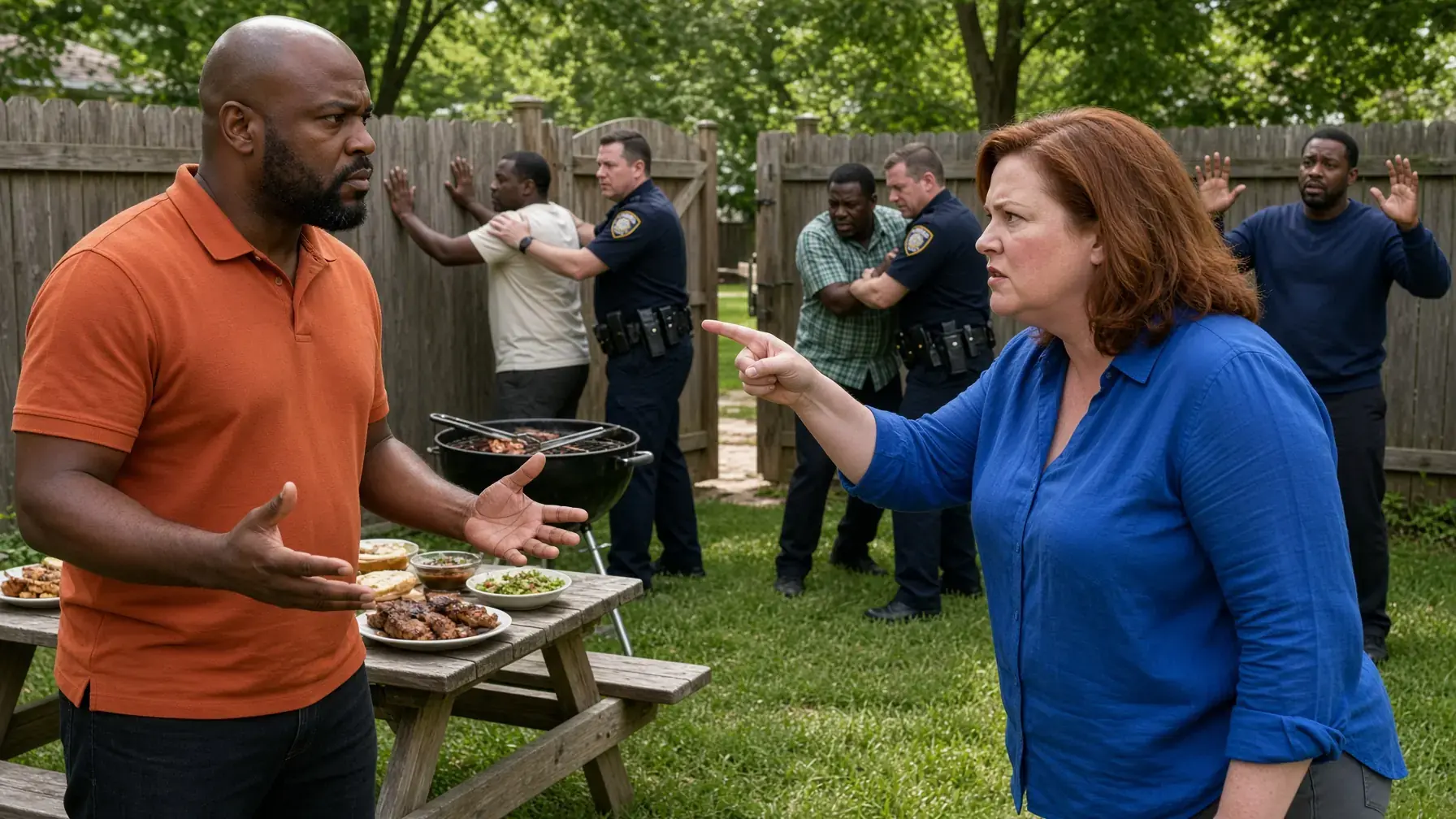
The chicken was almost ready when Marcus heard someone rattling the side gate.
He looked up from the grill.
Beyond the fence, a woman stood on the narrow path between his house and the property next door. He recognized her immediately, though he had met her only once.
Karen Whitmore.
The HOA president.
She wore a navy linen blouse, white trousers, and square-framed sunglasses. Her ash-blonde hair was pulled into a tight ponytail, and a phone rested against her ear.
Her free hand pulled at the gate latch again.
Marcus lowered the tongs.
“Can I help you?”
Karen did not answer him.
“Yes,” she said into the phone. “I’m at the property now.”
Marcus glanced at the other men.
His younger brother Andre stood beside a folding table, opening a bag of charcoal they no longer needed. Calvin, an old friend from work, was slicing tomatoes. Ben had been trying to assemble a patio chair without admitting he had attached one arm backward.
All three looked toward the gate.
Karen pulled once more.
The latch held.
“It’s locked,” she said. “They’ve locked themselves in.”
Marcus walked toward her, stopping several feet from the fence.
“Ma’am, it’s my backyard.”
She turned away as though his voice had interrupted an important conversation.
“There are four of them,” she told the person on the phone. “I can’t tell what they’re doing.”
Calvin looked down at the tomatoes.
Ben looked at the grill.
Andre stopped holding the charcoal bag.
Marcus felt the first cold movement of unease.
“What are you talking about?”
Karen moved farther from the gate.
“Yes. Four men. The owner is an elderly woman, and I’m concerned about her safety.”
Marcus stared.
Then he understood whom she meant.
Eleanor Price.
The woman who had sold him the house.
“She doesn’t live here anymore,” he said. “I bought it.”
Karen looked directly at him.
For a moment, he thought she might correct herself.
Instead, she said into the phone, “One of them is approaching me.”
Marcus stopped moving.
He was already standing still.
Andre set down the charcoal.
“Marcus.”
His brother said his name quietly, but the warning was clear.
Marcus lowered his hands.
“I’m not approaching you.”
Karen stepped backward anyway.
“Yes,” she said. “Please send someone.”
She ended the call.
For several seconds, the only sounds came from the grill and a lawn mower somewhere across the street.
Marcus looked at the phone.
“Did you call the police?”
Karen folded her arms.
“If you had answered the neighborhood’s concerns appropriately, this wouldn’t be necessary.”
“What concerns?”
She glanced at the other men.
“Who are they?”
“My guests.”
“That isn’t an answer.”
“It’s the answer you need.”
Her mouth tightened.
Behind Marcus, Ben carefully laid a screwdriver on the table.
Calvin turned off the small portable burner beneath a pan of beans.
Andre looked toward the house.
Marcus knew why.
His daughter was inside.
Lily was seven, and she had spent the morning decorating paper cups for their first meal on the patio. She had written DADDY on one, UNCLE ANDRE on another, and made Calvin’s cup blue because he said that was his favorite color.
Marcus did not want her coming outside now.
Karen looked through the slats in the fence.
“You can’t hold an unauthorized gathering here.”
“Four people eating lunch is not an unauthorized gathering.”
“This community has standards.”
“And I’ve read them.”
She seemed to dislike that answer more than the others.
Marcus had noticed the same thing during their first conversation.
Questions irritated her.
Documents irritated her more.
“I am responsible for this neighborhood,” she said.
“You aren’t responsible for my lunch.”
Andre made a brief sound behind him.
Not quite a laugh.
Karen heard it.
Her gaze sharpened.
“You think this is funny?”
“No,” Andre said. “I think you should leave.”
She pointed toward him.
“That’s the kind of hostility I’m talking about.”
Marcus looked back at his brother.
Andre pressed his lips together.
They had spent their lives learning the difference between being angry and allowing somebody else to describe what anger looked like.
Neither wanted to practice it in Marcus’s new backyard.
Marcus turned back toward Karen.
“You’re standing outside my fence. Nobody threatened you. Nobody invited you. Please leave.”
She looked toward the street.
“I’ll wait for the officers.”
Then she walked around the side of the house as though the matter had already been decided.
Marcus remained by the gate.
The food smelled good.
That seemed absurd now.
He had spent two days planning a meal that would mark the beginning of something. The mortgage payment frightened him, half his belongings were still in boxes, and the patio chairs came with instructions written in a font too small to read.
But the house was his.
For the first time in years, he wanted to celebrate that fact.
Now three men stood behind him, waiting to find out whether eating at his table would require explaining themselves to the police.
Ben spoke first.
“Want me to put the food inside?”
Marcus looked at the grill.
“No.”