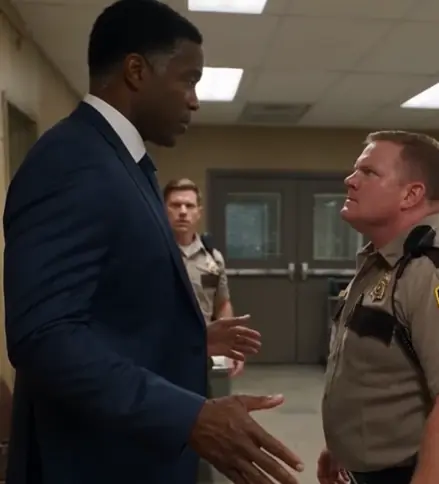
The cop slipped a bag of white powder into my pocket, pulled it out again, and smiled like he had just found a reason nobody would believe me.
We stood beside a beige sedan on a quiet county road, where winter fields stretched toward a distant tree line.
There were no houses close enough to hear a shout.
No passing drivers.
Only a young White officer, a Black man in an old jacket, and the particular kind of silence in which terrible things become official reports.
His nameplate read VOSS.
I had spent six months learning what that name could do to people.
“Oh,” he said, holding the bag between two fingers.
“Possession, huh?”
His smile was small and private.
He seemed to enjoy the second before fear arrived.
I looked at the bag, then at his face.
“You just crossed the line.”
The smile vanished.
“What did you say to me?”
Behind him, his patrol car idled with its headlights burning through the pale afternoon.
The camera mounted near its windshield had a black evidence envelope draped over it.
His body camera showed no light.
I had noticed both things before he ever touched me.
I had also noticed the silver ring on his right hand, the split seam beside his holster, and the faint tremor in his left thumb.
Fear sometimes looked like aggression when a man had practiced confusing them.
“Keep your hands where I can see them,” he snapped.
They were already visible.
He stepped closer anyway.
“What’s your name?”
“You have my license.”
“I asked you a question.”
He had taken my license seven minutes earlier, after claiming my rear tire crossed the shoulder line.
The license identified me as Nathan Cole.
That was my real name.
Everything else about the stop had been arranged carefully enough that the truth could survive it.
“You can call your supervisor,” I said.
Something moved across his face.
Not concern.
Recognition.
Then his hand closed into a fist.
He swung before I finished drawing breath.
I caught the first blow against my forearm, staggered against the sedan, and felt pain flash from wrist to elbow.
He came again, faster and uglier, abandoning whatever story he had intended to tell himself.
Training took over where thought would have been too slow.
I turned out of his reach, caught his arm, and used his momentum to bring him down.
His shoulder struck the pavement.
The plastic bag skidded beneath the driver’s door.
For one stunned second, he stayed on one knee.
Then his right hand moved toward his belt.
“Don’t,” I said.
He lunged instead.
We hit the sedan hard enough to make its suspension rock.
I pinned his arm against the hood, keeping his other hand away from the holster.
His breath came in sharp bursts.
“You have no idea who you’re messing with.”
“Actually,” I said, “that’s your problem.”
With my free hand, I opened the credential wallet clipped inside my jacket.
STATE OFFICE OF PROFESSIONAL INTEGRITY.
INTERNAL AFFAIRS — SPECIAL INVESTIGATOR.
His body became strangely still.
I watched him read the words twice.
“Wait.”
His voice had changed.
“You’re Internal Affairs?”
“Keep both hands on the hood.”
“You should’ve told me.”
The sentence nearly made me laugh.
Instead, I said, “You should’ve left my pocket empty.”
A dark SUV rounded the bend behind us.
Another followed.
My surveillance team had been less than a minute away, watching the feed from two cameras concealed inside the beige sedan.
The microphone stitched into my jacket had carried every word.
There had been no witnesses standing nearby.
That did not mean nobody had seen.
Investigator Lena Ortiz stepped out first, her coat open over her vest.
Two state officers moved past her.
One took control of Voss.
The other secured his weapon.
Lena looked at my arm.
“You hurt?”
“Later.”
She understood.
There were injuries you acknowledged only after the dangerous part stopped moving.
Voss turned his head as the cuffs closed.
“You don’t understand.”
Lena began advising him of his rights.
He talked over her.
“You need to check my car.”
“We will,” she said.
“No, now.”
His voice cracked.
For the first time since pulling me over, he sounded his age.
Twenty-seven.
Young enough to have become somebody else.
“Please,” he said.
“The radio.”
From his patrol car came a burst of static.
Then a man’s voice, calm and conversational.
“Unit Twelve, confirm package recovery.”
Lena stopped speaking.
I looked at her.
Neither of us moved toward the radio.
“Unit Twelve,” the voice repeated.
“Do you have Cole?”
My real name seemed louder coming from that speaker than it had any right to sound.
The operation had been restricted to seven people.
Voss had been our target.
He was not supposed to know he was part of an operation.
He certainly was not supposed to be waiting for me.
The radio clicked again.
“Bring him to the annex.”
Voss closed his eyes.
Beyond the ditch, dead corn leaves rattled in the wind.
I thought of the six complaints on my desk.
Six people who described the same fingers entering the same kinds of pockets.
Six lives that had narrowed afterward into court dates, dismissed applications, lost children, and rooms rented by the week.
One of those complainants had been a mechanic named Darius Bell.
He had given us a statement in June.
Three weeks later, his car went into the river.