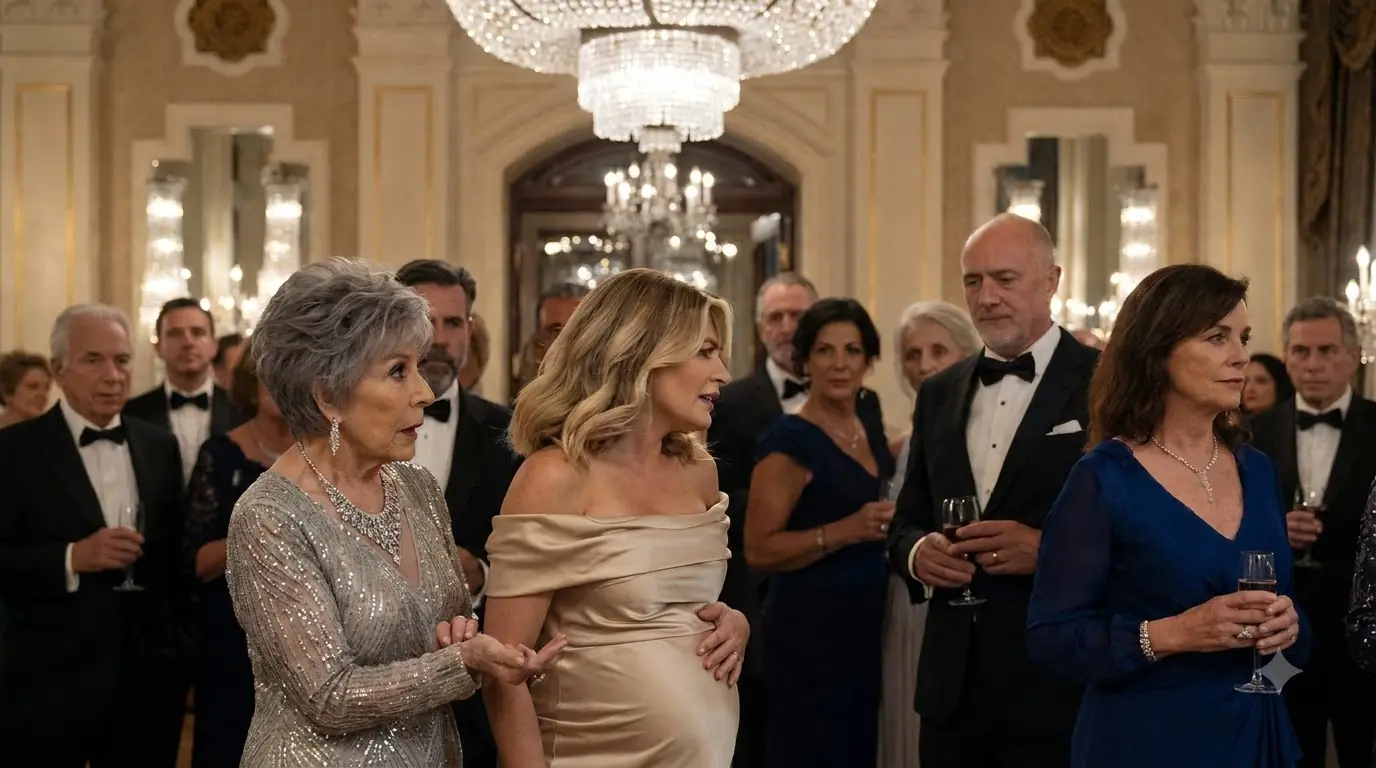
The first thing Eleanor Whitmore noticed on her wedding day was that the chandeliers were too bright.
Thousands of crystal fragments hung from the gilded ceiling of the Grand Bellamy Hotel, scattering golden light across the marble floor, the white roses arranged along the staircase, and the faces of nearly two hundred guests who had gathered to celebrate what they believed was the beginning of a perfect love story.
Everything was beautiful.
The orchestra played softly beside the enormous windows. Champagne sparkled in crystal glasses. Waiters moved between tables covered in ivory linen, carrying silver trays of delicate pastries and tiny desserts decorated with edible flowers. Beyond the windows, the city glittered beneath the evening sky.
Eleanor had dreamed of a wedding like this since she was a little girl.
Back then, she had imagined herself standing beneath a ceiling full of stars, wearing a dress that made her feel like a princess, while the man she loved waited at the end of an aisle lined with flowers.
She had imagined laughter, music, and a promise that would survive every difficulty life could place in their path.
She had never imagined that, on the evening she finally received everything she had dreamed of, she would feel as though she were standing in the middle of someone else's life.
Her wedding dress was a soft champagne color, fitted delicately at the waist before falling into a flowing skirt that brushed the floor. The fabric had been chosen by her mother, Margaret, who insisted that pure white would make Eleanor look too pale beneath the ballroom lights.
Margaret had also chosen the flowers, the music, the seating arrangement, and almost every detail of the reception.
She had done so with the confidence of a woman who believed that love could be organized, protected, and preserved through sufficient planning.
At sixty-two, Margaret Whitmore was still a striking woman. Her silver-blonde hair was arranged in elegant waves, and her silver gown shimmered whenever she moved. She wore a diamond necklace that had belonged to Eleanor's grandmother, a woman who had once told her that the secret to surviving a marriage was learning when to speak and when to remain silent.
Margaret had spent forty years following that advice.
Sometimes, Eleanor wondered whether it had saved her marriage or slowly destroyed it.
"Stop pulling at your ring," Margaret whispered.
Eleanor looked down.
Her fingers had been turning the diamond engagement ring around and around.
"I'm not pulling at it."
"You've been doing it for ten minutes."
"Perhaps it doesn't fit properly."
Margaret gave her a small, knowing smile.
"It fits perfectly. Your grandmother had it resized."
Eleanor glanced at the diamond.
It was beautiful, expensive, and entirely unlike the ring she would have chosen for herself.
She had once preferred simple gold bands, the kind of jewelry that looked better with age. Julian had insisted that a diamond was more appropriate for their engagement because, in his words, she deserved something extraordinary.
At the time, she had thought it was romantic.
Now she wondered why she had needed so many people to tell her what she deserved.
Margaret noticed her expression.
"Are you nervous?"
"A little."
"That's normal."
"Mother, did you ever feel nervous before you married Father?"
For a moment, Margaret's smile became still.
Then she looked toward the ballroom, where the guests were gathering around the dance floor.
"Your father was a very different man from Julian."
"That isn't what I asked."
Margaret turned back toward her daughter.
"Yes," she admitted. "I was nervous."
"What did you do?"
"I married him."
Eleanor laughed softly, but Margaret did not.
Her mother took her hand.
"Listen to me. There will be difficult days. There will be moments when you question your choices. Marriage is not a fairy tale, no matter how beautiful the wedding may be. You must learn to distinguish between a difficult moment and a reason to abandon the life you have built."
The words were ordinary enough.
Yet something in Margaret's voice made Eleanor look at her more carefully.
"Are you trying to tell me something?"
Margaret's fingers tightened around hers.
"No."
The answer came too quickly.
Before Eleanor could ask another question, the orchestra changed songs, and a burst of applause rose from the ballroom.
Julian had arrived at the dance floor.
He wore a black tuxedo tailored perfectly to his broad shoulders, his dark hair combed neatly away from his forehead. He had the sort of face that made strangers assume he was trustworthy: strong features, warm eyes, and a smile that appeared effortless.
He was handsome.
He was charming.
And for nearly three years, Eleanor had believed that he was the safest place in the world.
When he saw her, he lifted his glass and smiled.
She returned the smile automatically.
Margaret watched them.
Then, so quietly that Eleanor almost missed it, her mother whispered, "Whatever happens tonight, remember that you are allowed to choose yourself."
Eleanor turned sharply.
"What?"
Margaret kissed her cheek.
"Nothing, darling. You look beautiful."
And before Eleanor could discover what her mother had meant, Margaret walked toward the guests.
Eleanor remained beneath the chandelier, holding a bouquet of pale roses and trying to convince herself that the strange uneasiness inside her was nothing more than the ordinary fear of a woman about to begin a new life.
She did not know that, before the night ended, she would understand exactly why her mother had given her that warning.
Three years earlier, Eleanor had met Julian Ashford in a small bookstore on a rainy afternoon.
She had been standing near the back shelves, searching for a novel her father had once read aloud to her, when a man reached past her for the same book.
Their hands touched.
He apologized.
She laughed.
He asked whether she had read it before.
She told him she had, but that she wanted to read it again because the ending had always made her cry.
Julian said he trusted people who cried over books.
Eleanor said she distrusted people who pretended they never did.
He bought her a coffee.
They spent two hours talking beside the bookstore window while rain slid down the glass.
By the time they parted, Julian had asked for her number, and Eleanor had agreed to meet him for dinner.
For the first six months, their relationship felt almost impossibly easy.
Julian remembered small details. He knew that she disliked lilies because their scent reminded her of hospitals. He remembered the name of the elderly neighbor she helped with groceries. He sent her photographs of beautiful buildings because he knew she loved architecture.
He listened when she spoke about her dreams of opening a small design studio, a place where she could restore old furniture and transform forgotten rooms into spaces that felt alive again.
He told her she was talented.
He told her she was different.
He told her he wanted to build a life in which neither of them would have to be afraid of losing the things they loved.
For a woman who had grown up watching her parents move through a marriage filled with unspoken disappointments, those words felt like a promise of salvation.
Her father, Thomas Whitmore, had been a quiet man with paint beneath his fingernails and an extraordinary ability to see beauty in damaged things.
He had restored antique furniture for a living, working from a narrow shop behind their house. He often told Eleanor that a cracked surface did not mean an object was ruined.
"Sometimes," he would say, running his hand across a weathered wooden table, "the damage is the most interesting part. It tells you what the object has survived."
Eleanor had loved him more than anyone.
When she was sixteen, he died suddenly after a heart attack.
His death split her life into two separate worlds: the years when she believed that good things could last forever, and the years when she understood that love did not protect anyone from loss.
Margaret became quieter after his death.
She stopped singing while cooking. She stopped sitting in the garden in the evenings. She stopped opening the workshop where Thomas had spent most of his life.
Within a year, she had sold the business equipment, packed away his tools, and arranged for the house to be renovated.
Eleanor had been devastated.
She had wanted to preserve everything exactly as it was, afraid that changing the rooms would somehow erase her father's presence.
Margaret had insisted that life had to move forward.
They argued about it for months.
Eventually, Eleanor left for university and built a life of her own, returning home only for holidays and the occasional family obligation.
She loved her mother, but she never fully understood her.
Julian seemed to understand both of them.
He listened patiently when Eleanor spoke about her father. He visited Margaret regularly. He helped carry boxes when Eleanor decided to clear out some of the old furniture.
He even learned to restore wooden surfaces under the guidance of an elderly craftsman who had once worked with Thomas.
That gesture had touched Eleanor more deeply than any expensive gift.
She had thought Julian was learning to understand the parts of her that she could not explain.
She did not realize that he was also learning where her deepest wounds were buried.
When Julian proposed, he did so in the garden behind the Whitmore house.
He had arranged a small table beneath the old apple tree, lit candles along the stone path, and placed a ring inside a wooden box he had restored himself.
The box was beautiful.
Its hinges were slightly uneven, and one corner still bore a faint scar from an old crack. Julian had left the imperfection visible rather than hiding it beneath a layer of paint.
Eleanor had cried when she saw it.
Not because of the ring.
Because the box reminded her of her father.
Julian knelt beside her.
"I know I can't replace anything you've lost," he said. "But I want to be the person who stays. I want to be there when life becomes difficult, when things break, when you don't know what to do next. I want to build something with you that neither of us has to be afraid of."
She said yes before he finished speaking.
Margaret watched from the kitchen window.
Later that evening, she congratulated them, hugged Julian, and prepared dinner.
But when Eleanor entered the kitchen to thank her, she found her mother standing alone beside the sink, staring at the garden.
"Are you happy for me?" Eleanor asked.
Margaret turned.
"Of course."
"Then why do you look sad?"
"I was thinking about your father."
Eleanor stepped closer.
"He would have liked Julian."
Margaret looked at her for a long time.
"Would he?"
"Yes."
"Perhaps."
The uncertainty in her voice troubled Eleanor, but she dismissed it.
Her mother had spent years grieving a man who had died too young. Perhaps no one would ever be good enough to follow him.
That was the explanation Eleanor chose because it was the least painful.
Over the next two years, wedding preparations consumed nearly every available moment.
Julian's family was wealthy, influential, and deeply concerned with appearances. His father, Richard Ashford, owned a chain of luxury hotels and expected his only son to inherit the business.
The Ashfords had opinions about everything.
They believed that a proper wedding required a prestigious venue, an elaborate guest list, expensive champagne, and enough flowers to make the ballroom look like a royal palace.
Eleanor had wanted a small ceremony beneath the apple tree.
Julian had said they could have a private celebration later.
His mother had said that a wedding was not merely about the couple; it was about bringing two families together.
Margaret had encouraged Eleanor to compromise.
So Eleanor compromised.
She compromised on the venue.
She compromised on the guest list.
She compromised on the dress, the music, and the menu.
When she suggested inviting several friends from her design studio, Julian explained that space was limited.
When she asked whether they could reserve a table for her father's old friends, his mother said the seating arrangements had already been finalized.
When she proposed using some of Thomas's restored furniture in the reception lounge, Richard Ashford laughed and called the idea sentimental.
Julian apologized afterward.
He kissed her forehead and promised that their home would be different.
"Our marriage will be ours," he said. "No one else will decide how we live."
Eleanor believed him.
That was the problem.
She had begun to mistake his apologies for change.
Every time he disappointed her, he offered an explanation.
Every time he made a promise, he asked for patience.
Every time she questioned something, he reminded her of all the good things he had done.
And because she loved him, she continued to wait for the man she had first met in the bookstore.
Sometimes she glimpsed that man again.
He appeared when they were alone, when he cooked her favorite meal after a difficult day, when he sat beside her in the garden and listened to the rain.
Those moments convinced her that the person she loved was still there.
She only had to be patient enough to find him.
Then, six weeks before the wedding, Eleanor discovered a photograph.
She was searching for an old receipt in Julian's study when a folder slipped from the bottom drawer of his desk.
Inside were several photographs, printed on glossy paper.
The first showed Julian standing beside a blonde woman outside a restaurant.
The woman wore a dark blue dress and held his arm with the casual familiarity of someone who had known him for years.
In the second photograph, they were sitting together at a café.
In the third, they were leaving a hotel.
Eleanor stared at the images until the room seemed to tilt around her.
She recognized the woman.
Her name was Vanessa Cole.
She had attended several Ashford family events and worked as a consultant for one of Richard's hotels. Eleanor had met her twice, both times briefly, and remembered her as confident, elegant, and unusually interested in Julian's personal life.
There was nothing explicitly intimate in the photographs.
That was almost worse.
They looked ordinary.
Comfortable.
Like two people who had built a private world in which they no longer needed to explain themselves.
Eleanor waited until Julian came home.
She placed the photographs on the kitchen table.
He looked at them, then at her.
For a moment, neither spoke.
"Who is she?" Eleanor asked.
Julian removed his jacket.
"Vanessa."
"I know her name."
"She's a friend."
"Then why are there photographs of you leaving a hotel together?"
He sighed.
"That was a business trip."
"Why didn't you tell me?"
"Because there was nothing to tell."
"Why did you keep the photographs?"
He rubbed his forehead.
"Eleanor, this is ridiculous."
She felt something cold move through her chest.
"I am asking you a question."
"And I'm answering it."
"No. You're telling me that I'm being ridiculous."
Julian stared at her.
Then his expression softened.
He crossed the kitchen and took her hands.
"Vanessa and I dated briefly before I met you. It was years ago. We have mutual friends. She was helping me with a business matter, and someone took those photographs. I kept them because they were included in a file about the hotel project."
"Why was she with you at a hotel?"
"Because she was working on the project."
"At night?"
"Yes."
"Alone?"
He looked away.
It was only a second.
But Eleanor saw it.
"Julian."
He released her hands and walked toward the window.
"Do you know what it's like to have everyone expecting you to make the right decision all the time?" he asked. "My father expects perfection. My family expects perfection. I can't have a single private conversation without someone deciding it means something."
Eleanor said nothing.
"I chose you," he continued. "I am marrying you. Doesn't that count for anything?"
"Of course it counts."
"Then why are we doing this?"
"Because I need to know whether I can trust you."
He turned toward her.
"You can."
She wanted to believe him.
She wanted to put the photographs away, apologize for doubting him, and return to the comfortable certainty she had lived with before that afternoon.
Instead, she asked, "Have you ever kissed her since we started dating?"
Julian's face changed.
Not dramatically.
Not enough that anyone else might have noticed.
But Eleanor had spent three years learning his expressions.
She knew when he was amused, when he was angry, and when he was searching for the correct words.
This time, he was searching for a way out.
"No," he said.
The answer arrived a fraction too late.
Eleanor felt her heart sink.
"Look at me."
He did.
"Have you ever kissed her since we started dating?"
"No."
She studied his face.
Then she nodded.
"All right."
He stepped toward her.
"Eleanor, I love you."
She allowed him to embrace her.
She allowed him to kiss her hair.
She allowed herself to believe, for one more evening, that love could make uncertainty disappear.
But the photographs remained in her memory.
And once doubt had entered her heart, it became impossible to pretend that she had never opened the door.