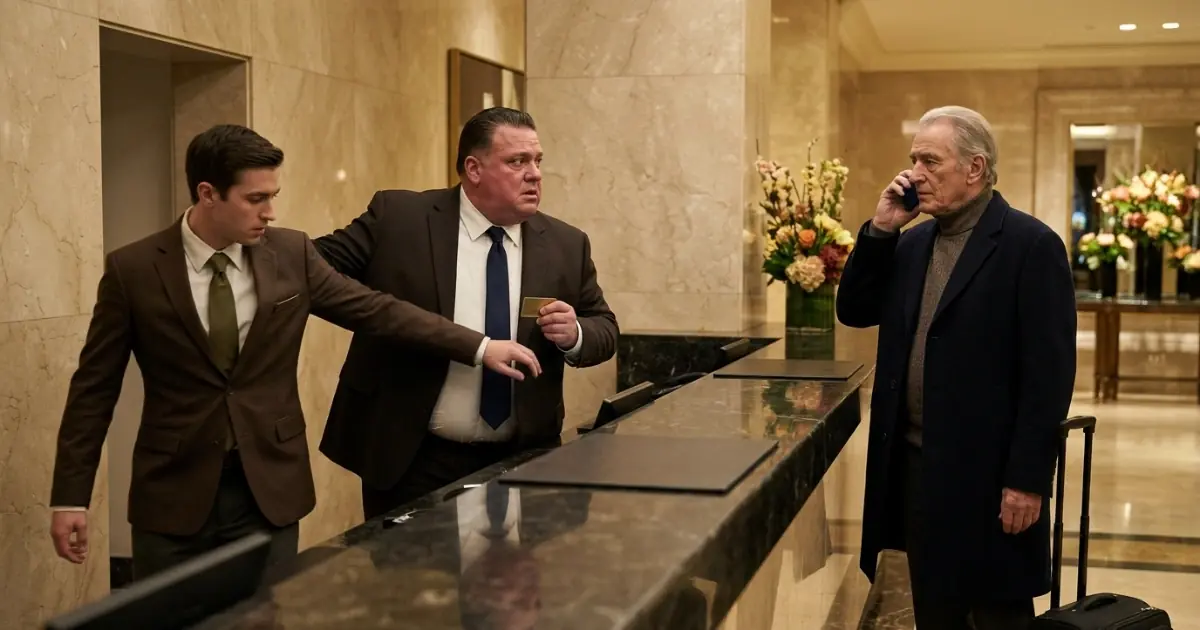
The sound of a man's fist striking the marble reception counter echoed through the lobby of the Grand Wellington Hotel.
"Get him out. Now!"
The command came from Richard Hargrove, the hotel's fifty-four-year-old general manager, whose expensive dark suit, polished shoes, and gold cuff links reflected the wealth he believed entitled him to absolute obedience.
Across the counter stood a thin elderly gentleman with silver hair, a weathered face, and a battered brown suitcase. His navy overcoat had clearly seen better days. Beneath it, a charcoal sweater showed signs of careful mending around the cuffs.
The old man's name was Thomas Whitmore.
He was seventy-six years old.
And although Richard did not know it, the man he was attempting to throw onto the street held the power to destroy everything Richard had spent fifteen years building.
Standing between them was Daniel Carter, a twenty-eight-year-old receptionist whose brown hotel uniform was immaculate despite the exhaustion visible beneath his eyes.
Daniel swallowed nervously.
"Sir, he's a guest. We should help him."
Richard turned toward him so sharply that Daniel instinctively stepped backward.
"You're fired!"
For a moment, the lobby seemed to fall silent.
Daniel stared at his manager.
"For helping him?"
Richard pointed toward the front doors.
"Turn in your badge. You're finished here."
The elderly gentleman placed one wrinkled hand on the marble counter.
He had remained silent throughout the confrontation.
Now his blue eyes settled on Richard with an expression that was neither frightened nor angry.
It was something far more unsettling.
Disappointment.
"One moment," Thomas said quietly.
He reached into his coat pocket and removed an old black cellphone.
Richard gave a contemptuous laugh.
"Calling someone to pick you up? Good. Tell them to hurry."
Thomas ignored him.
He pressed a number he knew by heart.
When someone answered, he spoke five words that would soon change the course of several lives.
"Send the hotel owner down."
Richard's smile disappeared.
But to understand why those words carried such extraordinary weight, one would have to understand the old man standing beside the counter, the young employee who refused to abandon him, and the hotel whose polished walls concealed fifteen years of carefully buried secrets.
Three hours earlier, Thomas Whitmore had stepped off a city bus near Wellington Square with a small suitcase in one hand and a folded letter in the other.
A cold November wind swept through the streets, scattering dry leaves along the sidewalk.
He paused beneath the shadow of an old maple tree and looked toward the enormous building rising beyond the intersection.
The Grand Wellington Hotel.
Twenty-two stories of limestone, glass, and carefully preserved architectural grandeur.
Its revolving entrance doors were framed by polished brass. A doorman stood beneath an elegant awning, greeting visitors arriving in luxury vehicles.
Above the entrance, the hotel's name glowed in golden letters.
Thomas remembered when those letters had been installed.
He remembered standing on that very sidewalk beside his wife, Margaret, while construction workers removed the scaffolding.
She had squeezed his hand and laughed at the sight.
"Tom, you've finally done it."
He had shaken his head.
"We've done it."
That distinction had always mattered to him.
The hotel had never been merely a business.
It had been their dream.
More than forty years earlier, Thomas and Margaret had arrived in the city with less than two thousand dollars between them.
He had been a maintenance technician at a small roadside motel. She worked the front desk, took reservations, cleaned rooms when the housekeeping staff was short, and somehow still found time to bake cookies for guests traveling with children.
Their first business had been a struggling twelve-room inn beside a highway.
The roof leaked.
The heating system failed every winter.
The parking lot flooded whenever it rained.
And for the first three years, they had barely earned enough to keep the lights on.
But Margaret had believed in something Thomas would never forget.
"People remember how you make them feel," she used to say. "They might forget the furniture, the carpet, or even the view. But they never forget whether you treated them with dignity."
That philosophy had transformed their little roadside inn into a successful business.
One property became three.
Three became seven.
Eventually, after decades of long days, financial risks, and countless sacrifices, the Whitmores acquired an aging downtown landmark and restored it into the Grand Wellington Hotel.
Margaret had personally selected the lobby's cream marble, the warm lighting, and the walnut reception desk that was later replaced with black marble.
She insisted that the entrance remain welcoming rather than intimidating.
And above all, she believed that employees deserved the same respect as wealthy guests.
Thomas had carried those principles through every expansion.
Until the world changed.
Until Margaret died.
Seven years earlier, cancer had taken her after a painful eighteen-month struggle.