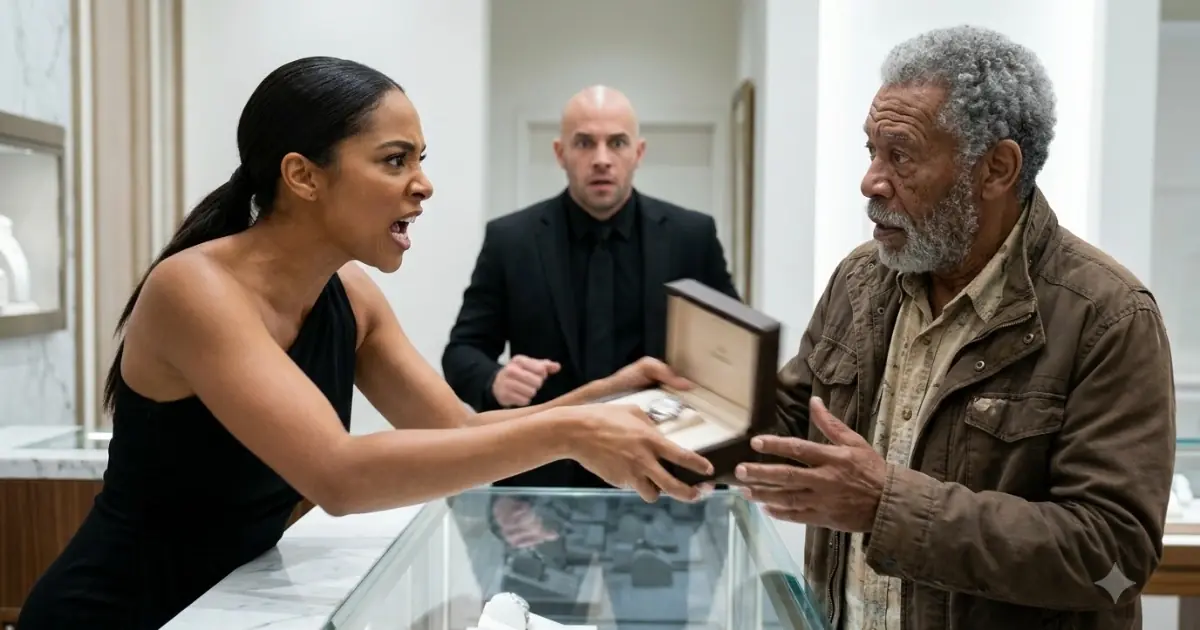
The old man stood beneath the dazzling lights of the jewelry store, holding a small green velvet box in his weathered hands.
Nobody looking at him would have guessed that the box contained something worth more than the most expensive diamond in the showroom.
His name was Arthur Bennett, and he was seventy-two years old.
His silver-gray hair was untidy, his beard had not been trimmed in several weeks, and the brown work jacket hanging from his shoulders had clearly seen better days. A small tear ran along one sleeve. His boots were worn and dusty, and his shirt was faded from countless trips through the washing machine.
He looked like a man who had spent his life working with his hands.
That was exactly what he had done.
But almost everything else about his appearance was misleading.
Across the glass counter stood Vanessa Cole, a twenty-nine-year-old sales representative whose perfectly styled black hair, expensive perfume, and immaculate dress made her look as polished as the diamonds surrounding her.
She stared at Arthur's jacket, then at the velvet box.
Her smile disappeared.
"Sir, perhaps I can help you find something more suitable for your budget."
Arthur looked up slowly.
"Something more suitable?"
Vanessa glanced toward the entrance, where a well-dressed couple had just walked inside.
"Yes. We do have less expensive items, although I should mention that most of our collections are intended for serious buyers."
Arthur rested the box carefully on the counter.
"I haven't told you what my budget is."
Vanessa's eyes narrowed.
"Well, with all due respect, sir, we have certain standards here."
Arthur said nothing.
She continued, lowering her voice just enough to make her words sound professional while allowing the cruelty beneath them to remain perfectly clear.
"Customers are not permitted to handle our high-value pieces without prior authorization. And frankly, I think you might be more comfortable shopping somewhere else."
The old man's expression barely changed.
But something in his eyes grew terribly still.
"Are you asking me to leave?"
Vanessa folded her arms.
"I'm afraid so."
Arthur looked past her at the elegant display cases, the golden lighting, and the carefully arranged diamonds.
Then he asked a question she did not understand.
"How long have you worked here, young lady?"
"Three years."
"And who taught you how to treat customers?"
Vanessa gave a sharp, impatient laugh.
"Sir, I don't think you understand how this establishment operates."
Arthur closed the velvet box.
"No," he answered quietly. "I'm beginning to understand it very well."
What Vanessa did not know was that the man standing before her had helped build the company whose name appeared in gold above the entrance.
And what she could not possibly imagine was that he had come to the store that afternoon carrying a promise he had made to his dying wife.
Thirty-eight years earlier, Arthur Bennett had been a completely different man.
He had been thirty-four, broad-shouldered, endlessly energetic, and convinced that hard work could solve nearly every problem in the world.
He and his wife, Eleanor, lived in a tiny rented apartment above a bakery in a working-class neighborhood outside Philadelphia.
Arthur repaired watches for a living.
He had learned the trade from his father, who had repaired railway clocks and pocket watches during the years when people still believed a good timepiece should last a lifetime.
Arthur loved the delicate mechanics of watches.
He loved the patience required to restore something broken.
But most of all, he loved the way a cherished object could carry a family's history.
A scratched wedding band was never merely gold.
A watch passed from father to son was never merely a machine.
And an inexpensive necklace saved from a grandmother's jewelry box could contain more love than a million-dollar diamond.
Eleanor understood that better than anyone.
She worked as a nurse at a small community hospital, often taking double shifts when money was tight.
They had one daughter, Margaret, who was six years old when Arthur began dreaming about opening his own shop.
He had almost no savings.
Their car was unreliable, their apartment leaked during heavy rain, and they regularly counted grocery money before payday.
Yet Eleanor never laughed at his ambition.
One winter evening, as snow fell beyond their kitchen window, Arthur spread several sketches across their small dining table.
"I want to build a place where people can bring the things that matter to them," he explained.
Eleanor examined his drawings.
"Another repair shop?"
"More than that. Jewelry. Watches. Custom designs. Engagement rings. Restoration work."
She smiled.
"That sounds expensive."
"It is."
"How expensive?"
Arthur hesitated.
"More than we have."
Eleanor studied his face.
Then she reached beneath her sweater and removed the little silver necklace Arthur had given her when they were teenagers.
The pendant was shaped like a tiny heart.
It was not especially valuable.
But she had worn it for seventeen years.
She placed it on the table beside his drawings.
Arthur frowned.
"What are you doing?"
"Helping you get started."
He pushed the necklace back toward her.
"Absolutely not."
"Arthur."
"Eleanor, that was the first gift I ever bought you."