You may think you know your own body pretty well.
You see it every day. You feel hunger, tiredness, pain, temperature, and stress. But underneath all of that, your body is constantly doing things that sound almost impossible.
Some of them happen while you're sleeping. Others happen without you noticing at all.
Here are 5 fascinating facts about the human body that might completely change the way you think about yourself.
1. Your brain can be active while your body is almost completely paralyzed
During certain stages of REM sleep—the stage most associated with vivid dreaming—your brain becomes highly active.
At the same time, your body temporarily reduces activity in many of your skeletal muscles. This natural mechanism, called REM atonia, helps prevent you from physically acting out most of your dreams.
That's why you might dream about running, fighting, or screaming while your real body barely moves.
But sometimes the systems don't transition perfectly.
This is one reason people can experience sleep paralysis: awareness returns before normal muscle control does. A person may feel awake but temporarily unable to move.
So that strange feeling of being awake while your body refuses to cooperate isn't necessarily your imagination.
Your brain and body may simply be waking up at different speeds.
2. Your stomach doesn't digest itself because it constantly protects itself
Your stomach contains extremely strong acid that helps break down food and destroy many microorganisms.
So why doesn't the stomach simply digest itself?
Because its inner lining has several protective mechanisms.
Special cells produce mucus that forms a protective barrier over the stomach wall. Other cells release bicarbonate, which helps neutralize acid near the surface of the lining.
Meanwhile, the stomach lining is continuously renewed.
In other words, your stomach isn't just sitting there filled with acid.
It's constantly maintaining its own protective shield.
And that shield matters. When the protective mechanisms are disrupted—for example, by certain infections or medications—the stomach lining can become damaged and ulcers can develop.
Your stomach is basically performing a nonstop balancing act between digesting food and protecting itself.
3. Your bones are not completely solid like rocks
When you look at a human skeleton, bones appear hard, dense, and lifeless.
But living bone is actually a dynamic tissue.
Inside many bones is bone marrow, where your body produces blood cells. Bone also contains blood vessels, nerves, minerals, collagen, and living cells that constantly break down and rebuild bone tissue.
Your skeleton is continually remodeling itself.
Old bone is removed by cells called osteoclasts, while other cells called osteoblasts help build new bone.
This process responds to things such as physical activity, hormones, nutrition, and age.
That's one reason regular weight-bearing activity is important for maintaining bone strength.
So your skeleton isn't simply the rigid framework holding you up.
It's living tissue that is constantly being repaired and remodeled—even while you're sitting on the couch reading this.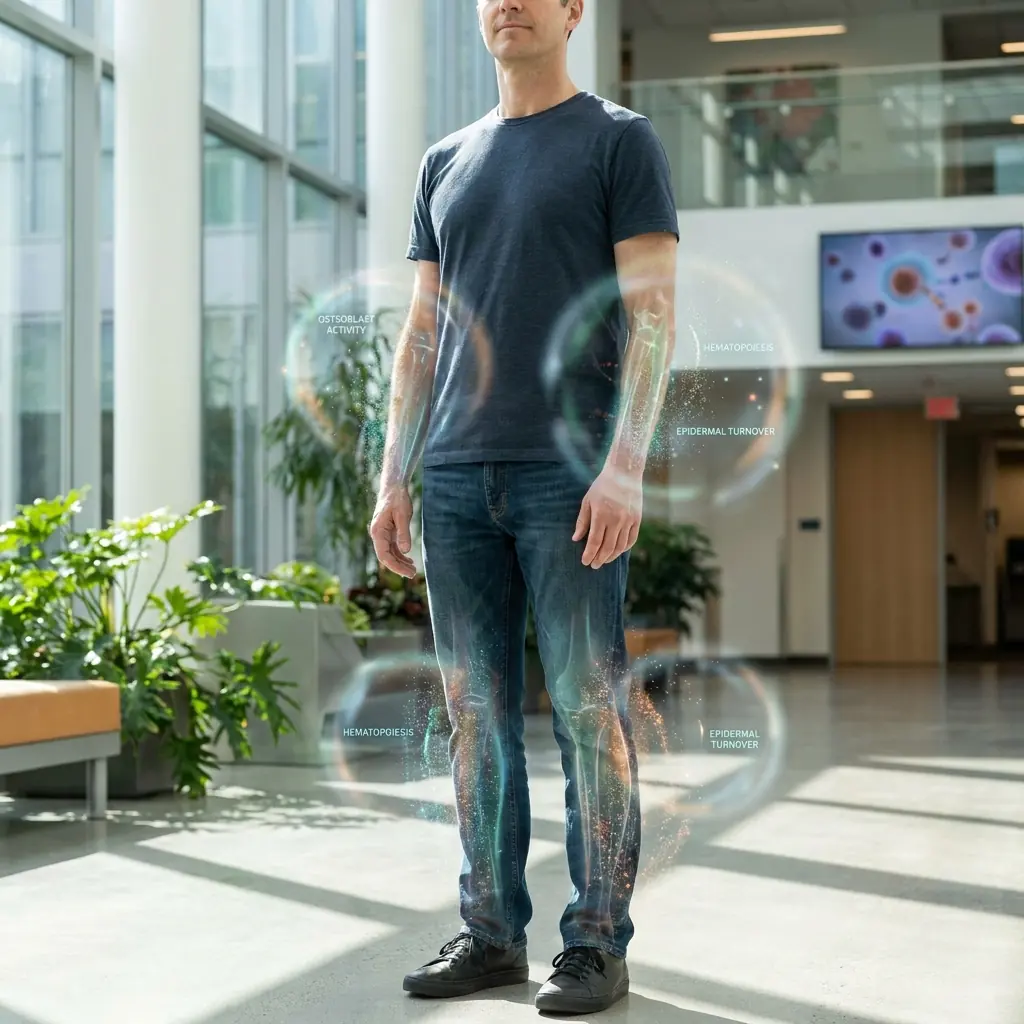
4. Your eyes have a blind spot—and your brain hides it from you
Here's a strange experiment.
Close your left eye.
With your right eye open, stare at a fixed point and slowly move an object or your finger from the side toward the center of your vision.
At a certain position, the object may suddenly disappear.
That's because each eye has a natural blind spot where the optic nerve leaves the retina. There are no light-detecting photoreceptors in that exact location.
So technically, you don't have complete visual information.
But you rarely notice.
Why?
Your brain fills in missing information using surrounding visual patterns and information from your other eye.
Your perception therefore isn't simply a perfect recording of reality.
Your brain is constantly interpreting and reconstructing what you see.
In a very literal sense, your brain edits your vision without asking permission.
5. Your skin is constantly shedding—and you probably never notice
Your skin may look like one continuous surface, but it's actually undergoing constant renewal.
Old skin cells gradually reach the surface and are shed as new cells develop underneath.
You lose tiny amounts of dead skin throughout everyday life—on your clothes, bedding, furniture, and floors.
Most of the time, you don't notice because the individual particles are microscopic or extremely small.
The process becomes more obvious when skin is particularly dry, irritated, or exposed to conditions that increase flaking.
Your body is therefore performing a quiet form of maintenance every day.
You aren't wearing exactly the same outer layer of skin forever.
You're continuously replacing it.
And that's perhaps the strangest thing about all five facts:
Your body isn't a machine that stays the same. It's a living system constantly rebuilding, protecting, correcting, and adapting itself—even when you aren't paying attention.