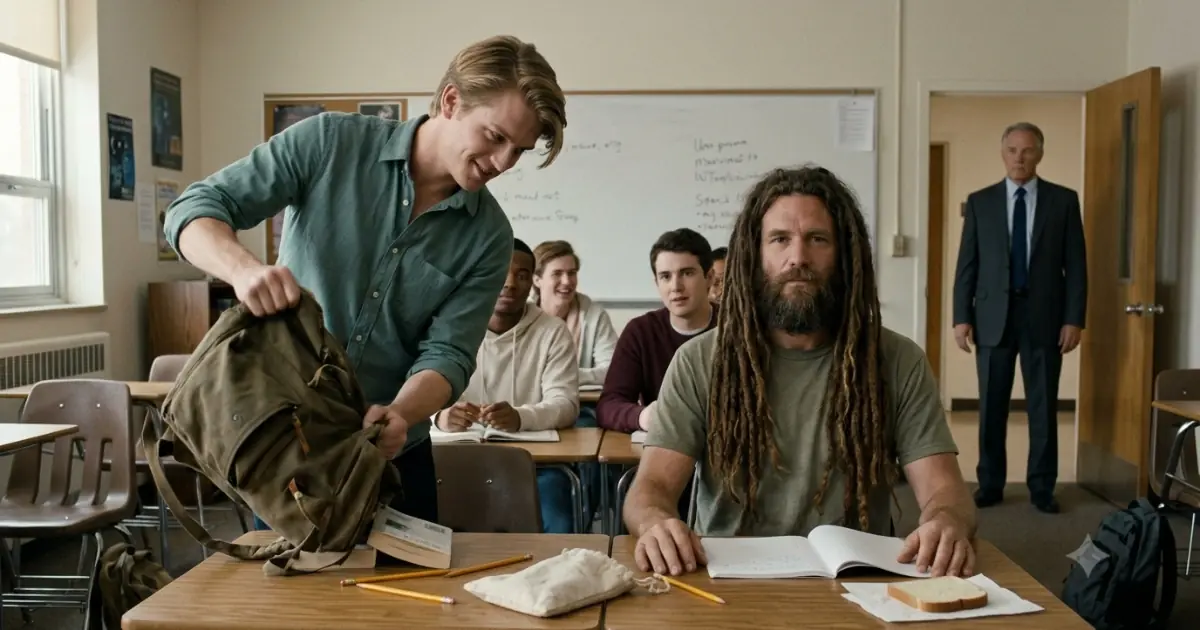
“Do you live in a car or something like that?”
The question was loud enough for everyone in the classroom to hear.
A few students laughed. Others lowered their heads, pretending to concentrate on their assignments. One young woman near the window looked uncomfortable, but she said nothing.
The man being addressed continued writing.
He was probably forty years old, although the exhaustion around his eyes made him appear older. His long brown dreadlocks rested against his faded olive-green shirt. His trousers were worn, his boots were scratched, and the old canvas backpack beside his desk looked as though it had traveled thousands of miles.
On the corner of his desk sat a simple sandwich.
Two slices of bread. Nothing particularly impressive.
Standing beside him was twenty-two-year-old Brandon Whitmore, a tall, handsome student with neatly styled blond hair and the confidence of someone who had never been forced to wonder where his next meal would come from.
Brandon looked down at the sandwich and smiled.
“Is that all?”
Another wave of laughter moved through the room.
The older man finally lifted his eyes.
He looked at Brandon for a moment, without anger or embarrassment. There was something almost sorrowful in his expression, as though he recognized a mistake that Brandon had not yet lived long enough to understand.
Then he returned to his notebook.
Brandon opened his mouth to continue.
Before he could speak, the classroom door opened.
An elderly gentleman wearing a dark tailored suit stepped inside. His silver hair was carefully combed, and his presence immediately quieted the room.
Several students recognized him.
Dr. Richard Caldwell, the university's dean of engineering, rarely visited ordinary classrooms without an important reason.
He looked across the rows of desks until his eyes settled on the man with the dreadlocks.
His expression softened.
“Dr. Vega.”
The older man put down his pen.
Then he stood.
Brandon's smile disappeared.
And what happened over the following weeks would change not only Brandon's understanding of success, but the futures of hundreds of people whose voices had gone unheard for far too long.
Because the man everyone had mistaken for a homeless stranger was carrying a secret far more important than money, influence, or academic titles.
And Brandon Whitmore's own family was part of it.
Eleven years earlier, Daniel Vega had lived in a beautiful house on a quiet residential street outside Pittsburgh, Pennsylvania.
The house was not particularly large, but to Daniel, it had been everything.
There was a maple tree in the front yard, a wooden swing hanging from its strongest branch, and a small vegetable garden behind the garage.
His wife, Elena, had planted tomatoes along the fence. Every spring, she insisted that the garden would produce enough vegetables to feed the entire neighborhood.
Every summer, the squirrels proved her wrong.
Daniel loved hearing her complain about them.
Their eight-year-old daughter, Lucy, had painted a wooden sign that hung above the garden.
It read:
MOMMY'S FARM. NO SQUIRRELS ALLOWED.
Daniel had earned his doctorate in structural engineering at thirty. By thirty-two, he was already considered one of the most promising researchers in his field.
He specialized in designing affordable, durable infrastructure for communities that could not afford expensive engineering solutions.
His work had received national recognition.
Companies offered him extraordinary salaries. Universities competed for his attention. Invitations arrived from conferences around the world.
But Daniel was never especially interested in becoming wealthy.
He had grown up in a neighborhood where families understood the cost of neglected infrastructure. Roads flooded after ordinary rainstorms. Apartment buildings remained unrepaired for years. Bridges that carried working families to their jobs received little attention until something went terribly wrong.
His father, a maintenance worker, had taught him that the people who depended most on public infrastructure were often the people with the least power to demand improvements.
“Never forget who has to live with your decisions,” his father used to say.
Daniel had built his career around that advice.
Elena understood him completely.
She was an elementary school teacher who kept spare coats, pencils, and snacks in her classroom because she knew some children arrived at school without them.
She believed kindness was something people practiced, not something they announced.
When Daniel received his first major professional award, Elena insisted that they celebrate at their favorite neighborhood diner instead of an expensive restaurant.
Lucy ordered pancakes for dinner.
Daniel still remembered the syrup on her chin and the way she demanded to hold his award even though it was nearly too heavy for her little arms.
Those memories would later become the most valuable possessions he owned.
At the time, however, Daniel believed there would always be more.
More dinners.
More birthdays.
More spring afternoons in the garden.