Victoria Sterling sat by the window of the night flight to London and watched New York fall away beneath her in a slow wash of amber light. The city had been her address and her argument and her armor for thirty seven years, and now it shrank to a grid of lamps and river dark, and then to nothing at all, as the aircraft climbed through cloud and found the smoother air above. She held the ticket in her hand long after the crew had checked it, the paper warm from her palm, the printed name clear in neat capitals, and she read the name again as if it belonged to a stranger. Victoria Sterling. The name had opened doors in Manhattan for as long as she could remember. It had opened the heavy glass doors of Sterling House on Madison Avenue, and the quiet doors of boardrooms where men in dark suits stood when she entered, and the doors of restaurants where a table appeared even when the room was full. Tonight the name felt like a coat she had outgrown, too heavy at the shoulders, too long at the sleeves, and she folded the ticket once and slipped it into the pocket of her jacket, close to her heart, where she could feel its edge against her ribs with every breath.
The resignation was behind her. For health reasons, the papers said, and she let the phrase rest there without examining it. Health was a clean word, a private word, a word that asked no further questions, and she was grateful for its clean edges. She had been chief legal counsel of a company that bore her family name, and now she was a passenger in seat twenty three A, with a suitcase in the hold and a handbag at her feet, and no title at all except the one printed on the ticket. The thought should have frightened her. Instead it steadied her, the way the hum of the engines steadied her, a low and even sound that asked nothing of her except that she sit still and let the miles pass.
She had laid out blouses and skirts and a dark coat, and a pair of shoes that could walk a London street in rain, and a small wash bag, and a book she had bought years ago and never read, and she had closed the case on the first try, which surprised her, because she had expected to struggle with the clasps. The rooms would keep. The city would keep. Only she was going, and going felt like the first honest thing she had done in a long time.
Outside the window the night was black and depthless, with a thin scatter of stars above the cloud. The wing cut a pale shape against the dark, and a small red light blinked at its tip in a slow rhythm, on and off, on and off, as steady as a pulse. Victoria watched the light until her eyes grew tired, and then she looked down at her hands. Her nails were neat and unpainted. Her wedding ring was gone, and the pale band of skin where it had sat for years was still visible, a faint circle that the light from the cabin caught when she turned her hand. She had worn the ring through board meetings and late nights and long flights before, and she had taken it off at last in the quiet of her own bedroom, and set it in a small velvet box on the dressing table, and closed the lid. The gesture had been simple. The meaning had not been simple at all. She flexed her fingers and felt the air against the bare skin, cool and strange and new.
The cabin was quiet in the way that night flights are quiet, a hush made of soft breathing and rustling blankets and the distant clink of a trolley in the galley. A man across the aisle slept with his mouth open and a magazine folded on his chest. A woman two rows ahead read by a small pool of light, turning pages with a slow and careful hand. A child slept curled against a mother, one small arm thrown across the armrest, and Victoria watched them for a while and felt a pang she could not name. She had never wanted a child, or so she had told herself in the years when work had filled every hour, and now, at thirty seven, with a suitcase and a ticket and no office to return to, she wondered what she had filled the hours with instead. Power, she thought. Applause. The sharp pleasure of winning an argument in a room full of men who had expected her to lose. She had been good at it. She had been very good at it. And she had paid for it with evenings alone and mornings that began before dawn, and she was not sure, tonight, whether the price had been fair.
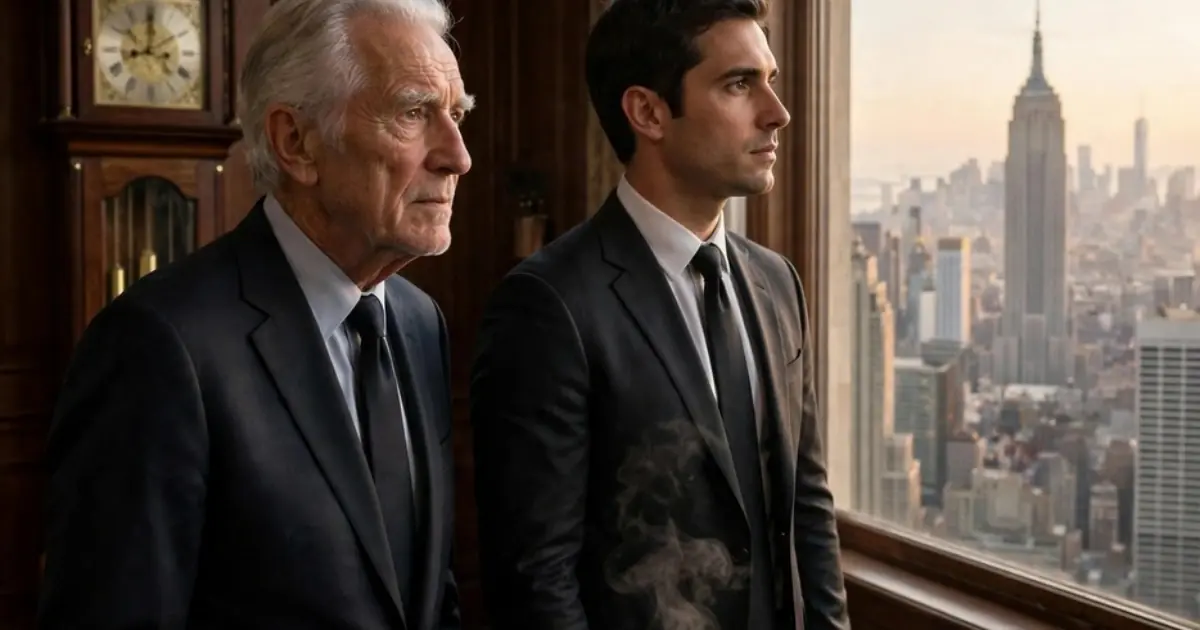
She asked the crew for tea, and when it came she held the cup in both hands and let the warmth seep into her palms. Charles Sterling sat in that study most evenings with a book and a cup, and the lamplight fell across the pages, and the house settled around him with creaks and sighs, and for a moment Victoria could see him there so clearly that she had to close her eyes. He was seventy two years old, a chairman with silver hair and a voice that could quiet a room without rising, and he had built the company from a small office with two desks into a name that mattered in London and New York both. She had wanted his approval all her life, and she had earned it in pieces, a nod here, a brief smile there, a case won, a contract saved, and she had never once heard him say that he was proud of her in plain words. Tonight, above the Atlantic, she allowed herself to admit that she had wanted such words more than she had wanted the title or the office or the salary, and the admission hurt in a clean way, like cold water on a cut.
The aircraft shuddered once as it crossed a band of rough air, and the seat belt sign chimed, and Victoria tightened her belt and set the cup down. She thought of Marcus, her brother, thirty four years old and steady in a way she had never been, with Sophia beside him in the house that had once been full of voices and now held only echoes. Marcus had always been the son who stayed, the son who listened, the son who kept his temper when she lost hers, and she wondered what he was doing tonight, whether he was awake in the dark, whether he was thinking of her at all. She had loved him since childhood, in the fierce and careless way that sisters love brothers, and she had also envied him, because their father looked at Marcus and saw a future, and looked at her and saw a problem to be managed. The envy had curdled over the years into something sharper, something she did not like to name, and on the flight she named it at last, silently, to herself alone. Ambition. She had wanted the company. She had wanted the chair. She had wanted the voting rights that Eleanor, her late mother, had kept with Charles in a separate will, and she had wanted them with a hunger that had surprised even her. The wanting had led her down roads she could not now walk back along, and the ticket in her pocket was the price of the road, and the road ended in London, in rain, in a city where no one knew her name.
London. She had been twenty two then, and the future had seemed wide and bright, and she had believed that a law degree and a famous name would be enough to carry her anywhere. Now she was returning at thirty seven with a suitcase and a resignation and a name that no longer opened doors, and she wondered what London would make of her. A flat somewhere quiet, perhaps, with a window that looked onto a street where buses passed and people hurried with umbrellas. A job, perhaps, in a firm where no one knew the Sterling name, where she would be judged on her work and nothing else. A life, perhaps, lived at a slower pace, with mornings that began with tea and a newspaper, and evenings that ended early, and weekends that belonged to her alone. The picture was modest, and the modesty of it appealed to her, because for years her life had been grand and hollow, a great house with empty rooms, and she was tired of the echo.
She opened the book she had packed and read a few pages without taking in a word, and then she closed it and put it back in her bag. Her thoughts kept returning to the house, to the long hall, to the clock, to the study where her father sat, and she let them come, because there was nothing else to do at thirty thousand feet except think, and the thinking was a kind of packing too, a sorting of what she would carry forward and what she would leave behind. She would carry the law, because the law was in her bones, the habit of reading a contract line by line and finding the clause that changed everything. She would carry her mother, Eleanor, who had died years ago, her voice still clear on certain evenings, low and calm, telling her to be kind and to be careful and to remember that power without kindness was only noise. She would carry Marcus, and the memory of a brother who had once shared a bicycle with her on a summer lane, and who had waited for her at the top of a hill when her legs gave out. She would leave behind the hunger for the chair, and the late nights, and the meetings that ran past midnight, and the feeling that she was always one argument away from being enough. She would leave behind the name as a key, and keep it only as a name, plain and unadorned, Victoria Sterling, a woman on a night flight with a ticket in her pocket and a suitcase in the hold.