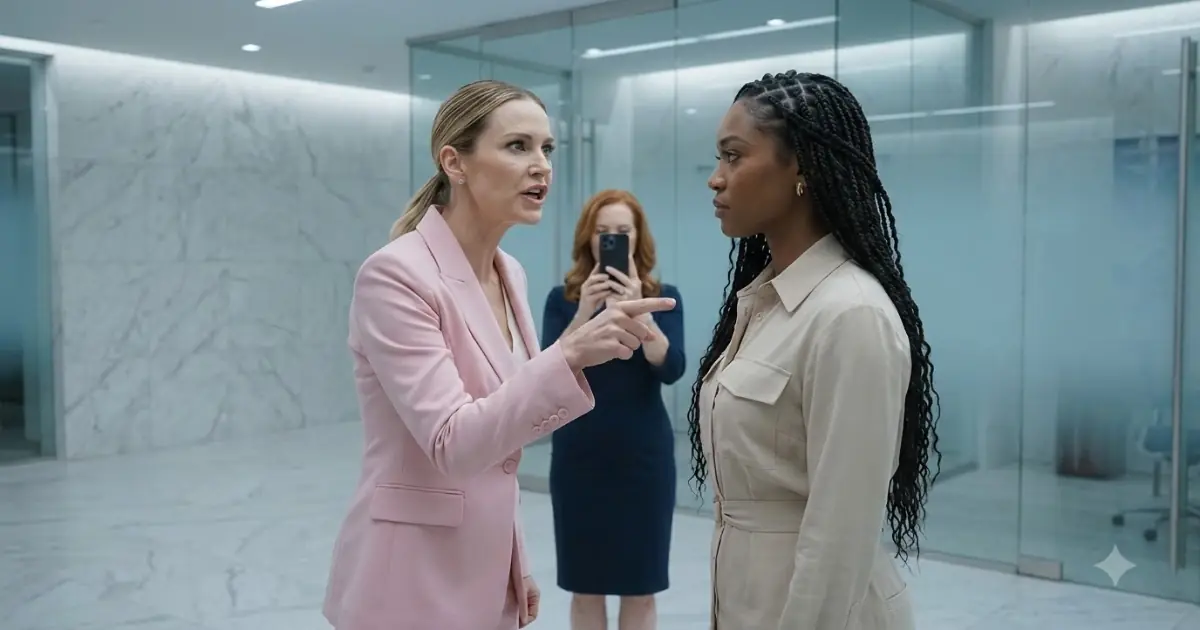
The woman in the pink suit had made one mistake.
She had mistaken silence for weakness.
In the gleaming showroom of Sterling Automotive, beneath rows of recessed lights and walls of glass, Vanessa Carlisle stood inches from a Black woman wearing an ivory blazer and a simple black skirt. Vanessa's blonde hair was pulled into a flawless ponytail. Her pink suit was tailored to perfection, her heels clicked sharply against the marble, and her expression carried the confidence of someone who had spent years believing that the world should move whenever she demanded it.
The woman facing her did not move.
She held a black portfolio against her side. Her long braids fell neatly over her shoulders, and her face remained calm despite the pointed finger Vanessa had thrust toward her.
"Do you understand what I'm telling you?" Vanessa demanded. "You cannot simply walk into this showroom and interfere with a private presentation."
The Black woman glanced briefly at the silver luxury vehicle displayed behind them.
"I'm not interfering with anything."
"Then why are you standing here?"
"Because I have an appointment."
Vanessa gave a short laugh.
"An appointment? With whom?"
"Mr. Whitmore."
The name seemed to irritate Vanessa.
"Mr. Whitmore is meeting with investors and senior executives. He doesn't have time for walk-ins."
"I didn't walk in. I was invited."
"By whom?"
The woman looked directly at her.
"By Mr. Whitmore."
A red-haired employee standing several feet behind Vanessa raised a smartphone, apparently recording the confrontation. Two sales representatives exchanged uneasy glances. Beyond the glass partition, a group of visitors gathered around the silver vehicle, waiting for the presentation to begin.
Vanessa noticed the audience and lowered her voice just enough to make her words sound more deliberate.
"Listen carefully. This is a high-end showroom. We have clients arriving from all over the country. We cannot allow people to wander around claiming to have appointments."
The woman in ivory tightened her grip on the portfolio.
"I understand the importance of professional standards."
"Then act professionally and leave."
The woman's expression barely changed.
"Perhaps you should verify my appointment before asking me to leave."
Vanessa stepped closer.
"I don't need to verify anything. I know who belongs here."
For a moment, the air between them seemed to grow colder.
The woman in ivory studied Vanessa's face, not with anger, but with a kind of quiet disappointment.
"Do you?"
Vanessa opened her mouth to answer.
Then the elevator doors at the far end of the showroom slid apart.
An older man in a dark charcoal suit stepped out. His silver hair was neatly combed, and he carried himself with the confidence of someone whose decisions could move millions of dollars. He was accompanied by two executives, both holding folders.
The moment he saw the confrontation, he stopped.
His eyes moved from Vanessa to the woman in ivory.
"What's happening here?"
Vanessa immediately turned toward him.
"Mr. Whitmore. I'm sorry you have to see this. We're handling an unauthorized visitor."
The older man did not look at her.
He was staring at the woman Vanessa had just ordered out.
"Dr. Bennett?"
The woman in ivory offered a small, composed smile.
"Good morning, Charles."
Vanessa's expression changed.
The older man crossed the showroom quickly.
"I didn't realize you had arrived. We were expecting you upstairs."
"I thought I'd take a look at the presentation before everyone gathered."
"Of course. The vehicle is ready, and the board members are waiting."
He turned toward the silver car, then back toward her.
"Are you all right?"
"I'm fine."
His gaze shifted to Vanessa.
"Why was she being asked to leave?"
Vanessa's lips parted.
"I—there was a misunderstanding."
Charles Whitmore looked at her for a long moment.
Then he said something that made the red-haired employee lower her phone.
"Vanessa, I'd like you to meet Dr. Evelyn Bennett. She is the majority owner of Sterling Automotive, the person who approved this facility's expansion, and the new chairwoman of the company."
The showroom went silent.
Vanessa's pointing hand dropped.
For the first time that morning, she seemed unable to find the right words.
Evelyn adjusted the black portfolio beneath her arm.
"Now," she said calmly, "perhaps we can begin the presentation."
But the presentation was no longer the most important thing happening in the showroom.
Because Evelyn Bennett had not come to Sterling Automotive merely to admire a new vehicle.
She had come to discover why the company she had invested millions in was losing customers, driving away talented employees, and quietly rewarding the very people who were damaging its reputation.
And the woman in the pink suit had just given her the first reason to investigate.
Vanessa Carlisle had no idea how much of her carefully constructed world was about to collapse.
Three weeks earlier, Evelyn Bennett had stood in the conference room of a private investment firm in Manhattan, listening to a financial analyst explain why Sterling Automotive represented an unusually attractive acquisition.The company had a recognizable name, a network of premium dealerships, and a growing presence in the electric luxury vehicle market. Its newest model had attracted attention from industry publications, and its expansion plan promised substantial growth.
But Evelyn was not interested in a company simply because its balance sheet looked impressive.
She had spent twenty-two years building Bennett Capital from a small advisory office into an investment group with holdings in technology, commercial property, logistics, and manufacturing. She had learned that the numbers told only part of a company's story.
The rest was written in the way it treated people.
She remembered her first job after college, when she had worked as an administrative assistant in a downtown office. She had been the only Black woman on the floor. Her supervisor had repeatedly assigned her work that belonged to other departments, then criticized her when she failed to complete everything on time.
When she asked for clarification, he called her difficult.
When she requested a promotion, he told her to be patient.
When a younger employee with less experience received the position she had applied for, she was told that he had a more suitable executive presence.
Evelyn had left six months later.
She had never forgotten the feeling of walking out of that building with a cardboard box in her arms, wondering whether she would ever find a workplace where competence mattered more than assumptions.
That experience had shaped the way she ran her own companies.
She expected high standards. She demanded accountability. She believed in measurable performance and financial discipline. But she also believed that respect was not a reward reserved for people with expensive clothes, impressive titles, or powerful friends.
It was the minimum standard of human behavior.
When her investment team first presented Sterling Automotive, she had asked for more than financial reports.
She requested customer satisfaction records, employee turnover data, warranty complaints, supplier evaluations, and internal reports concerning workplace conduct.
The results were mixed.
Sales were strong, but customer retention had declined in three regions. Employee turnover was unusually high among sales support staff. Several qualified applicants had withdrawn after interviews. A small number of complaints suggested that customers were receiving different levels of service depending on how they dressed, where they lived, or what kind of vehicle they appeared likely to purchase.
One report caught her attention.
A woman who had arrived at a dealership wearing work clothes had been ignored for nearly forty minutes. When she asked for help, a salesperson told her that the dealership did not offer financing for customers in her situation.
The woman later purchased two luxury vehicles from a competitor.
Another complaint described a business owner who had been refused a private viewing because the receptionist assumed he was a delivery driver.
The company had dismissed both incidents as isolated customer-service failures.
Evelyn was not convinced.
She asked her team to investigate further, but the information available from headquarters was incomplete. Several complaints had been marked resolved without a documented follow-up. Some customer records contained notes that were difficult to justify.
One entry read:
Customer not a serious buyer. Limited presentation potential.
Another stated: