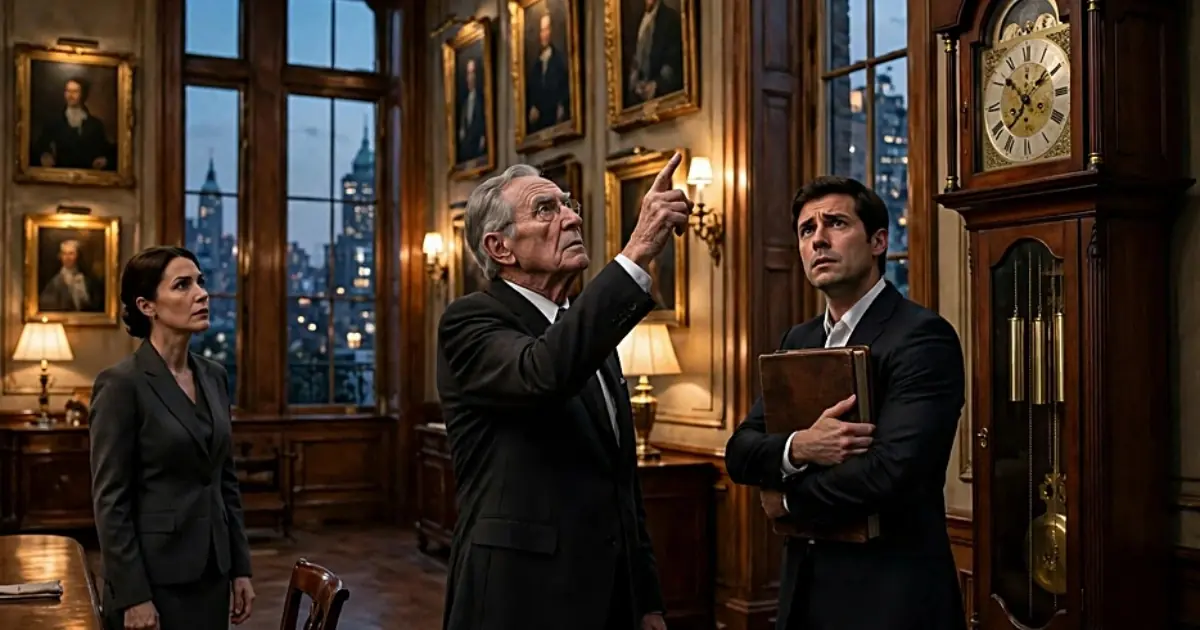
 The hall of the mansion in Manhattan held the last light of the day in its tall windows, and the quiet in the house was the kind that comes before a storm. Marcus Sterling stood near the foot of the grand staircase with a leather ledger in his hands, and he had been standing there for a long time, waiting. The household staff had gone to the far rooms one by one, as if the air itself had told them to leave, and now only the ticking of the grandfather clock in the corner broke the silence. Above the mantel the portraits of the founders looked down on the empty chairs, and the long table in the dining room beyond the arch stood set for a dinner that no one would eat. Marcus did not sit. He turned the ledger over in his hands and read the same lines again, and each time he read them the anger in his chest grew colder and harder.
He had flown home that afternoon, called back from a business trip by a voice on the telephone that had sounded grave and tired. The call had come from the audit committee, and the message had been short: the liquidity fund was short by eight million dollars, and the trail led to his father. Marcus had sat in the audit room for two hours and read every page the committee laid before him, and the pages had told a single story, over and over. Money had moved in the night, through accounts he had never seen, and every transfer bore the name of Charles Sterling. He had driven from the airport in a silence of his own, and he had walked into the mansion with the ledger under his arm and a question in his throat that he did not want to ask.
Now he waited, and the hall waited with him. The evening light fell across the marble floor in long gold bars, and the chandelier above hung dark and still. Somewhere upstairs a door closed softly, and then the house fell quiet again. Marcus looked at the grandfather clock, tall and dark against the wall, and he thought of all the evenings his father had stood in this same hall and greeted guests with a smile. He thought of his mother, Eleanor Sterling, who had died six months earlier, and of the empty chair at the head of the table where she used to sit. The house had never felt so large, or so empty.
Charles Sterling came down the stairs slowly, one hand on the rail, and the sight of him stopped Marcus where he stood. At seventy two, the chairman of Sterling Global Logistics still carried himself upright, but the evening had taken something out of him, and his face looked gray in the fading light. He wore a dark suit and a white shirt, and his shoes made almost no sound on the marble. He looked at his son, and then at the ledger, and something in his eyes told Marcus that he already knew why his son had come.
"Father," Marcus said, and the word came out harder than he meant it to. "We need to talk."
Charles nodded, and he came to a stop a few paces from his son. "Then talk," he said. "I have waited all evening for you to say what you came to say."
Marcus opened the ledger and held it out, and his voice shook when he spoke. "Eight million dollars is gone from the liquidity fund," he said. "Gone. The audit committee found it this morning, and the papers carry your name."
The words fell into the hall like stones dropped into still water. Charles stared at the ledger, and his hands began to tremble. He did not reach for the book. He looked at his son as if the man before him had become a stranger, and for a long moment he said nothing at all. The clock ticked on in the corner, and the light in the windows faded a little more.
Charles put a hand to his chest, as if the words had settled there like a weight, and he swayed a little where he stood. Marcus took a step toward him, and then stopped, torn between the son who wanted to catch his father and the accuser who wanted the truth. Charles waved the help away with a small motion of his hand, and he steadied himself against the back of the nearest chair. "I am all right," he said, though his voice said otherwise. "Say the rest of it. Say it all, so that I hear it plainly."
"You hold the ledger as if it were a weapon," Charles said at last, and his voice was low. "Is that what I have become in your eyes, Marcus? A thief in my own house?"
Marcus wanted to believe him. He wanted to set the ledger down and tell his father that the committee had made a mistake, and that the money would be found in the morning, safe in some account that had been overlooked. He had grown up in this house, and he had watched his father build Sterling Global Logistics from a single small office into a tower of glass and steel. He had sat at the long table as a boy and listened to his father talk about ships and schedules and the men who worked the night shifts, and he had learned early that a man's name was the only wealth that could not be bought back once it was spent. Now he stood in the hall with a ledger full of numbers that said his father's name had been spent, and the weight of it sat on his chest like a stone.
Marcus knew the company the way a sailor knows a ship. He had worked in the tower since his twenties, first in the shipping office, then in the operations wing, and now as the executive who ran the business across the northern half of the continent. He knew the ledgers, the schedules, the crews, and the clients, and he knew that eight million dollars did not simply vanish. Someone had moved it, and moved it with care, and the trail had been laid out in the books as neatly as a path through a garden. That neatness troubled him more than anything else, for a thief in a hurry leaves a mess, and this trail had no mess in it at all.
"I flew home the moment the call came," Marcus said. "I sat in the audit room and I read every page. The money moved in the night, through accounts I have never seen, and every transfer bears your signature. Tell me it is a mistake. Tell me someone made an error in the books. Tell me anything but what the ledger says."
Charles shook his head, and tears came into his eyes. "I never signed any transfer paper," he said, and his voice broke on the words. "I never touched the liquidity fund. I have given my life to this company, and I would sooner lose the house than steal from the people who work for it."
"Then explain the money," Marcus said, and his voice grew louder. "Explain the signatures. Explain why the fund is short by eight million dollars and why the trail leads to your desk. The committee will meet again on Friday, and the board will want an answer. If you cannot give them one, they will take the chair from you, and they will be right to do it."
"Where is Victoria?" Charles asked. "She should be here. She is chief legal counsel, and the committee answers to her as much as to me."
"She called this morning," Marcus said. "She is at the tower, with the lawyers. She said she would come when the committee calls her." He paused, and his jaw tightened. "She was the one who found the shortfall, Father. She reported it herself."
Charles absorbed that in silence, and something flickered in his eyes, too quick for Marcus to read. "Then she did her duty," he said quietly. "As she always does."
Charles wiped his eyes with the back of his hand, and when he spoke again his voice was quieter, and steadier. "Someone very close in this family betrayed me," he said. "I do not know all of it yet, but I know this much. The thief sits at our own table, and the thief wanted you to look at me."
Marcus laughed, a short sound with no mirth in it. "You ask me to believe that someone else used your name and your authority, and you knew nothing? Father, I came here as your son. Do not make me leave here as your judge."
Marcus looked away, toward the tall windows and the city beyond them, and for a moment he was a boy again, sitting on the floor of his father's office while the city hummed below. He had never once heard his father lie, not to a client, not to a worker, not to his own children, and the memory of that honesty cut him now more keenly than any line in the ledger. "If you are innocent," he said, "then someone has done a terrible thing, and I will find out who. But if you are not, Father, then nothing in this house will ever be the same."
"Your mother trusted me with this house," Charles said, and his voice shook again. "She trusted me with the company, and with you, and with Victoria. Six months she has been gone, and not a day passes when I do not miss her counsel. She would have known what to do tonight. She always knew."
For a moment neither man spoke, and the hall seemed to hold its breath. Charles looked at his son, and he saw the boy he had once carried on his shoulders, and the young man he had taught to read a balance sheet, and the executive he had trusted with half a continent. The pain of it nearly bent him double, and he put a hand on the back of a chair to steady himself. Then he drew a slow breath, and the trembling in his hands eased a little.
"I will give you proof," he said. "Not tonight, and not in anger. Tomorrow morning, at nine o'clock, call the family together in this hall, and I will show you the truth. Every name. Every voice. Everything the thief did, and when."
Marcus studied his father's face, searching for a crack in it, and found none. "Nine o'clock," he said. "If you have nothing by then, I will not be able to shield you from the board."
The grandfather clock had stood in that corner for forty years, a gift from the founders of the company on the day the tower opened, and its steady ticking had marked every family dinner, every holiday, every quiet evening in the hall. No one ever looked at the top of it. The carvings ran high up the dark wood, and the small black camera sat among them like one more shadow, unnoticed by the staff who dusted the shelves and by the guests who came and went. Charles had set it there himself, three weeks earlier, and he had told no one.
Charles nodded once, slowly, and he turned away from his son. His gaze traveled across the hall to the corner where the grandfather clock stood, tall and dark against the wall. He lifted his arm, slowly, and pointed up at the small black camera hidden on top of the clock, a small dark eye that had watched the hall in silence for weeks. Marcus followed the line of his father's finger, and his eyes widened. Charles kept his arm raised, and his voice, when it came, was low and sure. "The truth is already recorded," he said.
When Marcus had gone, the hall fell silent again, and Charles Sterling stood alone in the middle of it for a long time, listening to the clock tick in the corner. The evening had deepened into night beyond the tall windows, and the city lights had come on across Manhattan, a thousand small fires in the dark. Charles did not call for the staff. He did not ring for tea. He stood where his son had left him, and he let the quiet settle over him like a blanket, and for the first time since the morning, his hands stopped trembling.
He thought of the look in Marcus's eyes as his son had walked out, the look of a man who did not want to believe what the ledger told him and who believed it anyway. Charles felt no anger toward his son. Marcus had been handed a book full of numbers and a trail that led to his father's desk, and any honest man would have done what Marcus had done. The anger Charles felt was colder than that, and it was aimed at the one who had laid the trail, the one who had wanted father and son to stand in this hall and tear each other down with words. He would not give that one the satisfaction. He drew a slow breath, and he walked to the west wing study with slow steps, and he closed the door behind him.
The study was his own room, lined with shelves of books and the smell of old wood and ink, and the large desk by the window held the papers of the day in neat stacks. Charles sat in the leather chair behind the desk, and he took his telephone from his jacket pocket and set it on the desk before him. The screen lit up at his touch, and the small black camera on top of the grandfather clock in the hall looked back at him from the screen, live and clear. The image showed the hall exactly as he had left it: the empty chairs, the long table, the portraits above the mantel, the clock ticking in the corner. Charles watched it for a while, and a slow calm came over him.
The camera streamed live to his telephone, day and night, and every hour of its watching was backed up to the cloud, safe beyond the reach of any hand in the house. Nothing that happened in the hall or in the study could be unwatched now, and nothing could be undone. He had watched the stream each night before bed for three weeks, and he had learned the rhythm of the house after dark: the staff locking the doors, the lamps going out one by one, the long quiet hours when only the clock moved. And he had learned something else, too. He had seen figures in the study late at night, and he had heard voices he knew, and he had watched the footage until he understood what it meant. He did not need to name the voices aloud, not yet. The morning would do the naming.
Three weeks earlier, he had found the first small discrepancy in the London books, a figure that did not match the one beside it, small enough to be an error and strange enough to trouble him. He had spent a night with the ledgers, checking line by line, and he had found two more small mismatches, each one tiny, each one easy to miss. A lesser man might have called the audit committee at once and let the noise begin. Charles had not. He had built the company over a lifetime, and he knew that a loud accusation made too soon can wound the innocent and warn the guilty. He had said nothing to anyone, not even to Marcus, and he had decided to watch first, and to learn.
That night he had sat at the desk until the lamps burned low, turning pages with a patience he had learned in the early years of the company, when every coin had mattered and every error had a name behind it. The mismatches were small, a sum here, a sum there, each one the size of a rounding error, and each one pointing the same way, toward the liquidity fund. He had closed the ledgers at last and sat in the dark study listening to the house breathe around him, and he had understood that someone inside the company was moving money in the dark, and that the someone knew the books well enough to hide the trail. The knowledge had settled on him like a cold hand, and he had not slept at all that night.
Instead, he had called a quiet man he trusted, a man who installed such devices for banks and museums, and he had asked for a camera so small that no eye would catch it, and so silent that no ear would hear it. The man had come in the morning, while the staff were at market, and he had set the small black camera on top of the grandfather clock, among the carvings, where the eye travels past without stopping. Charles had paid him in full and asked for silence, and the man had nodded and gone. From that day on, the camera had watched the hall and the study, and Charles had watched the camera, checking the stream each night before bed, learning who used his study after hours, and when, and for how long.
He tested the stream now, as he did every night. He tapped the screen and the image shifted to the study itself, the desk, the shelves, the window, all empty and still. He tapped again and the hall returned, the clock ticking on, the chairs in their places. The picture was sharp, the sound clear, and the backup to the cloud had run without a fault since the day the camera was set. A man who hides a camera in his own house must be certain it will not fail him when he needs it, and Charles had made certain. He set the telephone down beside the lamp, and he opened the top drawer of his desk.
Inside the drawer, beneath a stack of old shipping manifests, lay the USB drive, a small dark stick no longer than his thumb. He held it in his palm for a moment, feeling its slight weight, and then he slid it into the side of his laptop and waited for the files to appear. They came up in a neat row on the screen: the footage from the hall, the footage from the study, the server logs, and the statement from Dr. Evans about the sleep medicine in his blood. He opened the first file and watched a few seconds of the hall, silent and empty, and then he closed it again. Everything was there. Everything was safe.
He thought, briefly, of the night three days earlier, when sleep had come down on him like a weight after his cup of chamomile tea, and he had woken in his study chair with his jacket still on and his head full of fog. At the time he had blamed his age and the long day. He had gone to Dr. Evans the next morning, more from habit than from fear, and the doctor had taken his blood and told him to rest. The statement on the drive said what the blood had shown, and Charles had read it twice and put it away without a word to anyone. Now, with the footage safe in his hand, he set the thought aside for the morning. The meeting at nine o'clock would ask its own questions, and the answers were already recorded.
Charles looked up at the portrait of Eleanor on the wall above the shelves, her face calm and kind in the lamplight, and he spoke to her in the quiet of the room, as he had done every night since her death. "You always said the truth needs no shouting," he said. "Only a witness. I have my witness now."
He got up from the chair and walked to the window, and he looked out over the city where the lights of the tower stood among the lights of Manhattan like a constellation that had come down to earth. He had built that tower from a single small office, and he had built it with his wife beside him, and he had promised her, on the day she died, that the house and the company would stand as long as he lived. The promise had held him through the six months since her death, through the long evenings and the empty mornings, and it held him now. Whatever the morning brought, the house would stand.
He remembered the way she used to sit in the chair by the window in the evenings, reading the company papers with a pencil in her hand, catching errors that three accountants had missed. She had been the financial brain of the company, and Charles had never been too proud to say so. The house had been quieter since her death, and the company had been colder, and Charles had felt her absence every day, in the empty chair at the table and in the silence of the mornings. Tonight, for the first time in six months, the quiet felt less like an absence and more like a vigil. The truth was in the house, and the morning would bring it into the light.
He thought of Marcus then, and of the apology his son would owe him, and of the forgiveness he had already decided to give. Marcus had been deceived, not cruel, and a father who has been wronged by his own child must decide whether to answer with anger or with grace. Charles had made his decision before the sun went down. He would not shout. He would not accuse. He would play the recording, and let the voices speak for themselves, and then he would do what a father must do, and what a chairman must do, and he would do it without raising his voice.
He would not call the police, not yet, and not unless the family failed him. A scandal would stain the name his wife had helped him build, and it would frighten the employees and the clients, and it would do nothing for the truth that a quiet morning in the hall could not do better. If the thief would own the act and leave, the house could heal. If not, the law would have its turn. Either way, the decision would be his, and his alone, and it would be made in the morning.
He thought of the company, too, and of the three thousand employees with livelihoods resting on the tower and the ships and the schedules, and of the board that would meet on Friday with the audit committee at its side. A scandal would wound them all, and Charles had no wish to wound them. He would settle this inside the family, in the hall, at nine in the morning, and the company would go on as it always had, steady and sound. That was the duty of a chairman, and it was also the duty of a father.
He put the USB drive back in the drawer and locked it, and he set his telephone beside the lamp where he could see the small live image of the hall. He would sleep in the study tonight, as he had done on many nights before, with the door locked and the truth close at hand. The board would meet on Friday, and the family would meet at nine in the morning, and by then the thief would have nowhere left to hide. Charles lowered the lamp, leaned back in the chair, and closed his eyes, ready for the morning and for whatever it would bring.
The telephone rang before dawn, while the house still slept and the city beyond the tall windows lay dark under a thin wash of rain. Charles Sterling reached for the receiver with a hand that already knew, in the way old hands know such things, that no good news ever arrived at such an hour. A nurse spoke from the hospital in a low and careful voice, and she asked him to come at once. He dressed in the dark, his fingers fumbling with buttons he had fastened a thousand times before, and he drove through empty streets with the windshield wipers beating a slow rhythm against the glass. By the time he reached the hospital, Eleanor Sterling was gone.
The doctor met him in a quiet corridor and told him, in plain words, that her heart had failed in the night. She had complained of tiredness in the days before, and of a heaviness in her chest when she climbed the stairs, and Charles had told her to rest, and she had smiled at him and said she would rest when the quarter ended. The rest had come too late. He sat beside her bed for a long time after the machines were stilled, holding a hand that was still warm, and he spoke to her in a low voice about the garden and the house and the company, as if words could still reach her. When at last he stood to leave, the room seemed smaller than it had been, and the corridor outside seemed longer, and the whole hospital seemed hushed, as if the building itself understood that something central had gone out of it.
The mansion stood quiet behind its gates, and the staff moved through the rooms with soft steps and lowered voices, and no one asked him anything, because there was nothing to ask. In the hall he paused beneath the tall clock and listened to its slow tick, and for a moment he could not remember why he had come downstairs. Then he went into his study and sat in his chair and looked at the papers on his desk, and the papers meant nothing, and the morning light moved slowly across the floor.
The funeral was held three days later, in a chapel filled with white lilies and with people who had known Eleanor Sterling in all the ways a woman can be known. Board members sat in the front rows, their faces grave, and employees of the company filled the rows behind them, and friends from long years stood at the back, and the minister spoke of a life spent building, and of a woman who had kept the accounts of a great house in order with a steady hand. Marcus stood beside his father through it all, tall and straight, his hand resting lightly on the old man's shoulder, and when the coffin was carried out into the pale light of the afternoon, he walked at its side with his head high, as if pride itself could hold grief upright.
Marcus had always believed in the order of his family, and in the rightness of the way his father and mother had built their lives. His father had raised the company from the docks with long days and stubborn will, and his mother had given the company its discipline, its reserves, its careful arithmetic, and Marcus had grown up in the space between the two of them, learning the vision from one and the numbers from the other. At the funeral he felt the weight of the name he carried, and he felt proud to carry it, and when people came to him afterward with condolences, he thanked them with a steadiness that surprised even himself, because his mother had trusted his father completely.
Victoria stood a little away from the family group, dressed in black, her face composed, her grief held close and private. She had loved her mother deeply, and she had learned at her mother's side how a company is truly kept, not by speeches in boardrooms but by contracts read line by line, by disputes settled before they became lawsuits, by late nights in an office high above the city while the lights of Manhattan glittered below. She had guarded Sterling Global Logistics for a decade, and she knew its weak places and its strong ones, and she had believed, in a quiet corner of her mind, that her mother knew it too, and that when the time came, her mother would say so in the plain language of a will. At the funeral she wept once, briefly, and then she dried her eyes, and she told herself that grief was grief, and business was business.
A week after the funeral, the family gathered in the office of the family lawyer to hear the reading of the will. The room was quiet, and the lawyer's voice was even and unhurried, and he read through bequests and instructions in the careful language of the law, while Charles sat with his hands folded and Marcus sat upright and Victoria sat very still. Then the lawyer came to the matter of the voting shares, and the room seemed to grow quieter still. Eleanor Sterling had left a block of forty percent of the voting shares. Thirty percent was placed in a trust that Charles controlled, to be held by him for the good of the company and the family. Ten percent was split between Marcus and Victoria, five percent to each of them. The lawyer read the numbers aloud, and the numbers hung in the air, and no one spoke for a long moment.
Charles himself heard the terms of the will with a quiet acceptance that surprised no one who knew him well. The trust was a burden and a gift at once, and he took it as his wife had meant it, as a charge to keep the company steady and the family whole. He did not want the chair without Eleanor beside him, and he said so to no one, because there was no one to say it to, and he went on chairing the board and signing the papers and taking the calls, because the company needed a chairman, and the family needed a father, and he was both, and he would be both until he could no longer stand it. In the evenings he sat in his study and looked at the chair where Eleanor had once sat with her ledgers, and he felt the weight of the trust settle on his shoulders like a coat he would wear for the rest of his life.
Marcus heard the terms of the will as a confirmation of everything he believed. His mother had trusted his father with the largest share, and rightly so, because his father was the founder, the man who had built the company from nothing, and the trust in his hands was the natural order of things. The five percent that came to Marcus himself felt generous, and he accepted it with gratitude, and he thought of it as his mother's faith in the next generation, a small share that would grow in time, as all good things grow when they are tended with patience. He believed the family would go on as it always had.
Victoria heard the same words and felt them land like a verdict. She did the arithmetic in her head before the lawyer had finished speaking, and the arithmetic was simple and cold. Her father held thirty percent in trust. She and her brother shared ten between them. She had given the company a decade of her life, the best years of her working life, and she had settled disputes that could have cost the company millions, and she had written contracts that protected it from rivals on two continents, and her reward was five percent and a seat at a table where her father still held the gavel. She kept her face still, because she had learned long ago to keep her face still, but inside her a door closed quietly, and behind the door a new thought began to form, a thought she did not yet have words for, a thought that felt like justice and like hunger at the same time.
Eleanor Sterling had been the financial brain of the company, and everyone who knew the inside of Sterling Global Logistics knew it, even if the world outside saw only the chairman. Charles had the vision and the daring, the instinct for a deal and the courage to risk everything on it, but Eleanor had the discipline, the ledgers, the reserves set aside in good years to carry the company through bad ones, the quiet refusal to spend what had not yet been earned. She had taught Victoria to read a balance sheet the way other mothers taught their daughters to read music, and she had taught Marcus that a company is a promise made to thousands of people who depend on it for their bread. In the days after her death, the company felt her absence in a hundred small ways, in questions no one could answer as quickly, and in a silence at the center of the tower where her judgment had once sat.