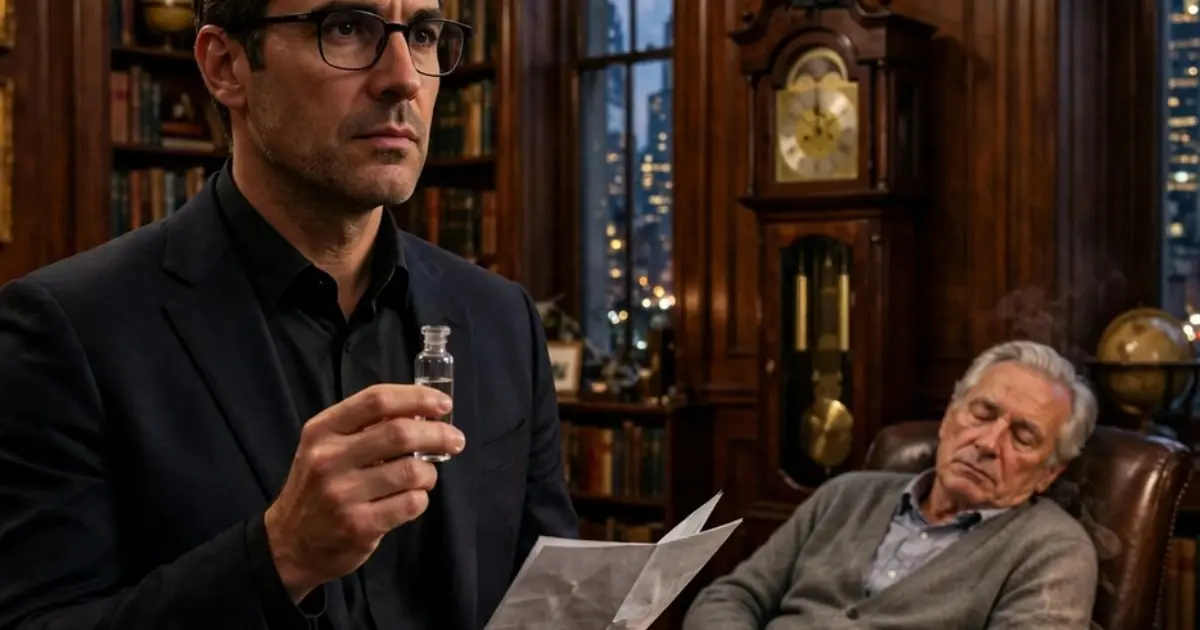
The telephone rang in Dr. Evans's kitchen at seven in the morning, and the sound cut through the quiet of the small flat above the clinic with a sharpness that woke him fully before he had lifted the receiver. The call came from the Sterling house, and the voice on the line belonged to Marcus Sterling, eldest son of Charles Sterling, and the voice was tight with a worry that tried to sound like control. Marcus said that his father had slept badly and had woken confused and weak, and that the family needed the doctor at the house at once, and Evans heard in the pauses between the words a second story underneath the first, a story that Marcus was not telling. Evans asked three short questions, about breathing and about pain and about whether Charles could stand, and Marcus answered each one quickly, as if he had rehearsed the answers, and then he said that Victoria was with their father now and that Sophia was making tea in the kitchen, and Evans wrote the time on a scrap of paper and reached for his bag.
He had been the Sterling family doctor for more years than he could count without thinking, and he knew the house on the hill above the river as well as he knew his own clinic, knew the long drive and the iron gates and the garden that Eleanor Sterling had loved and tended with her own hands in the summers before her death. Charles was not a man who complained. Charles was not a man who slept badly without reason. Charles was not a man who woke confused. Something in the call did not sit right, and Evans felt the unease settle in his chest as he turned the car through the gates.
Victoria met him at the door. She was thirty seven, chief legal counsel of the company her father had built, tall and composed and dressed as if for a board meeting rather than a morning at a sickbed, and her calm was so complete that it made Evans watch her more closely than he watched the hall behind her. She thanked him for coming so quickly, and she told him in a low even voice that her father had taken his usual sleep medicine the night before and had slept long and deep, and that he had woken late and unsteady on his feet, and that Marcus had found him sitting in the west wing study with his jacket still on and his eyes heavy. She said the words as if they explained everything, and Evans nodded without answering, because a doctor learns early that the first story told at a sickbed is often the story the family needs to believe, not the story the body is telling. He followed her through the hall, past the grandfather clock, and he noticed that the small black camera Charles had set upon the clock three weeks earlier was still there, its lens dark and still, and he filed the sight away without comment.
Charles lay on a couch in the west wing study, a blanket drawn up to his waist, his face pale against the cushions, his breathing slow and even. The room smelled of chamomile tea and old paper, and on the low table beside the couch stood an empty cup, the dregs dark at the bottom, and a saucer with a spoon laid neatly across it. Evans set his bag down and spoke to Charles by name, softly, and the old man opened his eyes and looked at him with a recognition that was clear and immediate, and then the eyes clouded again, as if a fog had drifted across them and then lifted. Evans took the pulse at the wrist, and he counted the beats with his watch, and the pulse was slow, slower than Charles's usual pulse, slow in the way that sleep medicine makes a pulse slow when the dose has been too strong. He lifted an eyelid and looked at the pupil, and the pupil was small and slow to answer the light, and he asked Charles to squeeze his hand, and the grip was weak, weaker than it should have been for a man who still shook hands with the firmness of a man who had once loaded trucks with his own hands.
"How long have you been awake, Charles," Evans asked, and Charles blinked and tried to answer, and the words came slowly, as if each one had to travel a long distance before it reached his mouth. He said that he had woken an hour ago, or perhaps two, and that the room had seemed to turn when he tried to stand, and that his legs had felt heavy, as if they belonged to someone else. He said that he remembered drinking tea in the evening, and that he remembered Victoria sitting with him for a while, and that after that the night had gone dark and silent, without dreams that he could recall. Evans listened, and he wrote nothing down yet, because he wanted the words to settle in his own mind before they became notes in a file. He asked about pain in the chest, and Charles shook his head. He asked about pain in the head, and Charles said that his head felt thick and dull, like cotton pressed behind his eyes. He asked about nausea, and Charles said that his stomach was quiet. He asked about the sleep medicine, how much Charles had taken, and Charles frowned, as if the question itself were difficult, and said that he had taken his usual amount, the amount Evans had prescribed years ago, the amount that had always let him sleep through the night and wake clear in the morning.
Victoria stood by the door, her arms folded, watching the examination with an attention that never wavered. Marcus stood at the foot of the couch, his hands clasped together, his face drawn with a worry that looked real enough, and yet Evans noticed that Marcus kept glancing at Victoria, as if he were waiting for her to speak first. Sophia came into the room with a fresh cup of tea, and she set it down without a word, and her hands trembled slightly as she turned away, and Evans noticed the tremor and noticed also that she did not look at Charles, and did not look at Victoria, and looked only at the floor as she left the room. Evans asked Victoria to step outside with him for a moment, and she followed him into the hall, and the grandfather clock ticked loudly in the silence between them. He asked her when exactly Charles had taken the sleep medicine, and she said that he had taken it with his tea in the evening, as he always did. He asked her who had made the tea, and she said that she had made it herself, in the kitchen, and had carried it to the study. He asked her whether anyone else had been in the study that evening, and she said that Marcus had come in briefly, and that Sophia had brought a plate of biscuits, and that after that Charles had been alone with his papers.
Evans went back into the study and took the blood pressure, and the reading was low, lower than Charles's usual reading, low in the way that a strong dose of sleep medicine makes the pressure fall and stay low through the morning. He listened to the heart, and the heart sounded steady but slow, and he listened to the lungs, and the lungs were clear. He asked Charles to sit up, and Charles tried, and his body swayed, and Evans put a hand on his shoulder to steady him, and felt the muscles tremble under the skin. He asked Charles to stand, and Charles put his feet on the floor, and the legs held for a moment and then gave way at the knees, and Evans caught him before he fell and eased him back onto the couch. The weakness was not the weakness of a man who had simply slept badly.
He took out his thermometer and his torch and his small hammer for the reflexes, and he worked through the examination with a care that left nothing out. The reflexes were slow. The skin was cool and a little damp. The mouth was dry. The tongue was coated. The eyes, when he looked again, were heavy lidded, and Charles fought to keep them open, and then gave in and let them close, and his breathing deepened into sleep again even while Evans was speaking to him. Evans let him sleep for a minute, and watched the rise and fall of the blanket, and counted the breaths, and the breaths were slow and regular, too regular, too deep, the breathing of a man still under the weight of a medicine that had not yet loosened its hold. Something had changed the dose, or something had changed the man, and Evans knew that he had to find which one it was.
Marcus asked whether his father would be all right, and Evans answered with the honesty that had made families trust him for years. He said that Charles needed rest and water and watching through the day, and that he would stay for a while, and that he would come back in the evening, and that no one should give Charles any more sleep medicine until Evans had looked at the blood. The words about the blood made Victoria look up sharply, and for a moment her calm cracked, and Evans saw a flash of something in her eyes that might have been fear or anger or calculation, and then the calm closed over it again, smooth as glass. Marcus asked why the blood mattered, and Evans said that the blood would tell them what the body had carried through the night, and that the blood did not lie about a dose, and that a doctor who wanted the truth started with the blood. He took a sample then, with a needle and a small vial, and Charles barely stirred as the needle went in, and the blood ran dark red into the glass, and Evans labelled the vial with the date and the time and the name Charles Sterling, and put it into his bag with a care that Victoria watched without blinking.
When he left, the sun was high and the house was quiet, and Charles was sitting up and drinking water, and his eyes were clearer, and his voice was stronger, and Evans told Marcus to call him at once if the weakness returned, and told Victoria that he would have the result of the blood test by the next day, and watched her face as he said it. She smiled, and the smile did not reach her eyes, and Evans drove away from the house with the vial in his bag and the unease in his chest growing into a certainty that the story he had been told in the morning was not the story the blood would tell.