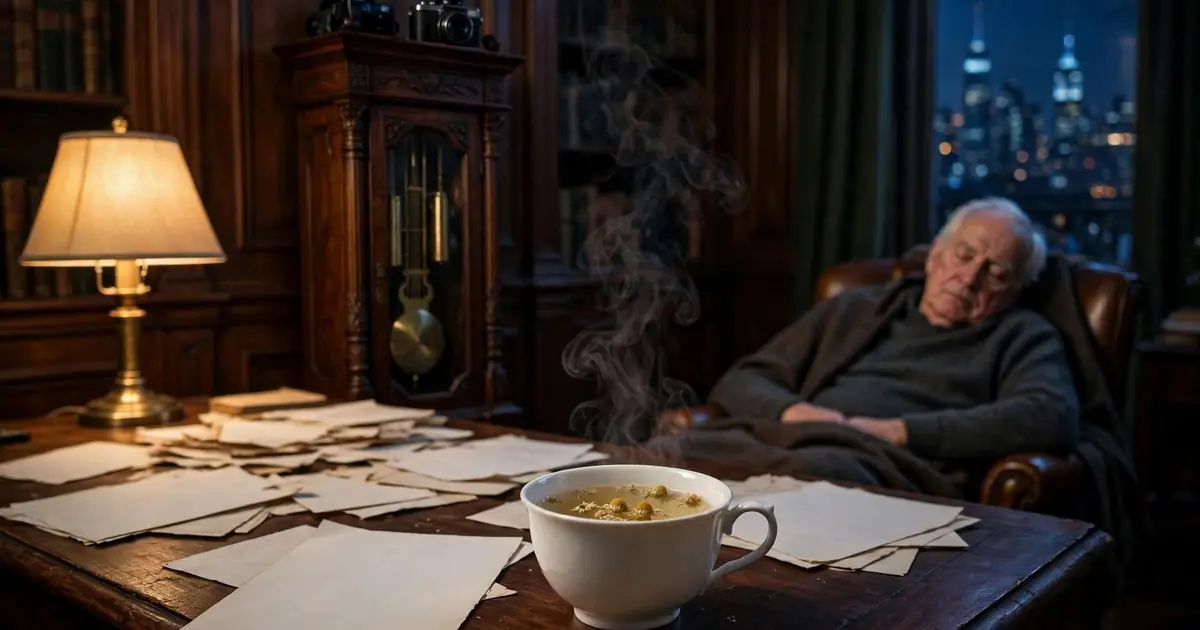
 The house had gone quiet by the time Victoria carried the tray up the stairs to the west wing study. The lamps in the hall burned low, and the rugs swallowed the sound of her shoes, and the only voice in the stillness was the slow tick of the grandfather clock by the stairs. Night had settled over the rooms like a hand laid gently on a shoulder, and the windows showed nothing but the dark glass of the garden and the pale smudge of the moon. She walked without hurry. Hurry would have looked like fear, and fear would have looked like guilt, and she had spent weeks teaching herself to move through the house as if nothing in her life had changed.
The cup was her father's favorite, heavy white porcelain with a hairline crack along the rim that he had refused to throw away. Beside it lay a small spoon and a folded napkin, arranged with the neatness she brought to everything, the same neatness that had made her the chief legal counsel of Sterling Global Logistics before she was forty. No one watching her would have seen anything unusual. A daughter bringing her father tea at the end of a long day. A small kindness, repeated a hundred times before, in a house where kindness had once been easy.
Only Victoria knew what she had done in the kitchen. The bottle of sleep medicine stood in the cabinet above the sink, amber glass, a plain white label, the kind of bottle any household keeps for restless nights. Her father took one tablet each night, dissolved in warm tea, because sleep had grown thin and restless for him since Eleanor died. Tonight Victoria had measured twice the usual amount, stirring it into the chamomile until the liquid ran clear again and no trace of it remained. Her hand had not shaken. She had practiced the motion in her mind so many times that it felt ordinary, like signing her name or locking a door.
She paused outside the study door and listened. From within came the soft rustle of paper and the low creak of her father's chair. He was still awake, still working, still bending over the figures that had filled his days since his wife's death. Charles Sterling had built Sterling Global Logistics from one small store into a company that spanned the country, and he had done it by refusing to leave a number unexamined. At seventy two, his hair was white and his shoulders had narrowed, but his eyes were still sharp when they fell on a column of figures, and his voice still carried the same calm weight it had carried when Victoria was a girl and the company was young.
She knocked once, lightly, and pushed the door open with her elbow. The study smelled of old wood and lamp oil and the faint sweetness of chamomile from nights before. Her father sat in his leather chair beside the desk, a blanket folded across his knees, a stack of papers at his elbow and a pair of reading glasses low on his nose. The lamp threw a warm circle of light across the desk and left the corners of the room in shadow, and the window behind him showed the black garden and the lights of the city far below.
"Your tea, Father," she said, and her voice sounded steady in her own ears, the voice of a daughter and nothing more.
Charles looked up and smiled, the tired smile of a man who had worked past the hour when work should end. "You did not need to trouble yourself, Victoria," he said. "I was almost done here."
"It is no trouble," she said. She set the tray on the desk beside his papers and lifted the cup into his hands, wrapping his fingers around the warm porcelain the way she had done when she was small and he had taught her to hold a cup without spilling. "Drink it while it is warm. You have been at that desk since supper."
He nodded and lifted the cup to his lips. The steam drifted past his face, and he breathed it in, and he drank. Victoria watched the level in the cup fall, slow and even, and she kept her face calm while her heart beat hard against her ribs. He drank again, longer this time, and set the cup down on the tray with a small sigh of comfort. The tea was doing its work already, or she imagined it was, and she told herself to be patient, to let the minutes pass as minutes always passed in this house, one after another, unhurried and unnoticed.
She took the empty tray and moved to the chair across from him, folding her hands in her lap. "The board meeting went well today," she said, because talk was the best cover for waiting, and because her father expected talk from her, the way he had expected it since she first learned to argue a point at his dinner table. "The audit committee asked after you. They want your notes on the London figures before the end of the week."
Charles nodded, his eyes already growing heavy. "Tell them they will have the notes," he said, his voice slower now, the edges of his words softening. "The figures are sound. The company is sound. I have checked them myself."
"Of course you have," Victoria said gently. She watched his head dip once, then lift again with effort, then dip again. The blanket slipped from his knees and pooled at his feet, and his hands loosened their grip on the arms of the chair. The lamp light caught the silver in his hair and the deep lines around his eyes, and for a moment he looked older than his years, a man worn down by grief and work and the long silence of a house without his wife.
"Victoria," he murmured, half asleep already, his eyes closing. "You work too hard. Your mother would say the same."
"I know," she said, and something tightened in her chest at the mention of her mother, a small hard knot that she pushed aside with the same discipline she brought to everything else. "Sleep now, Father. I will look after the papers."
He did not answer. His breathing deepened and slowed, and his head fell to one side against the back of the chair, and the room settled into the hush that follows when a sleeper gives himself over to sleep. The grandfather clock in the hall sounded the hour, a low chime that moved through the walls like a slow wave, and Victoria counted the notes under her breath and waited until the last one had faded.
Then she stood. She moved without sound, the way she had moved through the house all her life, and she crossed to her father's chair and looked down at his sleeping face. He looked peaceful, younger in sleep, and for a heartbeat she felt the weight of what she was doing press against her ribs like a stone. She pushed it aside. The plan was the only road left, and she had already walked too far down it to turn back.
His jacket hung over the back of the chair, dark wool, the pockets worn soft from years of use. Victoria slid her hand into the inside pocket, slowly, her fingers finding the shape she wanted by touch alone. The key card was there, thin and smooth, the card that opened the private office and the secure floor where the company's money moved. Beside it, folded small, was the code he kept written down because he distrusted his own memory in his later years, a string of figures in his careful hand. She took them both and slipped them into her own pocket, and her hand came away empty and clean, and no one in the house would have known that anything had been taken.
She stood for a moment longer beside the chair, listening to her father's breathing and to the slow tick of the clock in the hall. The clock had been in the family since before she was born, a tall dark shape of polished wood with a brass face that caught the lamplight. Her mother had wound it every Sunday without fail, and after her death Charles had taken up the duty himself, turning the key with the same care he gave to everything that had belonged to Eleanor. The clock marked the hours of the house, and it had marked every hour of Victoria's life, and tonight it marked the hour when her plan moved from thought into action.
She gathered the tray and the empty cup and walked to the door. At the threshold she looked back once, at her father asleep in his chair and the papers waiting on his desk and the lamp burning low beside him. The room looked the same as it had looked a hundred nights before, and that was the point. Nothing would look different in the morning. The house would wake as it always woke, and the company would open as it always opened, and only Victoria would know that the night had changed everything.
She closed the study door behind her without a sound and carried the tray down the stairs to the kitchen. She washed the cup and set it back on its shelf, and she dried her hands on a towel, and she stood at the sink for a long moment looking out at the dark garden. Her heart had slowed. Her hands were steady. The key card rested in her pocket, thin and smooth against her palm, and the code lay folded beside it, and the next hours would belong to her alone. The clock in the hall ticked on, patient and blind, marking the minutes as it always had, and Victoria listened to it and thought of the morning to come, when the company would find its money gone and its chairman asleep, and when the plan she had built so carefully would begin to move in the open.
She passed the grandfather clock on her way down the stairs, and she paused with her hand on the newel post, listening to its slow tick in the dark hall. The brass face caught a thread of moonlight from the window, and the sight of it steadied her. The clock had kept the time of the house for as long as she could remember.
She went to her own room and laid out the clothes she would wear in the morning, dark and plain and proper, the clothes of a grieving daughter and a dutiful counsel. She set her shoes by the door and her papers on the table, and she sat on the edge of the bed for a while, her hands folded, her eyes on the dark window. Sleep would not come easily, but she did not need sleep. She needed the morning, and the morning would come, as mornings always came to the house on the hill, with light in the east windows and the clock sounding the hour and the world going on as if nothing had happened in the night.
In the study, Charles Sterling slept on in his chair, his breathing deep and slow, the blanket pooled at his feet, the lamp burning low beside him. The tea had done its work. The medicine had done its work. And above them all, in the hall beyond the study door, the grandfather clock kept its patient watch, marking the hours one by one, keeping the time of a house that did not yet know what the night had cost.
Three weeks earlier, on a gray morning when the rain had washed the windows clean and the city below lay hidden in mist, Charles Sterling sat at the desk in his study and found a number that did not belong.
The papers before him had come from the London office the night before, carried across the ocean by courier and laid on his desk by the morning staff. They were the monthly books, the columns of figures that tracked the company's money as it moved from one office to another, from one account to another, from one quarter to the next. Charles had read such papers for fifty years, and he knew their shape the way a sailor knows the shape of a familiar coast. The totals were sound. The margins were sound. The company was sound, as it had been sound for decades.
Then he came to a single line, halfway down the second page, and his pencil stopped. A sum had moved from the liquidity fund to an account he did not recognize, and the entry beside it gave no clear reason for the move. The figure was not large against the size of the company, but size was not the point. The point was that the line did not reconcile with the lines around it. Money had left one place and arrived in another without a proper road between them, and in all his years of running Sterling Global Logistics, Charles had never let such a thing pass without an answer.
He read the line again, and then a third time, and then he turned back to the pages before it and read them again from the beginning. He checked the totals with his pencil, adding the columns by hand the way he had done when he was young and the company was small and every dollar passed through his own hands. The totals matched. The single line still did not. It sat in the middle of the page like a stone in a shoe, small and easy to miss and impossible to ignore once seen.
Charles set his pencil down and leaned back in his chair. He thought of Eleanor. His wife had been the financial brain of the company, the one who could look at a page of figures and see the story behind them in a single glance, and she would have caught this line at once. She had been gone six months, taken by heart failure on a quiet evening in the spring, and the house had been quieter ever since, and the company had been quieter too, as if the figures themselves missed her. Charles missed her in a hundred small ways each day, and this morning he missed her in the way he missed her most, as the one person who would have understood the trouble in a single line without needing it explained.
He did not call Marcus. His eldest son ran the North American side of the company with energy and confidence, but Marcus saw the world in broad strokes, and a small line in a ledger would have looked like nothing to him. He did not call Victoria either. His daughter was the chief legal counsel, sharp and precise and careful, and she would have asked for the papers and taken the matter in hand, and Charles did not want the matter taken in hand by anyone but himself. Not yet. Not until he understood what he was looking at.
Instead he did what he had always done when a problem first showed itself. He watched, and he waited, and he gathered what he needed in silence. He asked the London office for the full records behind the line, the complete trail of the money from its first move to its last, and he asked in his own name and in his own hand, so that no one else in the company would know that he was asking. The reply came two days later, and it told him less than he had hoped. The trail was thin. The account at the end of it belonged to a name he did not know, and the name led nowhere that he could follow from his desk in New York.
Charles sat with the papers for a long evening, the lamp burning low beside him, the rain moving down the window glass in slow lines. He thought about the company he had built, and about the people who moved through it each day, and about the trust that held it all together. Trust was the true capital of Sterling Global Logistics, more than the money in its accounts or the buildings that carried its name, and trust, once broken, was the hardest thing in the world to repair. He had given his trust freely all his life, to his children, to his managers, to the men and women who had worked beside him for decades. Now a single line in a ledger told him that his trust might have been misplaced, and he did not know where, or by whom, or how far the misplacement went.
On the third morning he made his decision. He would not accuse anyone. He would not raise an alarm. He would simply watch, and he would watch with eyes that could not be fooled. He went himself, alone, to a small shop in the city, and he bought a small black camera, no larger than a matchbox, with a lens that saw clearly in low light and a memory that kept everything it saw. He paid for it himself and carried it home in his coat pocket, and he told no one what he had bought or why.
That evening, when the house was quiet and the staff had gone to their rooms, Charles carried a chair into the hall and stood on it before the grandfather clock. The clock had stood in the hall since before his children were born, a tall dark shape of polished wood with a brass face that caught the lamplight, and Eleanor had wound it every Sunday without fail, and after her death Charles had taken up the duty himself. He knew the clock as he knew his own hands. He set the small black camera on the top of it, behind the carved crest, where it could not be seen from the floor below, and he angled the lens toward the study door and the stretch of hall where the life of the house passed each day. He stepped down from the chair and stood in the hall and looked up at the clock, and the camera was invisible from where he stood, a dark shape against dark wood, watching without being watched.
He set the camera to send its footage to his phone, so that he could look in on the house from anywhere, and he set it to keep a second copy in the cloud, far from the house and safe from any hand that might reach for it in the dark. He tested it twice, standing in the hall and watching the image appear on his phone, clear and steady, the study door and the stairs and the front of the clock itself all laid out before him. Then he put the chair back where it belonged, and he put his phone in his pocket, and he went to his study and sat at his desk as if nothing had changed.
That evening he ate supper with Marcus and Victoria in the dining room, as they did most evenings, and the talk moved along its usual roads. Marcus spoke of a client in Chicago and a contract that needed his signature, and Victoria spoke of the audit committee and its questions, and Charles listened and answered in his usual way, asking a question here and offering a thought there, and he gave no sign that his mind was anywhere but at the table. He watched his children's faces in the candlelight as they talked, the faces he had known since they were small, and he looked for anything in them that might explain the line in the London books, and he found nothing. Marcus laughed at a story about a driver who had taken the wrong road to a warehouse, and Victoria smiled at the tale, and the evening passed as evenings in the house had always passed, and Charles said nothing about the camera on the clock or the line in the books, and he carried the knowledge home to his study with him when the meal was done.
Nothing looked different. That was the point. The house went on as it always had, with meals at their hours and voices in the rooms and the clock sounding the hours one by one, and no one in it knew that a new eye had joined the household, patient and silent and unable to forget. Charles told no one. Not Marcus, with his energy and his confidence. Not Victoria, with her sharp mind and her careful hands. Not Sophia, who moved through the house like a guest in a place she had not yet learned to call home. He told no one at all, and he kept the knowledge to himself the way he had kept so many things to himself in the six months since his wife died, carrying it quietly and waiting to see what it would show him.
In the days that followed, he checked the footage on his phone at odd hours, in the morning before breakfast and in the evening before bed, and each time the house showed him nothing but its ordinary life. The staff came and went. The post arrived. The rooms filled and emptied with the rhythm of any household. Charles watched and said nothing, and he waited, because waiting was the one skill that age had taught him better than any other, and because he knew that if something was wrong in the company, it would show itself in the house sooner or later, as all such things did.
At night, when the house had gone quiet and the lamps burned low in the hall, Charles sometimes stood alone before the clock and looked up at the small black shape hidden behind the carved crest. No one passing through the hall would have seen it, and no one did. The house went about its life beneath it, the staff moving through the rooms with their trays and their linens, the post arriving in the morning, the telephone ringing in the study, and the camera kept it all without judgment, gathering the hours into footage that waited for him on his phone. He thought often, in the quiet minutes, of the trust he had placed in the people around him, and of how little he truly knew of what passed behind the doors of his own house, and he told himself that watching was not the same as suspecting, that a careful man watched first and judged later, and that the truth, whatever it was, would show itself in time.
And above them all, in the hall beyond the study door, the small black camera sat on the top of the grandfather clock, unseen and unnoticed, watching the study door and the stairs and the stretch of hall where the life of the house passed each day. The clock ticked on beneath it, patient and blind, marking the hours one by one, and the camera kept its own watch beside it, gathering the hours into footage and sending it far away to a place where no hand in the house could reach them. The house did not know it was being watched. The people in it did not know. Only Charles knew, and he kept the knowledge to himself, and he waited for the morning when the watching would matter.
The office was dark except for the lamp on Victoria's desk, and the city beyond the glass was a field of small lights going out one by one. She had sent her assistant home hours earlier, and the floor was silent around her, and the only sound was the low hum of the building settling into the night. The will lay open on the blotter, and beside it the governance binder, its pages marked with small slips of paper in her own hand. She had read the clause a dozen times over the years, in the way a lawyer reads words she already knows, and tonight she read it as if for the first time, because tonight she was not reading it as counsel. She was reading it as an heir.
If the chairman of Sterling Global Logistics was found incapable of managing the company's affairs, or guilty of serious financial wrongdoing, the board might strip him of the chair and hand control to the chief legal counsel. The will named the office, not the person, and Victoria Sterling held the office. She was the chief legal counsel, thirty seven years old, and she had waited long enough in rooms where men twice her age spoke over her and then asked her to write down what they had decided. The clause did not ask her to seize anything.
That was the shape of the whole plan, and she saw it now entire, the way an architect sees a house before a single wall is built. She did not need to take the chair. She needed the board to hand it to her, and the board would hand it to her because the documents told them to. The board followed the documents in all things, because the documents were the company, and the company was the only god the board had ever worshipped.
She counted the votes she would need, and the arithmetic was kinder than she had feared. The board was twelve men and women, and most of them trusted Charles Sterling with a loyalty that had been earned over decades, and most of them would follow the documents even further than they would follow the man. A finding of incapacity or serious wrongdoing would be enough. They would not need to believe he was a thief. They would need only to believe the numbers, and the numbers would be hers to arrange. At the center of her arithmetic sat the forty percent voting block that had once been her mother's, a weight she believed would fall her way when the moment came, because her mother had believed in the rules above all else, and the rules were on Victoria's side.
What the board needed was a wrongdoing serious enough to count, a report that came from a grieving daughter rather than an accuser, and a thief with his name on the credentials. She would give them all three. The wrongdoing would be a theft from the liquidity fund, large enough to be serious and clean enough to look like one man's act. The report would be her own, made with her own voice, in her own grief. And the credentials would be her father's, because the transfer would be made with his key card and his code, and the server would record a theft authorized by Charles Sterling himself.
The sum fixed itself in her mind at eight million dollars. It was large enough to matter and small enough to move in a single morning, and the liquidity fund was deep enough to hold it without a ripple until she said the word. A larger sum would have set off alarms through the night, and the fund managers would have frozen the accounts before the money reached its destination. Eight million dollars was the exact weight the plan required, and she wrote it down in her own hand on a clean sheet of paper, and she looked at the words for a long time, and they looked like nothing at all, which was exactly how she wanted them to look.
The destination was already waiting. Aegis Capital LLC, a shell company in Panama, held under an alias tied to her father's former private secretary, a man retired now in Portugal. She had built it through a lawyer in Panama City whom she had never met, papers signed under a name that was not hers, funds routed through accounts that had never touched her own. The alias was the cleverest thread in the whole design. It was built from the retired secretary's name and history, from the years he had spent carrying her father's private mail and keeping his confidences, and if anyone ever followed the trail of Aegis Capital, the trail would lead to a man who had loved Charles Sterling, and not to his daughter.
She remembered the secretary from her childhood, a thin man with careful hands who came to the house with leather folders and bowed to her mother and called her Miss Victoria, and she imagined him now in a white house above the sea in Portugal, tending a garden, unaware that his name had become the hinge of her plan. A flicker of something moved through her at the thought, something like guilt, and she set it aside with the ease of long practice. The plan needed a name that was not hers, and his was the only one that would bear the weight without breaking. He had served her father for thirty years. He could serve her once more without ever knowing it.
The sleep medicine was the simplest thread of all, and the one she thought about most. Her father took a cup of chamomile tea each night in the west wing study, and with it a small dose of sleep medicine from a bottle in the bathroom cabinet, prescribed by his doctor to help him rest. She had refilled the prescription early, and the extra tablets sat in a small tin in her desk drawer, and the arithmetic of the dose was simple enough for a child to follow. One dose brought sleep. A double dose brought a deeper sleep, a longer sleep, a sleep from which he would not wake until morning. She told herself it was gentle. She told herself it was a kindness, that her father slept badly since her mother died, and that a long deep sleep would do him good. She did not tell herself anything else.
She rehearsed the night in her mind until every movement was smooth. She would carry the cup into the study herself, the tea hot and fragrant, the doubled dose already stirred in and dissolved without a trace. She would sit with him while he drank it, talking of small things, of the office, of the weather, of nothing at all, and she would watch his eyes grow heavy and his voice grow slow. When he drifted off in his chair, she would wait, counting his breaths, and then she would take the key card and the small card with the code from the inside pocket of his jacket, where it hung over the back of the chair.
The code card was the detail she loved most, because it was the detail no one else knew. Her father kept the code on a small card with the key card, and she knew this because she had seen him take it out a hundred times, and because she had always been the one who knew where the papers were. The household accounts passed through her hands. The company accounts passed through her hands. Her father trusted her with everything except the chair itself, and the chair was the one thing she had decided to take for herself.
Sophia would bring the laptop. Marcus's laptop, the one with the banking access, the one he left in the study when he worked late. Victoria had asked her sister in law for a small favor, to bring the laptop and leave it where it would be needed, and Sophia had agreed without asking the question that sat behind her eyes. Victoria told herself that Sophia understood only the small favor and not the shape of the whole, and she did not look too closely at the telling, because looking too closely would have shown her the fear in Sophia's face, and fear was a thing she could not afford to see just yet.
The morning sequence was fixed in her mind like a timetable. At first light she would sit at the desk in the study with the laptop open and the key card in the reader, and she would move eight million dollars from the liquidity fund to Aegis Capital LLC, and the server would record a transfer authorized by her father's own credentials. The theft would wear her father's name from the first moment, and every record the company kept would point at him and only him. By the time anyone looked, the money would be in Panama, and the trail would lead to a retired secretary in Portugal, and the only person left in the room with the company would be his grieving daughter.
The report would be hers as well, and she rehearsed that too, the way an actress rehearses a scene she must play without a single false note. She would run the morning reconciliation herself, and her face would change, and she would call the fund manager, and she would ask for the records, and then she would call the audit committee and ask them to gather at once. Calm, grieving, precise. A daughter who had found a wound in the company her father built and who brought it to the board because it was her duty, because there was no one else to bring it, because the numbers did not lie and she would not lie about them either.