Chapter 1: The Badge in the Trash
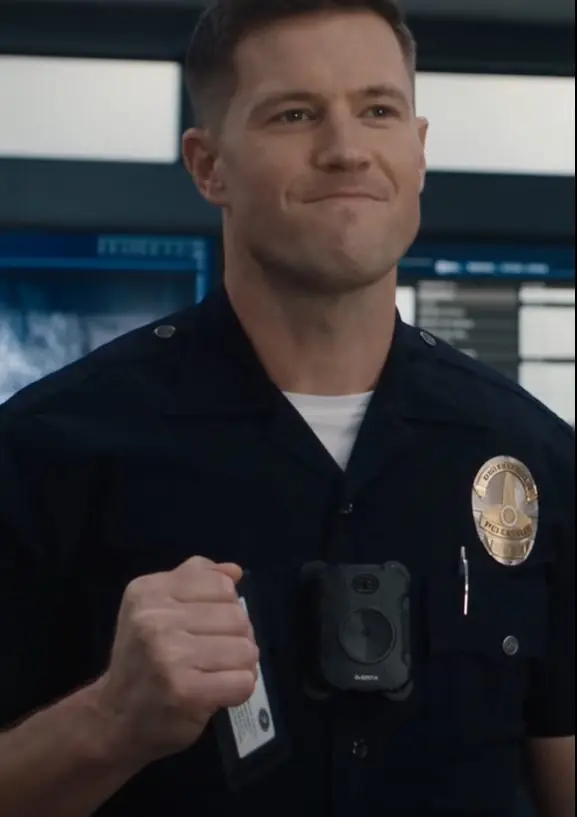
Officer Daniel Cole grabbed a federal agent by the arm before tossing her credential wallet into a precinct trash can.
He did more than embarrass her: he took her identification, ignored her warning, and treated an official federal inspection as a joke.
What he didn’t realize was that Claire Bennett had arrived to cross-check the precinct’s narcotics evidence ledger against federal seizure records, and his actions had just turned a routine inspection into something far more serious.
The North River Police Division continued operating around them.
Desk phones rang beneath harsh fluorescent lights, a printer churned out reports, and somewhere past the booking counter, a man protested loudly about his handcuffs.
The air carried the familiar smell of old coffee and floor wax.
Claire glanced at Cole’s hand gripping her upper arm before lifting her gaze to meet his eyes.
“Keep your hands off me.”
Her voice remained steady, which only seemed to irritate him further.
Cole released her with a slight push disguised as cooperation, his wide shoulders stretching a uniform that seemed to provide him with more confidence than common sense.
“You can’t come into my division, skip the visitor log, and start going through files,” he snapped.
Claire set a thick folder onto the closest desk.
It struck the surface with a solid thump, catching the attention of two patrol officers who were pretending not to notice.
“I signed the federal authorization sheet included in your task-force agreement.”
“I couldn’t care less which sheet you signed.”
“You really should.”
Eleven minutes before this confrontation, Claire had walked through the precinct’s public entrance wearing a charcoal suit and carrying a black audit case.
The inspection was supposed to be both unexpected and discreet.
Her plan was to compare the precinct’s narcotics evidence ledger with the federal task force’s seizure records before anyone had an opportunity to correct the inconsistencies.
She had conducted dozens of inspections during her federal career, but this one carried an unusual warning.
Three days earlier, an anonymous envelope had arrived at her regional office.
Inside were photocopies of narcotics inventory reports, a handwritten list of evidence identification numbers, and a message containing only seven words.
COUNT WHAT EXISTS.
NOT WHAT THEY CLAIM.
The handwriting was uneven, as though the author had been working under considerable pressure.
Claire had initially suspected an ordinary accounting discrepancy.
Police departments frequently made clerical errors involving weights, transfers, and property classifications.
Most could be corrected without disciplinary proceedings.
But the discrepancies in North River’s records were different.
Federal reports documented approximately sixty-four kilograms of narcotics transferred into the joint task force’s custody during the previous eighteen months.
The local inventory reflected considerably less.
The missing quantities had supposedly been destroyed, yet the paperwork contained no matching authorization from the federal agency responsible for approving their disposal.
Even more troubling, several destruction certificates carried identical timestamps despite involving evidence collected on different dates.
Claire had learned that identical mistakes were rarely accidents when money, careers, and criminal convictions depended upon the records being accurate.
At the front desk, a young civilian employee named Nina Patel had looked up from her computer.
“Can I help you?”
“Special Agent Claire Bennett.
I’m here for a scheduled-authority, unannounced compliance inspection.”
Nina’s fingers stopped moving.
“Federal?”
Claire displayed her credentials.
“Yes.
Your department participates in a federal narcotics task force.
The inspection authorization is already on file.”
Nina located the agreement, placed the required federal authorization sheet on the counter, and watched Claire sign it.
For several seconds, the young woman’s gaze lingered on the black audit case.
Then she lowered her voice.
“Are you checking the evidence room?”
Claire studied her.
“That’s part of my assignment.”
Nina looked toward the hallway behind the booking counter.
“Then you should probably hurry.”
Before Claire could ask what she meant, a telephone rang, and Nina answered it with an expression that suggested she regretted having spoken.
Claire continued toward the operations room.
Behind the booking counter, a handcuffed man was arguing with an officer.
He appeared to be in his late fifties, with thinning gray hair and a wrinkled brown jacket.
“I came here to report something,” he insisted.
“You can’t just lock me up because nobody wants to hear it.”
The booking officer ordered him to sit down.
Claire noticed the exchange, but the evidence inspection remained her immediate responsibility.
Near the narcotics desk, she opened her case and removed the authorization documents.
A patrol officer named Gabriel Ortiz glanced at the federal heading and immediately straightened.
“Do you need the evidence supervisor, ma’am?”
“Yes, please.”
Ortiz reached for his telephone.
That was when Daniel Cole appeared.
Cole was thirty-nine, powerfully built, and accustomed to having people step aside when he walked through the precinct.
He had spent eleven years wearing the North River uniform and believed seniority entitled him to unquestioned respect.
He noticed Claire standing beside the evidence desk and immediately frowned.
“Who let you back here?”
Claire turned.
“I’m conducting an authorized inspection.”
“Not in my division, you’re not.”
She offered to show him the paperwork.
He ignored the offer.
Instead, he glanced at the open audit case, noticed the numbered evidence records, and closed the distance between them.
“What exactly have you been looking at?”
“Records covered by the federal task-force agreement.”
Cole’s expression hardened.
“Those records don’t belong to you.”