“Watch where you're going!”
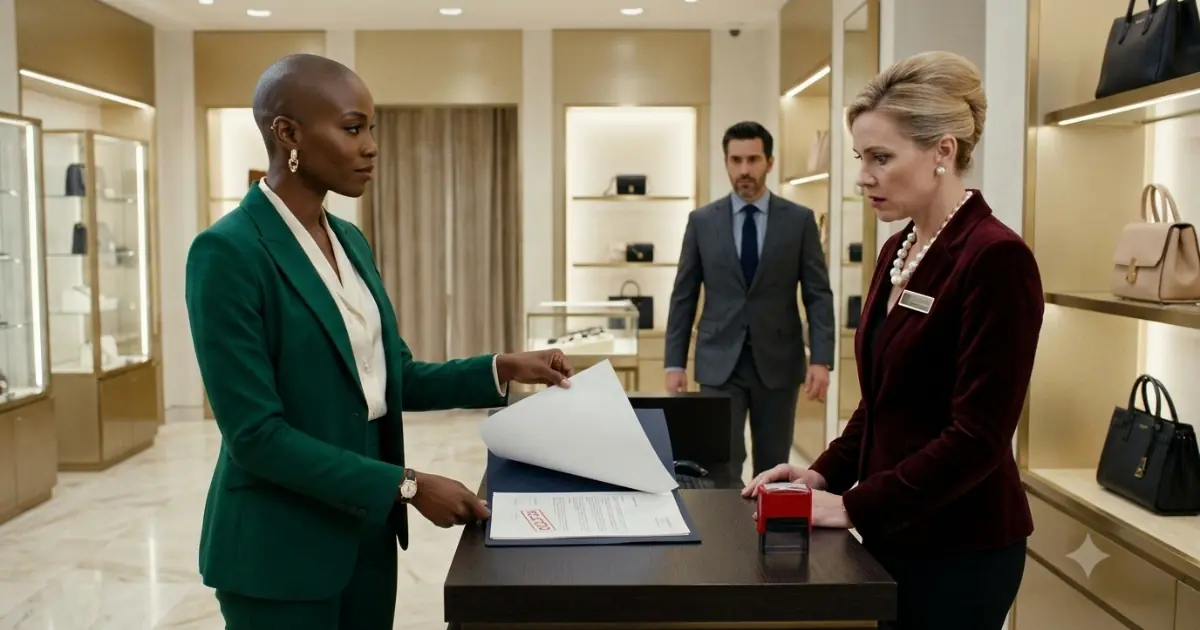
The woman's angry voice cut through the peaceful atmosphere of one of Manhattan's most exclusive luxury boutiques.
Conversations stopped. A sales associate froze beside a glass display cabinet. Several wealthy customers turned their heads toward the confrontation unfolding beneath the glittering chandeliers.
Standing in the center of the boutique was a tall Black woman dressed in an impeccably tailored royal-blue pantsuit. Her head was completely shaved, her gold earrings were striking, and an elegant necklace rested against her collarbone.
She carried herself with the quiet confidence of someone who had nothing to prove.
Her name was Victoria Bennett.
Facing her was a blonde woman wearing a shimmering silver evening dress. Her expression was twisted with irritation, and she held an expensive handbag as though it were a symbol of her superiority.
Her name was Cassandra Whitmore.
Cassandra had spent most of her adult life believing that money determined a person's worth. She had married into wealth, surrounded herself with influential people, and developed the habit of judging strangers before they had even introduced themselves.
To her, luxury was not simply something to enjoy.
It was a weapon.
And that afternoon, she had chosen the wrong person to use it against.
Victoria looked directly into Cassandra's eyes.
“You have just made a grave mistake.”
Cassandra laughed.
“You have nothing to do with this boutique!”
The words echoed across the polished marble floor.
Victoria did not argue. She did not raise her voice. She did not attempt to explain who she was.
Instead, she reached into her handbag and removed her phone.
Cassandra rolled her eyes.
Standing nearby, her husband, Richard Whitmore, watched with growing curiosity.
Victoria made a call.
“Temporarily block the relevant accounts,” she instructed calmly. “Launch the audit immediately. No reopening until I authorize it.”
Richard's expression changed.
“But who is she?” he whispered.
Victoria lowered her phone.
“That's precisely the problem,” she replied. “You never bothered to find out.”
At that moment, the boutique's general manager hurried from a private office.
Behind him came the department directors, supervisors, and sales associates. They assembled themselves along both sides of the central aisle.
As Victoria began walking toward the exit, the employees lowered their heads respectfully.
Cassandra's mouth fell open.
Richard stood completely motionless.
Neither of them understood what had just happened.
But before the day ended, they would discover that the woman Cassandra had publicly humiliated was the one person capable of dismantling the luxurious world upon which they had built their entire lives.
And Victoria Bennett had not come to the boutique to purchase a handbag.
She had come to uncover a secret.
A secret that had been hidden for nearly seventeen years.
Long before Victoria Bennett became one of the most influential women in the international luxury industry, she had lived in a small apartment in Baltimore with her mother, Eleanor.
Their apartment was modest. The kitchen cabinets were old, the windows rattled during winter storms, and the living room contained furniture purchased from secondhand stores.
But Eleanor had filled that home with something money could never buy.
Dignity.
Eleanor worked as a seamstress. Her hands were often sore from hours of repairing dresses, adjusting jackets, and carefully stitching garments for customers who rarely knew her name.
Every evening, Victoria sat beside her mother and watched her work.
“Why do you spend so much time fixing things that belong to other people?” Victoria once asked.
Eleanor smiled.
“Because everything deserves care, sweetheart. Especially things people think are no longer worth saving.”
Victoria remembered those words for the rest of her life.
When she was twelve, Eleanor took her to a department store downtown.
Victoria had saved her allowance for several months. She wanted to buy her mother a beautiful scarf for her birthday.
They entered the store wearing ordinary clothes.
Almost immediately, a sales associate began following them.
Whenever Victoria approached a display, the employee moved closer.
When Eleanor reached toward a silk scarf, the employee intervened.
“That's quite expensive,” she said.
Eleanor withdrew her hand.
“I understand.”
“Perhaps you would be more comfortable in another department.”
Victoria felt her face grow hot.
Her mother had done nothing wrong.
Yet the employee spoke as though their presence itself were an inconvenience.
Victoria wanted to protest, but Eleanor gently took her hand.
They left without purchasing anything.
Outside, Victoria began to cry.
“Why didn't you tell her she was wrong?”
Eleanor crouched beside her daughter.
“Because I know who I am. I don't need a stranger's permission to feel worthy.”
“But she treated you like you were nobody.”
Eleanor brushed a tear from Victoria's cheek.