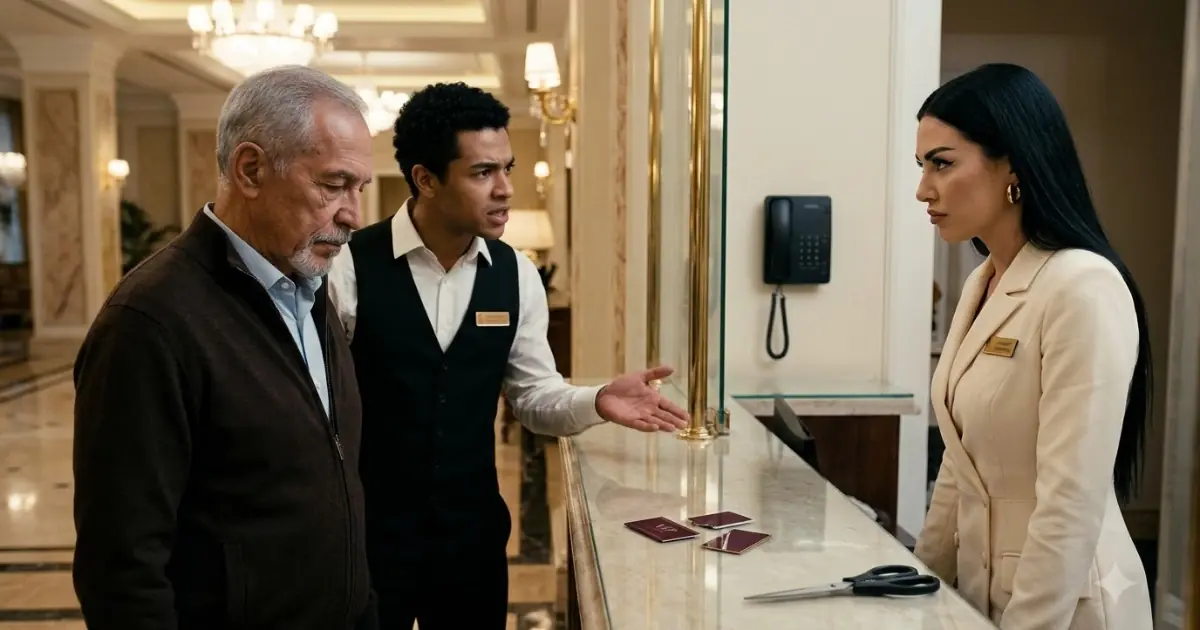
The young hotel employee had barely finished saying that every guest deserved respect when the woman behind the marble reception desk pointed toward the revolving doors and ordered him to leave.
"Then you're fired. Get out with him."
Her voice carried across the magnificent lobby, rising above the gentle music and the soft conversation of wealthy travelers. Several guests turned their heads. A woman near the elevators lowered her champagne glass. A businessman stopped speaking into his telephone. Even the bellman standing beside the brass luggage cart seemed to hold his breath.
The older man at the center of the confrontation did not move.
He was seventy-one years old, with close-cropped gray hair, a neatly trimmed silver beard, and deep lines carved around eyes that had witnessed far more hardship than anyone in that glittering lobby could imagine. He wore a faded brown zip-front cardigan over a light blue shirt, dark trousers, and simple black shoes polished by hand. His small suitcase stood beside him, its corners worn from years of travel.
He had arrived at the Grand Ellington Hotel in Chicago just twenty minutes earlier.
Now the elegant woman in the cream-colored blazer dress was treating him as though he were something that needed to be removed before the important guests arrived.
Her gold name badge read Vanessa Bell — Guest Relations Director.
The young employee standing between them was named Daniel Brooks. He was twenty-six, tall and athletic, with short black curls and a freshly pressed white shirt beneath his black hotel vest. He had worked at the Grand Ellington for only eleven months.
Daniel looked at Vanessa, then at the older man.
"If treating a guest with dignity costs me my job," he said quietly, "then I'll leave with my dignity."
Vanessa let out a sharp laugh.
"How touching."
The older man studied her for a moment.
There was no anger in his face. No embarrassment. No pleading.
Only a kind of profound disappointment.
Then he reached into his cardigan pocket, removed an old black cellphone, and pressed a familiar number.
When the call connected, he spoke just seven words.
"James, come down to the lobby. Now."
Nobody in that room understood what those words meant.
Not yet.
But within the next fifteen minutes, the Grand Ellington Hotel would become the setting for a revelation that would expose years of corruption, destroy a powerful woman's carefully constructed reputation, and remind one extraordinary young man that doing the right thing matters even when no one is watching.
And it all began with an old man who had asked for nothing more than a room and a little respect.
Arthur Whitmore had never been particularly interested in luxury.
That might have surprised the people who knew his name in the hospitality industry.
For nearly fifty years, Arthur had built, purchased, renovated, and occasionally rescued hotels across the United States. The company he founded, Whitmore Hospitality Group, owned interests in seventeen properties, including historic inns in New England, mountain resorts in Colorado, and several landmark hotels in major American cities.
His personal fortune was substantial enough that financial magazines occasionally mentioned him among the country's most successful private hotel investors.
Yet Arthur still drove a twelve-year-old sedan, bought his shirts at ordinary department stores, and preferred a diner breakfast to the complicated dishes served in expensive restaurants.
His late wife, Eleanor, had always teased him about this contradiction.
"You own hotels with chandeliers that cost more than our first house," she once said, "and you still complain when a cup of coffee costs five dollars."
Arthur had laughed.
"That's because I remember when we couldn't afford the coffee."
And he did remember.
He remembered every dollar.
He remembered washing dishes in a roadside restaurant at sixteen. He remembered cleaning motel bathrooms after midnight. He remembered the winter he and Eleanor lived in a room above a laundromat while they saved enough money to purchase their first struggling boardinghouse.
More than anything, he remembered the people who had treated them kindly when they had nothing.
The elderly waitress who gave them extra toast without charging.
The mechanic who repaired their car and allowed them to pay in installments.
The motel owner who let Arthur sleep in an unused storage room during a snowstorm.
Those small acts of kindness had shaped him more deeply than any business success.
When Arthur eventually became wealthy, he promised himself that no hotel carrying his name would ever measure a person's worth by the price of their clothing.