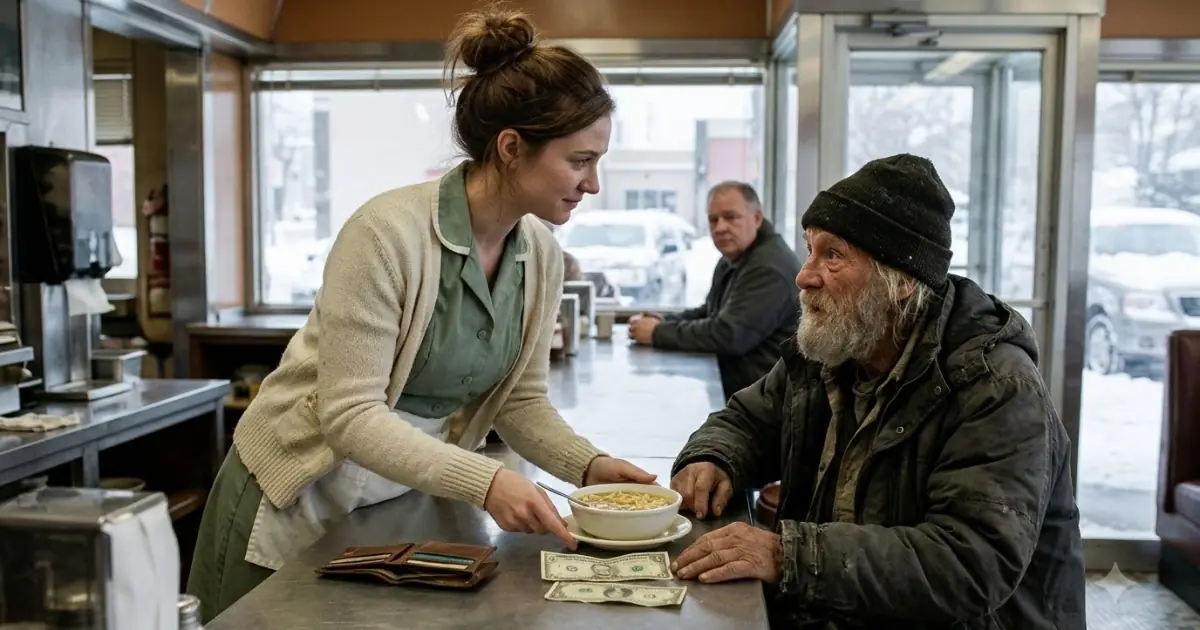
The bell above the entrance of Hope's Diner rang sharply on a bitterly cold December morning.
A tall man wearing an expensive black overcoat stepped inside. His polished shoes, dark three-piece suit, and carefully styled hair seemed completely out of place among the worn red stools, chipped coffee mugs, and aging booths.
He glanced around the room before speaking.
“Which one of you is Emily Parker?”
Behind the counter, a young waitress stopped counting the change in her old brown wallet.
“I am,” she answered nervously. “Why?”
The stranger approached her.
Several customers lowered their newspapers. The cook stopped moving behind the kitchen window. Even the elderly manager, who rarely paid attention to anything beyond his morning coffee, turned toward them.
The man reached inside his coat and removed an envelope.
“For your service, my dear.”
Emily stared at him.
She wondered whether she had accidentally offended someone, whether there had been a complaint about her work, or whether another unpaid bill had finally caught up with her.
Then the stranger said something that made her heart stop.
“Walter Bennett was my father. I came here to find the woman who fed him with her last seven dollars.”
Emily's fingers tightened around her wallet.
Suddenly, the diner seemed impossibly quiet.
She remembered the elderly man with the tangled gray beard, the worn jacket, and the trembling hands. She remembered the bowl of chicken noodle soup, the snow falling outside, and the way he had apologized simply for being hungry.
Most of all, she remembered the words she had spoken when he tried to refuse her kindness.
“Then stay alive long enough to repay me.”
She had never expected to see him again.
And she certainly had never expected his son to find her.
But the envelope in the stranger's hand was only the beginning of a story that would change more lives than either of them could have imagined.
Three days earlier, Emily Parker had awakened in her small apartment to the sound of the radiator struggling against the winter cold.
The apartment was located above an old hardware store on the outskirts of a quiet Pennsylvania town. It had two narrow windows, peeling paint around the kitchen cabinets, and a bathroom door that never closed properly.
It was not much, but it was home.
Emily sat on the edge of her bed and opened the banking application on her phone.
Her account balance was less than two dollars.
Inside her wallet were seven crumpled dollar bills.
That was everything she had until Friday.
She needed groceries, bus fare, and medication for her mother. Her electricity bill was overdue, and her landlord had already reminded her twice that December's rent had not been paid in full.
For several minutes, she simply stared at the numbers.
Then she put her phone away.
Worrying would not make money appear.
She dressed in her sage-green uniform, pulled on her cream cardigan, tied her brown hair into a loose bun, and walked into the small bedroom where her mother was sleeping.
Margaret Parker was sixty-four years old. Three years earlier, a stroke had changed her life.
Once an energetic school cafeteria worker who could prepare meals for hundreds of children, she now struggled to walk across a room without assistance.
Emily adjusted the blanket covering her mother's shoulders.
Margaret opened her eyes.
“You're leaving already?”
“Early shift.”
“Did you eat breakfast?”
Emily smiled.
“I'll eat at work.”
It was a familiar lie.
Margaret studied her daughter's face.
“You shouldn't have to work this hard because of me.”
“I'm not working because of you, Mom. I'm working because I'm terribly fond of paying bills.”
Margaret laughed softly.
Emily kissed her forehead.
There were things she never told her mother. She never mentioned the nights she went to bed hungry or the shoes she continued wearing despite the holes in their soles.
She never explained that she had postponed her own dental appointment four times because Margaret needed physical therapy.
And she certainly never told her that she had once dreamed of becoming a nurse.
Life had taken a different direction.
Emily did not blame her mother for that. She loved Margaret more than anything in the world.
Still, sometimes, when she watched young women her age walking through town carrying college textbooks or wearing hospital identification badges, she wondered what her life might have become under different circumstances.
That morning, she placed a glass of water beside Margaret's bed and left for work.
Snow had begun falling before sunrise.
By seven o'clock, the sidewalks were covered in white, and the wind swept through the streets with a sharpness that made every exposed inch of skin ache.
Hope's Diner stood at the corner of Maple Street and an old state highway.