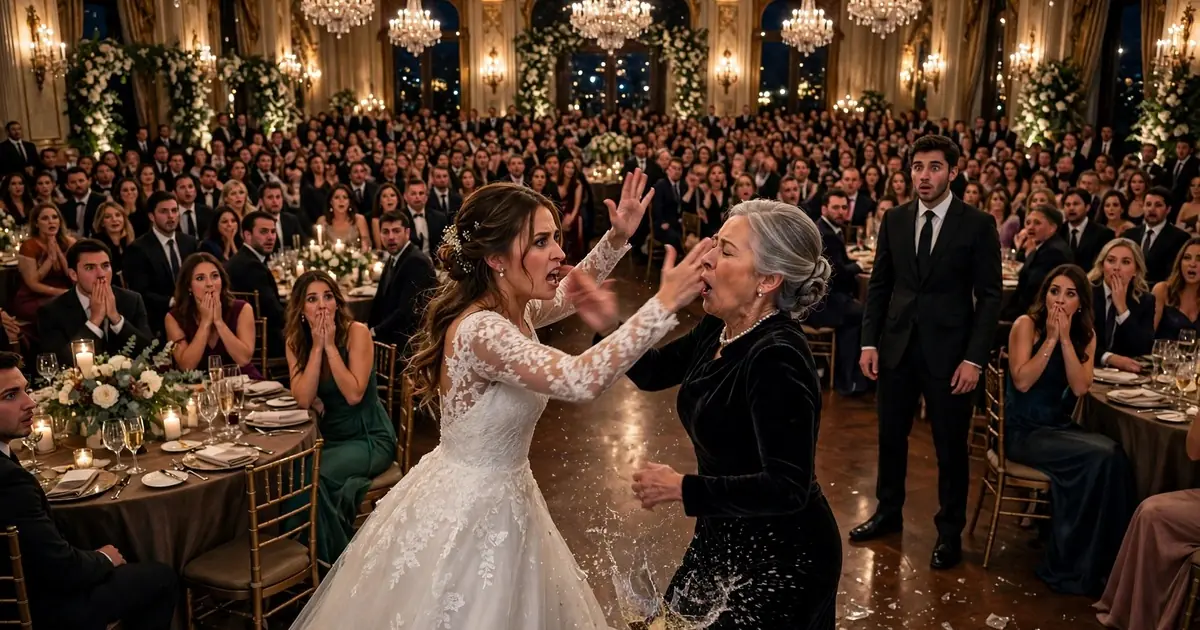
 The ballroom was bright that evening, and the light from the crystal chandeliers fell across two hundred and fifty guests in soft waves. The band played beneath the high ceiling, and the music moved through the room in a gentle tide, and the tables shone with pale cloths and silver and glass. Margaret Bennett stood near the edge of the dance floor with a glass of water in her hand, and she watched the room she had paid for, and she tried to find some joy in it, and she found very little.
She knew every contract in the room carried her name. The ballroom itself, the bar, the musicians, the transportation waiting outside, the dinner service, the honeymoon suite upstairs, and the farewell brunch planned for the morning after, all of it rested on her signature. They smiled and talked and lifted their glasses, and they believed the evening belonged to the bride, and in a way it did, because Margaret had wanted her son to have a beautiful start, and she had said yes so many times that yes had become a habit, and the habit had become a weight she carried in her chest.
Eighty guests, a simple ceremony, dinner with family, and then everyone would go home happy. Margaret had pictured it often in the months after Matthew told her he was engaged. She had pictured a small room full of familiar faces, and simple flowers on the tables, and a quiet evening where she could sit beside her sister Helen and watch her son smile. She had told Matthew she would handle the wedding, and she had meant it, and she had believed it would be a modest affair, and she had been glad to pay for it.
Then Tiffany began making everything bigger. Eighty guests became two hundred and fifty. The restaurant turned into an exclusive private estate, with a ballroom so large that the band sounded small beneath the ceiling. Seasonal flowers were upgraded to imported orchids and lilies, flown in at great expense, and Margaret watched the florists carry them through the doors in tall boxes and wondered how flowers could cost so much and last so little. Then came professional lighting, and luxury transportation, and premium wine, and a designer cake, and personalized gifts for every guest, and an open bar, and a live band. Each new item arrived with a smile and a fresh invoice, and each one seemed manageable on its own, and together they grew into a mountain Margaret could no longer see over.
Whenever she tried to slow the spending, Matthew would pull her aside. He would take her arm gently and lead her a few steps away from Tiffany and her parents, and he would look at her with the same eyes he had worn as a boy when he wanted something he knew she could not afford.
"Please, Mom," he would say.
"It is only one day."
Or he would say, "She is dealing with a lot of pressure."
Most often he would say, "Can you let this one go too?"
Because she loved him, she continued saying yes. She said yes to the extra guests, and yes to the estate, and yes to the orchids, and yes to the lighting, and yes to the transportation, and yes to the cake, and yes to the gifts, and yes to the open bar, and yes to the band. Each yes felt small in her mouth, and each one cost her a little more sleep, and she told herself her son deserved a beautiful start, and she told herself the money did not matter, and she told herself she would find a way, even as the way narrowed with every passing week.
She emptied her savings account. She had built it slowly over many years, a little at a time, from the wages of a working life, and she watched it drain away until the numbers on the statements grew thin and frightening. She canceled a trip she had dreamed about for years, a journey she had promised herself she would take one day when the children were grown and the house was quiet. She had kept the brochures in a drawer beside her bed, and she had read them on winter evenings, and she had imagined streets and hills and water under a foreign sun. She put the brochures away and told no one she had canceled anything, because saying it aloud would have made the loss feel heavier, and she was already carrying enough.
Then, when there was nowhere else to get the money, she sold a piece of the land her late husband had left behind. The property had belonged to his family for generations, and it was the last piece of him she still held in her hands, and letting it go hurt more than she let anyone know. She did not tell Matthew the whole of it at the time. She told him only that the money would be there, and that he need not worry, and that the wedding would go ahead as planned. She kept the details locked away in her own heart, because she had learned that her son heard worry as criticism, and criticism as a reason to ask her to let one more thing go.
She stood in the ballroom now and looked at the guests, and she thought of all the yeses that had brought her here, and she wondered when saying yes had stopped feeling like love and started feeling like surrender. The band played a slow song, and couples moved onto the dance floor, and the crystal chandeliers threw light across the room in bright fragments, and Margaret felt very far from the center of it all, as if she were watching the evening from behind glass.
Helen had traveled three hours to be here, and she sat at a family table near the front, and her face was kind and watchful, and she had barely spoken to Margaret all evening because Tiffany kept repositioning the family seating around the people taking pictures. Helen caught her eye across the room and gave her a small nod, and Margaret nodded back, and the small exchange steadied her for a moment, because Helen was the one person in the room who had known her since they were girls, and who had seen her marry, and who had sat with her at the hospital when her husband died, and who understood that a smile could hide a great deal.
Tiffany moved through the room in her white gown, and her parents followed close behind her, and she greeted guests with a polished smile, and she looked every inch the bride she had wanted to be. Her father wore a dark suit and kept his arms folded across his chest when he was not shaking hands, and her mother stayed near the head table and watched the servers with a sharp eye. Margaret watched them all and felt the distance between herself and Tiffany's family grow wider with every hour, because they had never once asked her how much the evening cost, and they had never once offered to help, and they had treated her money as if it were a river that would never run dry.
The servers moved between the tables with trays of food and glasses of wine, and the guests ate and drank and laughed, and the evening unfolded in a bright blur. Margaret thought of the dinner service she had paid for, and the musicians she had paid for, and the transportation waiting outside in a long line, and the honeymoon suite upstairs with its fresh flowers, and the farewell brunch she had planned for the morning, and she added it all up in her mind, and the total frightened her, and she pushed the thought away, because the evening was still young, and the toasts had not yet begun, and she did not want to spoil her son's night with her own fear.
Matthew stood near the edge of the dance floor with Tiffany, and he was pale and still, and his smile came and went like light through clouds. He looked at his mother once, and his eyes held a question she could not answer, and then he looked away, and Margaret felt a cold place open inside her chest. She had raised him alone after his father died, and she had carried him through fever and worry and long nights, and she had believed he would stand beside her when it mattered, and now she was not sure. She told herself not to judge him on a night when he was nervous and caught between two families, and she told herself he loved her, and she believed it, and still the cold place stayed.
The band finished the slow song and began another, and the dancers shifted and turned, and the chandeliers swayed almost imperceptibly above them, and the light moved across the walls in slow arcs. Margaret set her glass down on a side table and folded her hands together, and she thought of her late husband, and she wished he were standing beside her. He would have laughed at the size of the evening, and he would have shaken his head at the orchids, and he would have told her to say no sooner, and she would have listened to him, because his voice had always been the one that could steady her. Without him, she had said yes too many times, and now the yeses filled the ballroom around her, and she could not take a single one back.
She looked at the head table where Tiffany sat with Matthew, and she looked at the guests who had come from far away, and she looked at the band and the bar and the lights, and she thought about how much of herself she had poured into this one evening. She had given her savings, and she had given her trip, and she had given a piece of her husband's land, and she had given her sleep and her peace, and she wondered what would be left of her when the evening ended. The thought frightened her, and she pushed it aside, and she smiled at a guest who passed, and she walked slowly toward the family table to sit beside Helen, because Helen was the one anchor in the room, and Margaret needed to feel anchored before the toasts began.
The wedding planner moved through the ballroom with a clipboard in her hand, and she checked each table twice, and she spoke softly to the servers, and Margaret watched her work and felt a strange envy for a woman who could manage such a large evening without owning any of it. The gifts for the guests sat in neat rows beside the doors, small boxes wrapped in pale gold, and each one had taken time and money, and Margaret wondered if any guest would remember the box a year from now, or if the boxes would be opened and forgotten by morning. She thought of the designer cake waiting in the kitchen, tall and pale, and of the premium wine breathing in the bar, and she added the gifts and the cake and the wine to the long list in her mind, and the list grew longer with every minute, and still the evening had not reached its brightest hour.
The evening moved on, bright and loud and beautiful, and Margaret sat with her sister and watched her son dance with his bride, and she kept her hands folded in her lap, and she waited for the moment when the music would soften and the glasses would be raised. She did not know that the night was about to change, and she did not know that a single bottle of champagne would become the crack through which everything hidden would finally show itself. She knew only that she had paid for it all, and that her name was written on almost every contract in the room, and that nobody in the ballroom seemed to remember that except her.
The southern meadow had belonged to Margaret's husband and his family for generations, and it was the finest piece of land they owned. It lay beyond the garden and past the fence at the edge of the house grounds, a wide stretch of open grass that changed color with the seasons, green and soft in spring, gold in late summer, pale and quiet under the first frost. A line of cedar trees marked its far edge, tall and dark against the sky, and beneath the trees the ground stayed cool even in the hottest weeks of the year. Margaret had walked that meadow since she was a young wife, and she knew every rise and hollow in it, and she knew where the wildflowers grew thickest, and she knew the sound the wind made as it moved through the cedars.
Her husband had loved the meadow more than any other place on earth. He had grown up running through it as a boy, and he had worked it as a man, and he had taught Matthew to drive an old pickup there when the boy was still too young to reach the pedals without stretching. Her husband had lifted Matthew onto his lap and let the boy hold the wheel while the pickup rolled slowly across the grass, and Matthew had laughed until tears ran down his face, and her husband had laughed with him, and the sound of their laughter had carried across the meadow and into the house where she stood at the kitchen window. She had watched them through the glass, and she had thought her heart would break from happiness, and she had been right to treasure that afternoon, because afternoons like that do not come twice.
When her husband died, she scattered some of his ashes beneath the cedar line, in a quiet place where the light fell through the branches in the morning. She had gone there alone on a still day, and she had sat in the grass, and she had opened the small wooden box, and she had let the ashes fall gently onto the earth, and she had whispered goodbye to the man she had loved since she was a girl. Afterward she visited the spot often, and she sat beneath the cedars, and she talked to him in her mind, and she told him about Matthew, and about the house, and about the small worries of ordinary days, and the meadow held the conversations in its silence, and she always left feeling less alone than when she had come.
It was the one thing her husband had left her that could not be spent in a hurry, and it was the one thing she had promised herself she would never sell. She had told Matthew so when he was a young man, and she had told him the meadow belonged to the family, and that it would belong to his children one day, and that some things were worth more than money. Matthew had nodded, and he had said he understood, and she had believed him, because he had looked at the meadow the way his father had looked at it, with love and with respect, and she had thought the promise would hold.
Then the wedding grew, and the costs grew with it, and the money began to run out. She moved money from one account to another, and she cut back on the small pleasures of her own life, and she stopped buying anything she did not need, and still the invoices kept coming. The estate wanted its deposit, and the florists wanted theirs, and the caterers and the musicians and the transportation company all wanted theirs, and each deposit was due on a different day, and each one took another piece of her savings, until one morning she sat at her kitchen table and looked at her bank statements and understood that the money was gone. She sat there for a long time with her hands folded around a cold cup of tea, and she listened to the clock on the wall, and she thought about the land, and she told herself not to think about it, and she thought about it anyway.
Matthew came to her kitchen after dinner one evening, and he looked exhausted, and his shoulders sagged as if he were carrying something far heavier than his years. Tiffany had just increased the guest list again, and the deposits were due, and he did not know what to do, and he told his mother so in a low voice, and he asked her what they should do, and he did not ask her directly for anything, and he did not need to, because his helplessness was already a request. Margaret asked how large the shortfall was, and he refused to answer at first, and then he cried, and the tears ran down his face, and Margaret held him the way she had held him when he was a small boy with a fever, and her heart ached, and she told him not to worry, and she told him she would handle it, and she meant it, even as she knew what handling it would cost.
She lay in her bed and listened to the house settle around her, and she thought about the meadow, and she thought about her husband, and she thought about the promise she had made to herself, and she thought about her son crying in her kitchen. She would sell a piece of the land, the southern meadow, fourteen acres of it, and she would pay for the wedding, and she would not tell Matthew the whole of it, because telling him would only add guilt to his worry, and guilt would not help anyone. She told herself she was choosing, and she believed it, and some of her believed it truly, and another piece of her knew the choice had been shaped by months of pressure she had never named.
She called Harold Grant, the attorney who had handled her husband's affairs, and she asked him to arrange the sale. Harold was careful and kind, and he explained the steps, and he asked her if she was certain, and she said yes, and her voice did not shake, and she was proud of that. He found a buyer through an agent, and the buyer was a company, and the papers were drawn up, and the appraisal came back lower than she had expected, and Harold told her the appraisal appeared professionally prepared, and she trusted him, because she had trusted him for years, and she signed the papers at his office on a gray afternoon. Her hand was steady as she wrote her name, and she felt something inside her go very quiet, as if a door had closed in a distant room of her house.
She did not go back to the meadow for weeks after the sale. She could not bear to look at the fence and know that the grass beyond it no longer belonged to her family. When she finally did go, she walked slowly along the fence line, and she looked across the fourteen acres, and the meadow looked exactly as it always had, green and wide under a pale sky, and that sameness hurt her more than any change would have, because the land did not know it had been sold, and the cedars did not know, and only she carried the knowledge. She stood beneath the cedar line where her husband's ashes rested, and she put her hand against the rough bark of a tree, and she whispered that she was sorry, and she whispered that she had done it for their son, and she hoped he would understand, and the wind moved through the branches above her, and she listened to it for a long time before she walked back to the house alone.
In spring the grass grew thick and sweet, and Margaret's husband had cut hay there, and the hay had smelled of sun and rain. In summer the cedars gave shade, and Margaret had carried lunch out to her husband in a basket, and they had eaten beneath the trees while Matthew played nearby with a wooden horse. In autumn the light turned gold across the grass, and the air grew cool, and the family had walked the fence line together on Sunday afternoons, and her husband had pointed out the boundary markers his grandfather had set. In winter the meadow lay white and silent, and the cedars stood dark against the snow, and the house felt warm by comparison, and Margaret had watched the meadow from the kitchen window and felt grateful for the land and for the life it had given them. The neighbors knew the meadow as well as Margaret did, and they had watched her husband work it, and they had watched Matthew grow up running through it, and they spoke of the family with respect, because the family had held the land for generations and had never sold a single acre of it until now. When the sale became known, the neighbors said little, and their silence was kind, and Margaret was grateful for it, because she did not want pity, and she did not want questions, and she wanted only to keep walking through her days without explaining herself to anyone.
She told her sister only that money had been tight, and that she had managed, and Helen had looked at her with knowing eyes, and had not pressed her, because sisters learn when to ask and when to wait. Margaret hid the sale the way she hid many things, not out of deceit but out of shame, because having limits felt like failure to a woman who had spent her life being the one everyone could depend on. She was ashamed that she had run out of money, and ashamed that she had sold her husband's land, and ashamed that she had let the wedding grow so large, and the shame sat quietly inside her, and she carried it through the months of planning, and she carried it into the ballroom on the wedding evening, where the orchids and the lights and the music all shone brightly around her.
Fourteen acres of grass and cedar shadow, fourteen acres where her husband had taught their son to drive, fourteen acres where the ashes of her husband still rested beneath the trees. She had sold it for a wedding, for one evening of music and flowers, and she told herself her son would remember it forever, and she told herself the memory would be worth it, and she almost believed it, and the piece of her that did not believe it stayed silent, because silence was easier than facing the truth that she had given away something precious to pay for something that would be over by morning.
In the ballroom that evening, as the band played and the guests danced, Margaret thought of the meadow, and she thought of the cedar line, and she thought of her husband's ashes resting in the cool earth, and she thought of the fourteen acres she would never walk as her own again. The thought climbed and fell inside her like a tide, and she pushed it down, and she smiled at the guests, and she watched her son dance with his bride, and she waited for the evening to end, never knowing that the night would ask more of her still, and that the land she had sold was only the beginning of what Tiffany and her family had planned to take.
The ballroom glowed under crystal chandeliers, and the band played beneath them while two hundred and fifty guests filled the long tables, and Margaret Bennett stood near the edge of the dance floor with a glass of water in her hand, watching the evening she had paid for unfold around her. The light caught the gold rims of the plates and the pale lilies and orchids arranged down the center of every table, and the music moved through the room in soft waves, and for a moment she allowed herself to believe the night might still end well. She had imagined this evening for months, and she had pictured her son smiling at the head table, and she had pictured herself sitting close enough to see his face, and now the room was full and loud and bright, and her son was somewhere near the far side of the floor, and she was standing alone with her water, counting nothing, listening to the band, trying to feel glad.
The plan had been simple once. Eighty guests, a plain ceremony in the morning, dinner with family in the evening, and a short drive home while the light was still good. Margaret had liked that plan. She had liked the small guest list and the quiet room and the feeling that the day belonged to the family rather than to the spectacle. Then Tiffany had begun making everything bigger, and each new idea had arrived with a smile and a reason, and each reason had sounded loving at the time. Eighty guests became two hundred and fifty. The restaurant became a private estate with a ballroom and a garden and a long drive lined with lanterns. Seasonal flowers became imported orchids and lilies flown in at great cost. Then came professional lighting, luxury transportation, premium wine, a designer cake, personalized gifts, an open bar, and a live band. Whenever Margaret tried to slow the spending, Matthew pulled her aside and asked her to let one more thing go, and because she loved him she said yes, and because she said yes the list grew again.
The cake tasting had been the first time she understood how far the evening had drifted from the plan. Tiffany had ordered a designer cake with five tiers and sugar flowers so fine they looked alive, and the price had made Margaret's hand shake as she signed the order, and Matthew had put his arm around her and told her it was only one day, and she had believed him because believing him was easier than arguing. Then came the lighting test, when the ballroom glowed gold and warm under the new rigs, and the man in charge of the lights had named another sum, and Margaret had signed again. Then the personalized gifts, one for every guest, and the premium wine, and the open bar, and the live band with its brass and its drums, and each new order arrived with a smile and a reason, and each reason sounded loving, and each signature took a little more from the account that had once held her whole life's savings. She remembered standing in the estate garden during a rehearsal, watching Tiffany direct the placement of the lilies and orchids, and she remembered how natural it had felt to say yes, and how hard it would have been to say no in front of the florist and the coordinator and her son, and she had said yes, and the evening had grown, and the money had gone, and she had told herself it was love, because love was the only word big enough to cover the cost.
She had emptied her savings to keep saying yes. She had canceled a trip she had dreamed about for years, a slow journey through Italy that she had planned in her mind down to the small coastal town where she meant to sit beside blue water and do nothing at all. Then, when there was nowhere else to get the money, she had sold a piece of the land her late husband had left behind. The land had belonged to his family for generations, and the southern meadow was the heart of it, and she had walked that ground with him when they were young, and she had watched her son learn to drive an old pickup along its edge, and she had scattered a little of her husband's ashes beneath the cedar line. That sale had hurt more than she let anyone know. But she had told herself her son deserved a beautiful start, and she had signed the papers, and she had watched the money disappear into deposits and orders and invoices, and she had kept smiling because a mother is supposed to smile on her son's wedding day.
The champagne was the one line she had drawn. Laurent Reserve, the imported bottle Tiffany wanted for her father's toast, cost more money than Margaret could bear to spend on a single drink, and the champagne package already included in the order was more than generous enough. She had quietly removed the bottle from the order weeks earlier, and she had told the bar manager herself, and she had believed the matter was settled. She had imagined the toast going ahead with the fine champagne already on the tables, and she had imagined nobody noticing the difference, and she had been wrong.
The trouble began at the bar, where a guest asked for Laurent Reserve for the toast and the manager shook his head and said the bottle was not on the order. The word moved across the room the way such words always move, from one guest to another, until it reached Tiffany where she stood beside the head table, and her father heard it too, and his face darkened, and he turned toward her with a look that said the evening had been promised to him in full. Tiffany had spoken of that bottle for weeks, as if it were the crown of the whole celebration, as if her father's toast would fall flat without it, and Margaret had listened to all of it in silence, and she had said nothing, because saying anything would have started the argument sooner. Now the argument had arrived anyway, on the dance floor, in front of everyone, and Tiffany was crossing the ballroom with her parents behind her, and the music seemed to soften around them.
Tiffany walked across the ballroom with her parents behind her, and the music seemed to soften around them, and the guests at the nearest tables turned their heads, and Margaret set her water glass down on a small table and folded her hands. Tiffany's gown caught the light as she moved, and her face was polished and composed, and her voice was calm at first, the way it always was when she wanted something and expected to get it.
"The bar manager says the Laurent Reserve is not being served."
"That is correct."
"Tell them to put it on your card."
"No."
She stared at Margaret, and the polished expression stayed in place for a moment longer, and then a small crack appeared in it.
"This is my wedding."
"And I have already paid more than enough."
"My father specifically requested that bottle."
"Then your father is free to purchase it."
Her father folded his arms across his chest and remained silent, and her mother stood a little behind her with her hands clasped, and the silence from the three of them felt heavier than any shouting. Margaret kept her eyes on Tiffany, and she kept her voice low, and she did not step back, because she had stepped back so many times over the past two years that there was nowhere left to step.
"You have been against this wedding since the beginning."
"I questioned the spending."
"You tried to control every detail."
"I paid for every detail."
The room became unbearably quiet. The band had not stopped playing, but the music felt distant now, as if it came from another room, and the guests at the nearest tables had stopped talking, and the clink of glasses had faded, and all Margaret could hear was her own breathing and the low murmur of the crowd further away. Her son stood near the edge of the dance floor, pale and still, and she waited for him to speak up, and she watched his face, and she saw the struggle in it, and she saw him look at Tiffany and then at her, and she waited, and he said nothing at all.
Across the room, Helen sat at a table near the garden doors, and she watched the three of them with her hands clasped tight in her lap, and she had traveled three hours to be here, and she had barely spoken to her sister all evening because Tiffany kept moving the family seating about, and now she saw the color leave Margaret's face, and she started to rise, and then she stopped, because the moment belonged to Margaret and she knew it. Tiffany's father stepped forward then, his arms still folded, and he spoke for the first time, his voice low and certain, and he said the bottle was a small thing and a mother should not make a scene over a small thing, and Margaret looked at him steadily and said the bottle was a small thing and that was exactly why she would not pay for it twice over. Her mother looked away and studied the lilies on the table, and the guests at the nearest tables leaned toward one another and whispered, and the whispering moved outward in a slow wave, and the whole ballroom seemed to hold its breath, waiting to see what the woman who had paid for everything would do next.