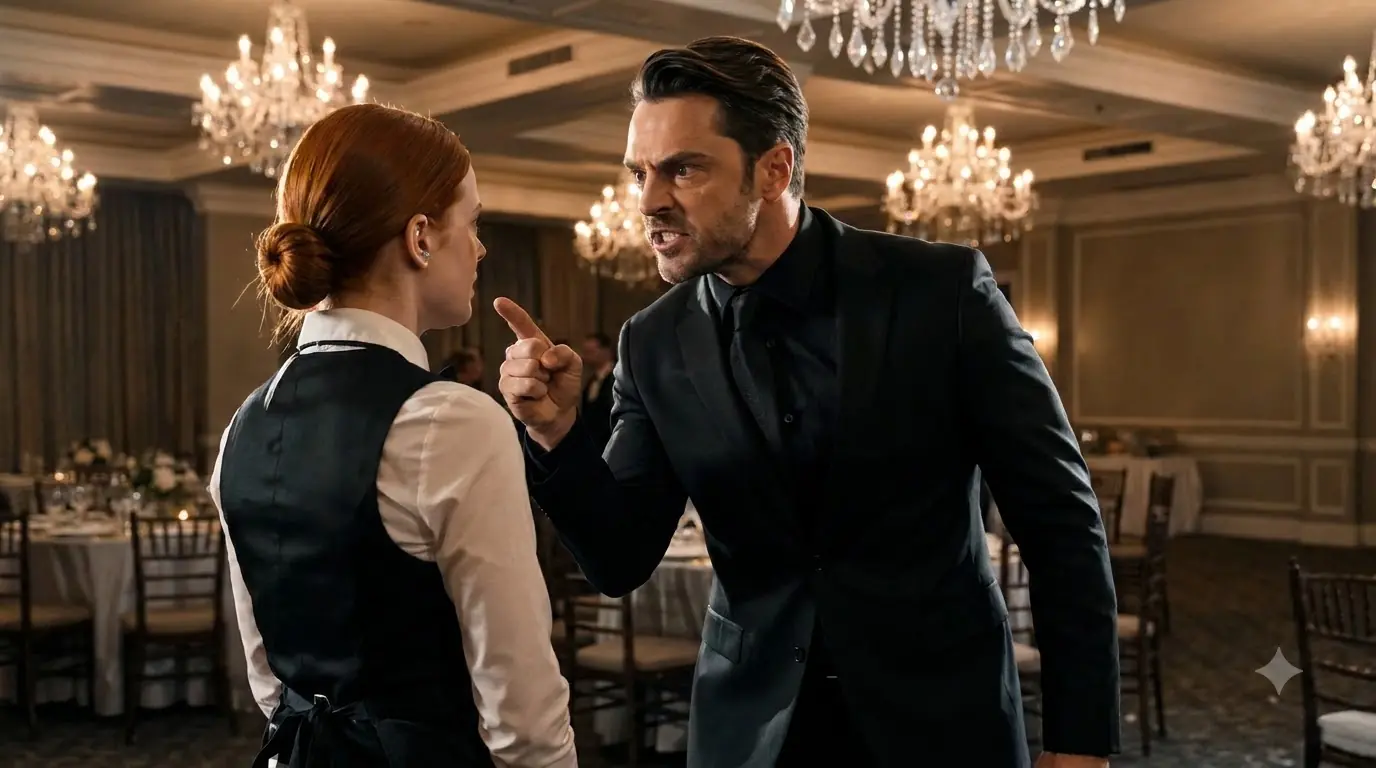
Crystal light fractured across the grand ballroom of the Imperia Hotel, spilling pale gold over black linen, polished flatware, and thirty-two tables of men who had spent the last four decades dividing Chicago by river, rail, and blood. Near the raised dais, where three tiered chandeliers hung like inverted crowns of ice, Maeve Gallagher gripped the rim of a white porcelain service plate until her knuckles turned chalky. Her red hair was pinned so tightly into a low bun at the nape of her neck that every heartbeat pulsed behind her ears. She wore the uniform of the Imperia's private banquet staff—crisp white collar, stiff black bow tie, fitted black vest, ankle-length black apron—and in the deep right pocket of that apron, hidden beneath folded linen napkins, rested a dented silver medal of St. Jude no wider than a quarter.
At the head table three paces to her left, Lorenzo Conti had not touched his wine. Dressed in black wool, black silk shirt, and black tie, he looked carved from slate rather than flesh. Five days earlier, his younger brother Dante had been lowered into frozen earth beneath a row of bare oaks in Calvary Cemetery. Tonight, instead of mourning behind drawn blinds, Lorenzo had convened the Winter Accord—an annual dinner meant to prove to every captain, dock steward, and rival syndicate in Illinois that the Conti family did not bend, did not bleed in public, and did not surrender a single shipping lane along the Calumet River.
Beside Lorenzo sat his uncle and consigliere, Vittorio Rinaldi, his silver hair combed back with old-world precision, his thumb turning a heavy gold signet ring around his pinky as he murmured to the waiter pouring his espresso. Across from them leaned Cesare Marchetti, boss of the West Side rail yards, whose smile never reached the gray chill of his eyes.
"A terrible business, truly," Cesare said, loud enough for the inner ring of tables to catch the cadence if not every syllable. He lifted his crystal tumbler of grappa toward Lorenzo without drinking. "And such a waste of youth. My boys near the river heard talk from the paramedics—ugly talk. A gut shot in the dark, left on wet concrete for an hour before his lungs gave out. Makes a man wonder who Dante annoyed enough to earn a slow exit."
Lorenzo did not blink. Only the muscle beneath his sharp dark jawline tightened once, like wire pulled taut over bone. "Your boys near the river talk too much, Cesare," Lorenzo answered, his voice low and level, carrying effortlessly across the black cloth. "And paramedics don't read my brother's autopsy. I do."
"Of course," Cesare murmured, dipping his chin in mock deference. "Still, the street remembers how a man goes out. Quietly, or begging for air in the cold."
Behind Lorenzo's chair, Maeve's breath caught high in her throat. The ballroom blurred around the edges of her vision. The porcelain plate tilted in her damp palms. She tried to steady it against her hip, tried to turn back toward the brass service doors before anyone noticed the tremor in her wrists, because twenty-four hours a day for the past five days she had heard one voice in her head warning her that silence was the only wall keeping her seventeen-year-old brother breathing.
*Wet concrete for an hour. Begging for air.*
It was a lie. A filthy, deliberate lie spoken by men who smelled of expensive cologne and wanted Lorenzo to believe his brother had died terrified and alone.
Her left thumb slipped on the glossy rim of the dish. The porcelain dropped cleanly from her fingers, struck the corner of a gilded chair leg, and exploded against the dark patterned carpet at Lorenzo's polished black oxford. Sharp white shards skittered across the woven wool, two of them spinning right up against the cuff of his trousers.
The low hum of ninety conversations died in half a second. Forks halted halfway to mouths. By the dais wall, Nico Ferri—Lorenzo's chief enforcer, broad-shouldered and scarred beneath his left ear—took two rapid steps forward, his hand slipping inside his dinner jacket.
Lorenzo raised one palm to stop Nico without looking away from the shattered china at his feet. For two seconds he stared at the white fragments as if the breaking of that single plate were the final insult a rotten city had dared to throw at him. Then he shoved his chair back with a harsh scrape against the hardwood border and stood. He did not merely rise; he unfolded to his full height, his shoulders blocking the chandelier light behind him, casting Maeve into shadow.
"You know what you've done," Lorenzo thundered, the restraint of the entire wretched week tearing loose in one ragged crack of fury. He stepped straight over the jagged crescent of porcelain, crowding her space until she had to crane her neck to meet his blazing dark eyes. "I'll make sure you never work again!"
He jabbed a forefinger inches from her face, his teeth bared, every vein in his neck straining against the black collar. Across the ballroom, Cesare Marchetti leaned back in his gold chair, delighted by the spectacle of the young Don losing his iron grip over a clumsy red-haired server. Vittorio Rinaldi laid a hand on the tablecloth as if preparing to smooth the embarrassment away before it spoiled the roast course.
Maeve did not flinch backward. She could not. Something inside her chest—five nights of sleepless terror, five nights of scrubbing dried blood out of her fingernails in a cold sink above a laundromat, five nights of swallowing the truth while the city gossiped—finally buckled under the weight of Lorenzo's grief-blinded rage. Hot tears spilled over her lower lashes, cutting paths down her pale cheeks and soaking into the stiff white collar beside her bow tie.