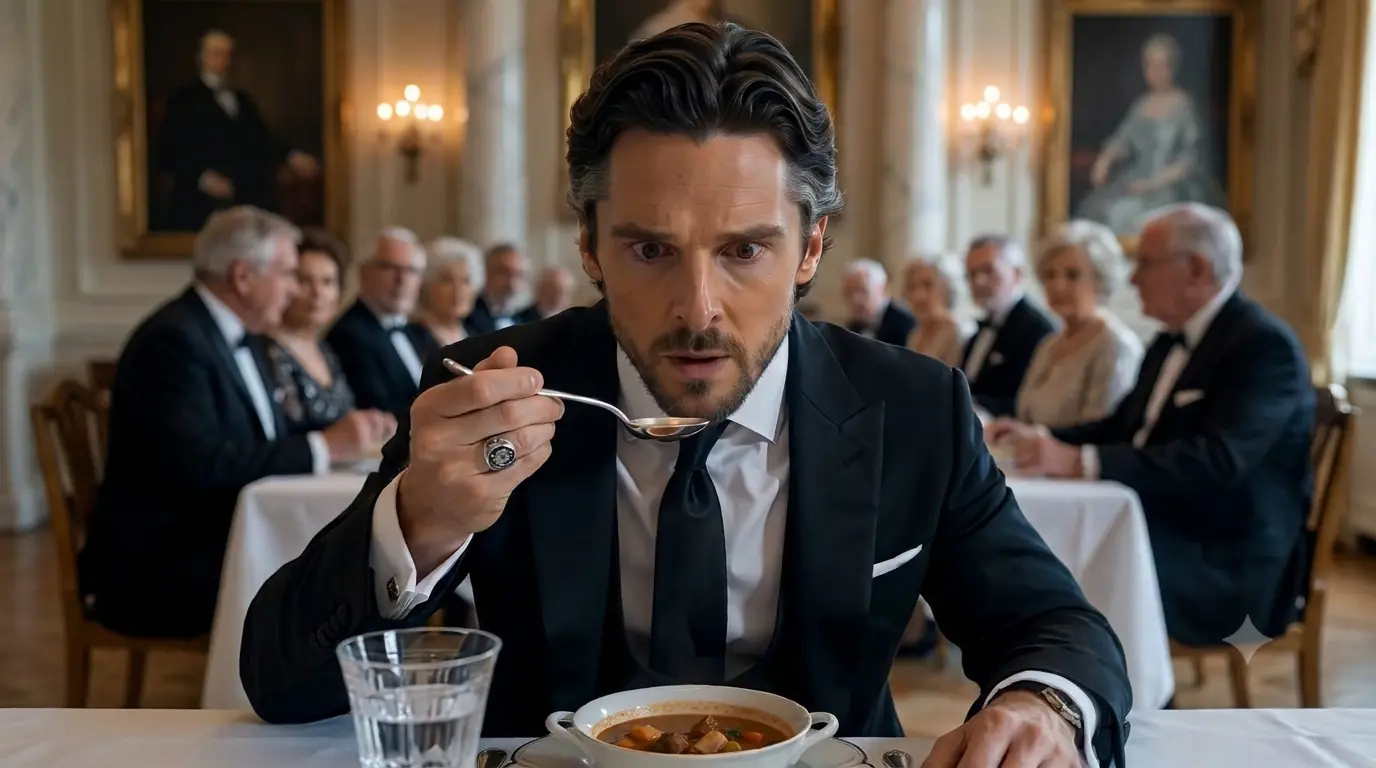
Steam curled off the surface of the mahogany-colored broth, carrying an aroma that had no business existing inside a living room.
Dante Marchetti paused with the heavy silver spoon an inch from his lips. Around him, the grand dining hall of Villa Marchetti hummed with the polite, restrained murmur of forty dangerous men and their wives. Three crystal chandeliers hung like frozen waterfalls from the coffered ceiling, casting crisp light across fluted marble pillars and long white tablecloths lined with tight clusters of white roses. Tall arched windows framed the fading slate-gray light of late October over the Hudson River. At the far end of the hall, towering above a carved limestone hearth, hung the gilded oil portrait of a silver-haired woman in a black silk dress, a single strand of pearls resting against her collarbone. Her painted dark eyes seemed to look straight down the length of the table at the man sitting in the seat of honor.
Dante wore his black tuxedo with the quiet stiffness of armor. The heavy silver signet ring on his left hand caught the gleam of a candle as he dipped the tip of the spoon back into the porcelain bowl, parted the tender chunks of beef and carrot, and tasted the broth.
First came the deep, slow warmth of roasted marrow. Beneath it sat the sharp resinous bite of charred rosemary, followed half a second later by something almost imperceptible—sun-dried Seville orange peel steeped with crushed juniper berries and a whisper of black vinegar to cut the fat.
Dante did not swallow right away. His jaw locked. The polite conversation around him—the clink of crystal water glasses, the dry laugh of Don Aurelio Valli two seats away, the murmur of his uncle Silvio praising the vintage Barolo—receded into a flat, distant hum.
He lifted the spoon again, staring into the dark liquid quivering against the silver curve.
"That's impossible," he murmured, his voice dropping beneath the chatter at his elbow.
To his left, Elena Valli turned her sleek dark head, the diamonds at her throat catching the chandelier light. "Did you say something, Dante? Is the soup cold?"
He did not look at her. His eyes remained fixed on the bowl, his brow drawing together as if the broth might rearrange itself into an explanation. He raised his gaze down the long corridor of white linen toward the tall double doors of the butler's pantry.
"Marco," Dante said. He did not raise his voice. He never had to.
Marco Bellini, standing three paces behind Dante's chair in a charcoal suit that hid a shoulder holster without a single crease, stepped forward immediately. "Boss?"
"Bring the cook who finished this pot. Not Laurent. Whoever actually stood over the stove."
Silvio Marchetti leaned forward slightly from across the corner of the table, swirling crimson wine in his crystal stem. At sixty-four, Dante's uncle still possessed the manicured poise of a retired diplomat, though his knuckles were scarred from an older, rougher decade. "Dante, the Valli delegation has barely touched the first course. If Henri over-salted the reduction, we can handle the kitchen after dessert."
"I didn't say it was over-salted, Uncle." Dante's tone was level, polite, and entirely immovable. "Marco. Now."
Elena's manicured fingers tightened slightly around the stem of her wineglass, though her expression remained serene. Across the table, Don Aurelio Valli—thin, silver-haired, wearing spectacles that magnified his cold gray eyes—watched Dante with quiet calculation, leaving his own silver spoon untouched beside his napkin.
Two minutes passed in strained quiet along the upper end of the table. Guests down near the middle still talked softly about dock tariffs and city council races, unaware that the temperature at the head of the room had plummeted. Then the pantry doors swung inward.
Head Chef Henri Laurent emerged first, pale beneath his tall linen toque, gesturing furiously back toward the corridor before catching Dante's eye and freezing mid-step. Behind him walked a young woman who looked as though she had been pulled straight off the prep line without time to wipe her hands.
She couldn't have been more than twenty-four. Her bright copper-red hair was twisted into a loose, hurried knot at the crown of her head, stray wisps framing a narrow face dusted with faint freckles across the bridge of her nose. She wore a black double-breasted chef's jacket streaked across the shoulders and chest with smudges of white flour, beneath a cream canvas apron tied tight at her waist. At the open V of her collar rested a thin gold chain bearing a small four-petal filigree pendant.
She stopped five paces from the head of the table, her hands clasped tightly in front of her apron, her knuckles white. When she saw forty pairs of eyes turning toward her—men in tailored wool and women dripping in gold—her chin dipped slightly, though she forced herself to hold Dante's stare.
Dante slowly set his elbows beside his bowl, the silver spoon still balanced between his fingers. He looked her over from the flour on her sleeves to the honest terror barely held back behind her green eyes.
"You made this," Dante said quietly.
"Yes, sir," she answered. Her voice was clear, carrying the faint, clipped cadence of somewhere north of New York—coastal, plain-spoken, entirely out of place among the marble columns. "Chef Laurent's saucier went home sick before service. I stepped in to finish the braise."
"The recipe," Dante said, lifting the spoon an inch so a single amber drop slipped from its tip and splashed cleanly back into the bowl. "Who gave you the recipe?"
Laurent opened his mouth to defend his kitchen's classical French menu, saw Marco's hand shift an inch toward his jacket lapel, and snapped his teeth shut.