CHAPTER 1: THREE WORDS IN COURT
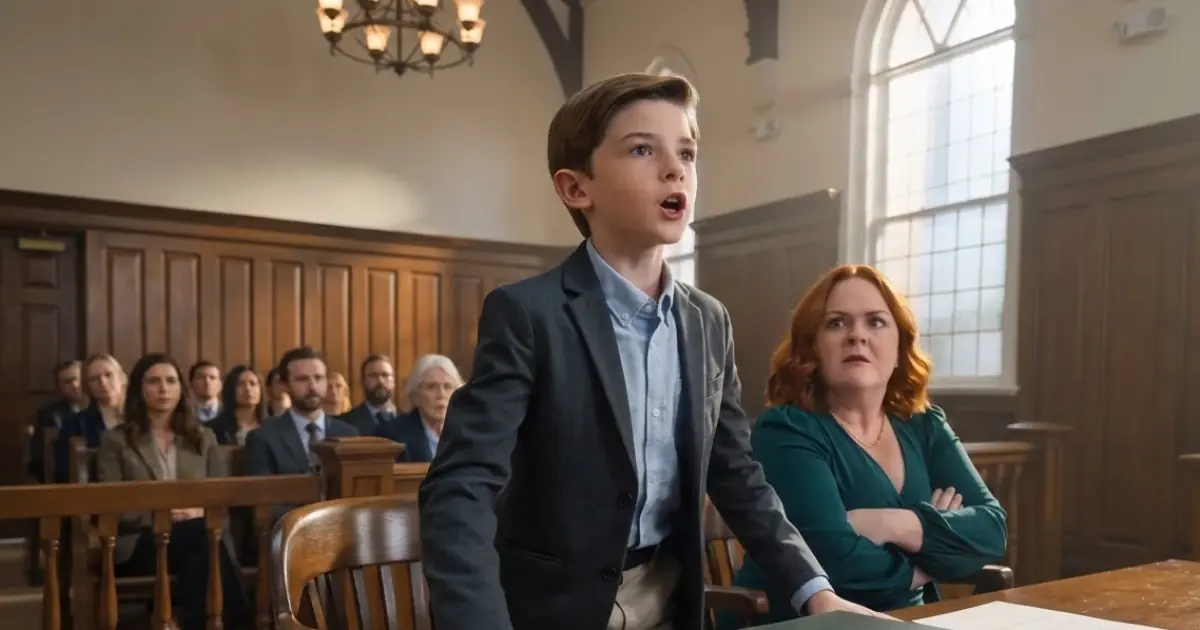
The first sound Noah Mercer remembered from the hearing was the crack of a folder striking polished wood. His mother had thrown it across the counsel table. White pages slid over the edge and fluttered onto the courtroom floor. For a moment even the court reporter stopped typing.
“I have already explained what I want,” Celeste Mercer declared. She was wearing an immaculate suit and a necklace that shone beneath the lamps. “I won't allow these people to turn my generosity into a scandal.”
Noah sat very still. At eleven, he was old enough to recognize the difference between a promise and a performance. He had watched his mother practice that same speech in the mirror, pausing after the word generosity as if applause might follow. He had not expected to hear it addressed to a judge.
At the far end of the front bench, his grandmother Ruth clasped her hands until the knuckles showed white. She wore the navy cardigan she saved for church, with one cuff darned in two places. Beside her sat her lawyer, Amara Price, whose yellow notebook held more facts than anyone in the room had yet heard.
Judge Miriam Bell waited for the pages to settle. “Mrs. Mercer, throwing documents is not helpful. We are here to decide what arrangements will protect Noah's welfare. This is not a negotiation over an asset.”
Celeste's lawyer, Stephen Voss, rose halfway from his chair. “Your Honor, my client is understandably upset. She has agreed to a substantial trust contribution in connection with the guardianship proposal.”
“And we will examine the proposal,” the judge said, “without attaching a price to this child.”
The words made Noah think of a winter afternoon when his mother brought home a small brass scale from an antique shop. She had set an apple on one side and coins on the other, explaining that everything had a value. Noah had wanted to ask what love weighed, but he knew she disliked questions that sounded childish.
A court attendant gathered the pages. One sheet stopped near Noah's shoe. Across its top he saw a phrase he had copied into a notebook two nights earlier: irrevocable release. He didn't understand every legal word. He understood the date and the number printed beneath it. The number had six zeroes.
Judge Bell leaned forward. “Noah, you were invited today because you asked through the guardian ad litem to speak. You do not have to. You may talk to me privately if that feels easier.”
Noah looked at Ruth. She nodded once, not urging him forward or telling him what to say. That was the difference between them, he thought. Grandmother left room for his answer.
He stood. The courtroom seemed impossibly large from where he was. The gallery was full of relatives, business acquaintances, and strangers who had come because Celeste's separation had become local news. A man at the back lifted his phone until an attendant told him to put it away.
“I want to say three things,” Noah said.
Judge Bell's expression softened. “Take your time.”
“First, Grandma didn't buy me.” He heard a sharp intake of breath from Celeste. “Second, my mom didn't tell the whole truth about why she wanted me to live somewhere else.”
Voss rose. “Your Honor—”
“I will determine how to receive his statement,” the judge interrupted. “Please sit.”
Noah unfolded the paper in his pocket. He had written it at Ruth's kitchen table while the kettle hummed behind him. The handwriting slanted sharply near the bottom because he had been shaking. He would have preferred to read every line, but the sight of his mother staring at him made the paper seem too heavy.
“Third,” he said, “there's another paper. It has my name on it, and Mom told somebody I didn't know about it. But I do.”
A low murmur rolled through the gallery. Ruth did not look triumphant. She looked afraid for him, and that made Noah brave enough to continue.
He remembered the night he found the paper, the blue light beneath his mother's study door, and a voice saying that the boy would eventually adjust. He remembered a business card with the name of a place he had never visited. He remembered his mother kneeling before him later and promising that nothing would change, although by then the boxes in his bedroom were already labeled.
Judge Bell asked the clerk to approach, then spoke to the lawyers. The hearing would pause while the court determined how the document should be handled and whether Noah should continue in a less public setting. Celeste's confident smile was gone. For the first time all morning she looked not at the judge but at her son.
Noah sat down beside Ruth. She offered him a handkerchief without asking whether he needed it. He took it. The room was silent enough that he could hear his own heartbeat.
He had not come to punish his mother. He had come because no one had asked him where he wanted to sleep when the lights went out, or whose voice he needed when he woke from a bad dream. Those questions were worth more than the number on the page.