A VIP Called Police on a Black Woman Carrying Three Dresses — Then the Regional President Ran Downstairs and Said, “She Owns the Company”
November 3, 2026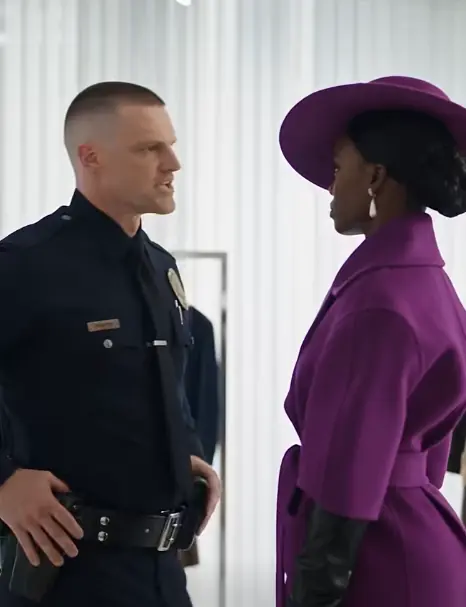
THE FOURTH PHONE
At 4:17 on a Thursday afternoon, Officer Paul Brennan made a decision that would follow him for the rest of his career.
He looked at Camille Porter, standing beneath the enormous crystal chandelier in the Madison Avenue flagship of Vale Rowe, and said something he believed would bring the situation under control.
“Ma’am, if you continue refusing to cooperate, I may have to detain you.”
The words traveled farther than he intended.
A woman near the handbag display stopped examining a burgundy leather tote. Two customers standing beside the fragrance counter turned toward the center of the sales floor. An older gentleman lowered the reading glasses he had been using to examine a price tag.
And somewhere behind a marble column, a young employee quietly raised her phone.
It was the fourth phone recording the confrontation.
Camille Porter did not look frightened.
She did not raise her voice.
She did not throw the three dresses onto the nearest table or demand that somebody call the store’s corporate headquarters.
Instead, she shifted the dresses slightly against her left arm, looked directly at the officer, and asked a question.
“What exactly do you believe I stole?”
Brennan blinked.
For several seconds, he appeared unable to decide whether she had genuinely misunderstood him or was deliberately making his job difficult.
“Ma’am, we’re trying to establish what happened here.”
“Then let’s establish it.”
“Put the merchandise down.”
“Why?”
“Because I asked you to.”
“Is that because you believe the merchandise is stolen?”
The officer’s jaw tightened.
Behind him, Martin Keene, the boutique manager, looked as though he wished the polished marble floor would open beneath his shoes.
And several feet away, Evelyn Carrington watched everything with a small, satisfied smile.
She believed the difficult part was over.
She believed the police had finally arrived to deal with the woman she had decided did not belong in the store.
She had no idea that the person standing in front of Officer Brennan owned the building, the merchandise, the company, and every department responsible for the decisions that had brought them all into that room.
More importantly, she had no idea that Camille had spent the previous six months investigating precisely this kind of behavior.
And this afternoon, without intending to, Evelyn Carrington had provided the clearest evidence Camille had ever received.
Forty minutes earlier, Camille had entered Vale Rowe through the revolving doors on Madison Avenue.
The afternoon was cold, but not yet bitter. Manhattan was preparing for the holiday season, and the sidewalks were crowded with shoppers carrying glossy department-store bags, office workers hurrying toward appointments, and tourists stopping beneath the elaborate window displays.
Vale Rowe’s flagship stood between two historic commercial buildings, its limestone exterior carefully restored during the previous summer’s renovation.
The entrance was framed by tall glass panels and brushed-brass lettering.
VALE ROWE.
Below the name, smaller letters announced the company’s familiar slogan.
Elegance Without Compromise.
Inside, the store looked almost theatrical.
Cream-colored marble stretched across the sales floor. Warm lighting illuminated rows of handbags, shoes, tailored coats, and evening dresses. The walls were covered in pale limestone, while dark walnut display cabinets provided contrast.
At the center of the ground floor stood a circular staircase leading to the private shopping salons and executive offices.
The renovation had cost $6.2 million.
Camille had approved every major element.
She had personally reviewed the architectural plans, selected the materials for the redesigned fitting rooms, and rejected three different proposals for the new security system.
The store had been open under its renovated design for eleven weeks.
And Camille had deliberately waited until the holiday season approached before conducting an unannounced inspection.
She wanted to know what the store looked like when nobody was expecting her.
That distinction mattered.
Executives who announced their visits received rehearsed hospitality.
Employees smiled more often. Managers arrived early. Security guards checked their uniforms. Supervisors reminded everyone to use proper greetings and maintain the presentation standards.
The entire building became a performance.
Camille had learned that the best way to understand a company was to observe what happened when nobody believed the owner was watching.